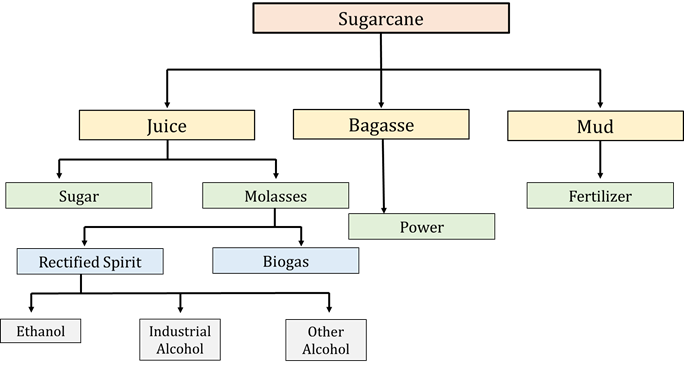
Roadmap for Ethanol blending In India 2020-25:
Decoding the opportunities in Ethanol Blending in India and how certain sector can benefit out of it.
Retweet for maximum reach to spread knowledge. 🙏🙏
🧵👇
Decoding the opportunities in Ethanol Blending in India and how certain sector can benefit out of it.
Retweet for maximum reach to spread knowledge. 🙏🙏
🧵👇
Data-facts:
• 98% of India fuel requirement in road transportation is met through fossil fuel.
• Bio fuels only consist about 2% of use for road transportation.
• 98% of India fuel requirement in road transportation is met through fossil fuel.
• Bio fuels only consist about 2% of use for road transportation.
• Ethanol is the important part of biofuel. It is naturally produced from fermentation of sugar by years or via petrochemical process such as ethylene hydration.
• Combined ethanol distillation capacity of India is 684 crore litres
• Combined ethanol distillation capacity of India is 684 crore litres
There are different types of Ethanol variants:
1. E-10: In this, 90% of usage is gasoline & 10% Ethanol.
2. E-10 is maximum used in India.
E-20:
3. In this, 80% of usage is gasoline & 20% Ethanol.
The calorific value of ethanol is around 2/3rd of gasoline
1. E-10: In this, 90% of usage is gasoline & 10% Ethanol.
2. E-10 is maximum used in India.
E-20:
3. In this, 80% of usage is gasoline & 20% Ethanol.
The calorific value of ethanol is around 2/3rd of gasoline
Recent Target Improvements:
• National Policy for Biofuel has increased the target of Ethanol Blending to 20% from 10%
• With low quantity around 50% of petrol sold is E10 blended & rest is unblended(E0).
• Current level of Ethanol blending is ~7-8%, & 10% is expected by 2022
• National Policy for Biofuel has increased the target of Ethanol Blending to 20% from 10%
• With low quantity around 50% of petrol sold is E10 blended & rest is unblended(E0).
• Current level of Ethanol blending is ~7-8%, & 10% is expected by 2022
Ethanol Industry Size:
• Global production of fuel ethanol touched 110 Bil. Ltrs in 2019, growing at CAGR 4% from last decade.
• USA & Brazil contributes 92 Billion Ltrs (~84% share). Rest is contributed by Europe, China, India, Canada & Thailand.
• Global production of fuel ethanol touched 110 Bil. Ltrs in 2019, growing at CAGR 4% from last decade.
• USA & Brazil contributes 92 Billion Ltrs (~84% share). Rest is contributed by Europe, China, India, Canada & Thailand.

There has been constant increase in Ethanol Supply and Blending Trends. In past 2 year we have seen massive shift in C-Heavy Molasses to B-Heavy Molasses.
Read about B-Heavy & C-Heavy Molasses here.
Read about B-Heavy & C-Heavy Molasses here.
https://twitter.com/tycoonmindset05/status/1409498967004508163
Reason behind increase in B Molasses:
Sugarcane price is the highest for ethanol(Rs 62.3). Sugar companies priority is to manufacture sugar. Hence there won’t be much traction here (entire shift to ethanol), while the price difference between B-Molasses and Sugarcane is only Rs5
Sugarcane price is the highest for ethanol(Rs 62.3). Sugar companies priority is to manufacture sugar. Hence there won’t be much traction here (entire shift to ethanol), while the price difference between B-Molasses and Sugarcane is only Rs5

‘B’ and ‘C’ molasses has price difference of Rs 12. The production cost from ‘B’ to ‘C’ molasses is not that significant, with respect to price gain of Rs12. Hence the production of ethanol has been shifted from C-Molasses to B-Molasses
GST on Ethanol:
• GST on C Molasses- Rs 3.13
• GST on B Molasses- Rs 2.28
• GST on Petrol- Rs 33
• GST on C Molasses- Rs 3.13
• GST on B Molasses- Rs 2.28
• GST on Petrol- Rs 33
Vehicles Trend in India
The gasoline vehicles (2 wheelers & 4 wheelers) in the country can be tuned to suit ethanol blended fuels ranging from E0 to E5 depending on the vehicle type. On material front the rubber and plastic components are compatible with E10.
The gasoline vehicles (2 wheelers & 4 wheelers) in the country can be tuned to suit ethanol blended fuels ranging from E0 to E5 depending on the vehicle type. On material front the rubber and plastic components are compatible with E10.
However government has targeted E20 (80% gasoline and 20% Ethanol) for which there would be need of both vehicles and material advancement. Government expect gasoline vehicles to increase by 6% every year till 2030
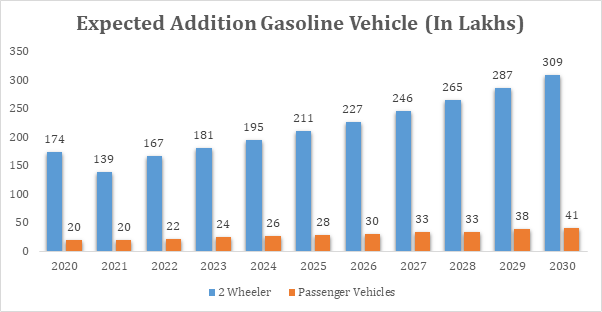
Society of Indian Automobile Manufacturers have assured government with the availability of making of E10 & E20 base vehicle, with increase in Ethanol blending.

Pricing of E20 Vehicle:
The cost of E20 compatible vehicles is expected to be higher in the range of Rs 3,000 to Rs 5,000 for four-wheeler and Rs 1,000 to Rs 2,000 for two-wheeler, over and above the cost of ordinary vehicles tailored to run on 100% gasoline.
The cost of E20 compatible vehicles is expected to be higher in the range of Rs 3,000 to Rs 5,000 for four-wheeler and Rs 1,000 to Rs 2,000 for two-wheeler, over and above the cost of ordinary vehicles tailored to run on 100% gasoline.
Government Ambition towards Pollution control:
With usage of Ethanol based petroleum, there is expectation of decline in Carbon Monoxide and Hydrocarbons.
With usage of Ethanol based petroleum, there is expectation of decline in Carbon Monoxide and Hydrocarbons.

However it has certain impact on fuel efficiency as well:
A. 6-7% for 4 wheeler designed for E0 and calibrated for E10
B. 6-7% for 4 wheeler designed for E0 and calibrated for E10
C. 1-2% for 4 wheeler designed for E10 and calibrated for E20
A. 6-7% for 4 wheeler designed for E0 and calibrated for E10
B. 6-7% for 4 wheeler designed for E0 and calibrated for E10
C. 1-2% for 4 wheeler designed for E10 and calibrated for E20
Global Companies for Ethanol Blending:
Brazil continuous the mandate for blending of 18-27.5% of ethanol in Gasoline, which was started in 2015. US and EU in their Renewable Fuel policy also started with the ethanol blending.
Brazil continuous the mandate for blending of 18-27.5% of ethanol in Gasoline, which was started in 2015. US and EU in their Renewable Fuel policy also started with the ethanol blending.
In India Ethanol blending policy has been brought up a decade ago, but with no implementation on ground level. Now that government is serious on increase national bio fuel, the policy can be favourable for short period.

Flex Fuel:
Brazil has continuously adopted flex fuel which run on more than 1 fuel blended with ethanol or methanol, stored in common tank.
Brazil represents over 80% of total number of new vehicles sold in country. Flex fuel vehicles used in Brazil operate with E27 to E100.
Brazil has continuously adopted flex fuel which run on more than 1 fuel blended with ethanol or methanol, stored in common tank.
Brazil represents over 80% of total number of new vehicles sold in country. Flex fuel vehicles used in Brazil operate with E27 to E100.
Government target for Ethanol Blending:
Govt. has targeted to generate ethanol blending of 550cr ltr from sugar & 466cr ltr from Grain.
Govt. is also targeting for other crops than sugar, as it is environmental costly crop, because it requires much higher amount of water.
Govt. has targeted to generate ethanol blending of 550cr ltr from sugar & 466cr ltr from Grain.
Govt. is also targeting for other crops than sugar, as it is environmental costly crop, because it requires much higher amount of water.

Water Cost in Sugar:
1 tonne of sugarcane produce 100kg of sugar, & 70 ltr of ethanol.
Cultivation of 1kg of sugar requires 1600 to 2000 ltr of water. Hence, 1ltr of ethanol from sugar requires about 2860ltr of water. Sugarcane & paddy use around 70% of irrigation water of India
1 tonne of sugarcane produce 100kg of sugar, & 70 ltr of ethanol.
Cultivation of 1kg of sugar requires 1600 to 2000 ltr of water. Hence, 1ltr of ethanol from sugar requires about 2860ltr of water. Sugarcane & paddy use around 70% of irrigation water of India
Sugar blending target is expected to increase 2.5x in next 5yr, while grain target is expected to increase 30x in next 5 year.
Government target is to generate 1,016 cr litre ethanol blending till 2026. While rice is also expected to be next priority crop for ethanol blending.
Government target is to generate 1,016 cr litre ethanol blending till 2026. While rice is also expected to be next priority crop for ethanol blending.
Additional Capacity Required for Blending Target:
As per government report, India will be required additional capital of 1,500 cr ltr till the next 5 year for coming to this Ethanol Blending Target.
As per government report, India will be required additional capital of 1,500 cr ltr till the next 5 year for coming to this Ethanol Blending Target.

For the estimated ethanol supply of 1350cr ltr, there would additional capacity of 723 cr ltr required to meet the target.
Government is targeting to add 241 molasses based and 482 grain based capacity for ethanol blending for this capacity augmentation.
Government is targeting to add 241 molasses based and 482 grain based capacity for ethanol blending for this capacity augmentation.

Ethanol Blending Policy:
For this project, government has eased the norms of Environmental Clearance. After preparation of EIA report based on ToR, it is submitted to SPCB. SPCB further writes this to District Collector with takes 2-4 months.
For this project, government has eased the norms of Environmental Clearance. After preparation of EIA report based on ToR, it is submitted to SPCB. SPCB further writes this to District Collector with takes 2-4 months.
Further application of EC approval is submitted to MoEF & CC/SEIAA and the permission is granted by them.
These whole activity take now atleast 10 months which previously used to take around 1.5-2 year.
These whole activity take now atleast 10 months which previously used to take around 1.5-2 year.
Driving Factors for Ethanol:
A. Demand Enrichment: Increasing minimum blending percentage, & adopting E20 blending
B. Supply Enrichment: Schemes for ethanol production, thereby fulfilling gap of demand & supply.
C. Incentives to manufacturer Ethanol Blending to the sugar mills
A. Demand Enrichment: Increasing minimum blending percentage, & adopting E20 blending
B. Supply Enrichment: Schemes for ethanol production, thereby fulfilling gap of demand & supply.
C. Incentives to manufacturer Ethanol Blending to the sugar mills
Outlook:
Ethanol Policy drive benefit to sugar companies as government are incentivizing sugar mills to produce ethanol.
This will stabilize the demand – supply gap in sugar industry, and government expenditure to protect sugar mills and farmer’s income will be reduced.
Ethanol Policy drive benefit to sugar companies as government are incentivizing sugar mills to produce ethanol.
This will stabilize the demand – supply gap in sugar industry, and government expenditure to protect sugar mills and farmer’s income will be reduced.
Other focus area to look at is the rice and grains manufacturers, as the ethanol blending base is very low. Hence ethanol blending target for rice manufacturers is targeted to be 36x in next 5 year.
However not all the rice manufacturers will get benefit as the cost of ethanol from rice doesn’t yield higher margins. While currently the MSP in rice has been increased. Certain rice manufacturers has ethanol blending cost higher than ethanol price announced by government.
As mentioned by government, the blending target from crops can be change. Hence there is even possibility of shifting the grain based ethanol to sugar based ethanol.
How long will this theme survive?
1. Until the price of ethanol are sustainable:
GST in Petrol from ethanol is only 2-3 ltr. Hence govt. source of revenue will be decreased.
With ethanol blending of 332cr ltr, revenue loss to the government amounts to Rs. 10,950 crore per annum
1. Until the price of ethanol are sustainable:
GST in Petrol from ethanol is only 2-3 ltr. Hence govt. source of revenue will be decreased.
With ethanol blending of 332cr ltr, revenue loss to the government amounts to Rs. 10,950 crore per annum
2. Every sugar players are increasing the capacity. Over years, as the capacity increases, supply will increase. This will eventually again exceed the demand.
3. If government increase the ethanol blending target post 2025 these theme may again work, which even has higher possibility.
As an investor one has to enter companies which has sustainable BS, good Corporate Governance, and to stay in the ride of industry tailwind, until the theme is sustainable. Upcoming supply is expected to take atleast 1-2 year, until when there can be few sustainable years.
Industry figures (on production and supply of sugar) should be in consistent watchlist. Government measures should be tracked properly.
While for filtering companies in sugar sector, you can refer to our previous thread.
While for filtering companies in sugar sector, you can refer to our previous thread.
https://twitter.com/tycoonmindset05/status/1409499576264904717
• • •
Missing some Tweet in this thread? You can try to
force a refresh