Most of us know that Logistic Regression is a Classification Algorithm! But why does it have the word 'regression' in it?
Let me explain 👇👇
Let me explain 👇👇
🌟 Let's start by basics:-
Classification: It is a process of putting things/items into a category.
When you a fruit bowl. You can separate all the fruits by categorising them by name, type, or size.
Classification: It is a process of putting things/items into a category.
When you a fruit bowl. You can separate all the fruits by categorising them by name, type, or size.
Classification can be binary or multi-class.
Binary Classification is where there exist only two categories.
Multi-Class is where there exist more than two categories.
(See the image below)
Binary Classification is where there exist only two categories.
Multi-Class is where there exist more than two categories.
(See the image below)

Regression helps to find a relationship between one dependent and one or more than one independent variable.
In regression, the values are continuous in nature. Examples of continuous values are height, temperature, weight, etc.
In regression, the values are continuous in nature. Examples of continuous values are height, temperature, weight, etc.
The dependent variable is the one that we try to predict through regression. The independent variable(s) are the ones that we use to predict the dependent variable.
See the equation given below:-
See the equation given below:-
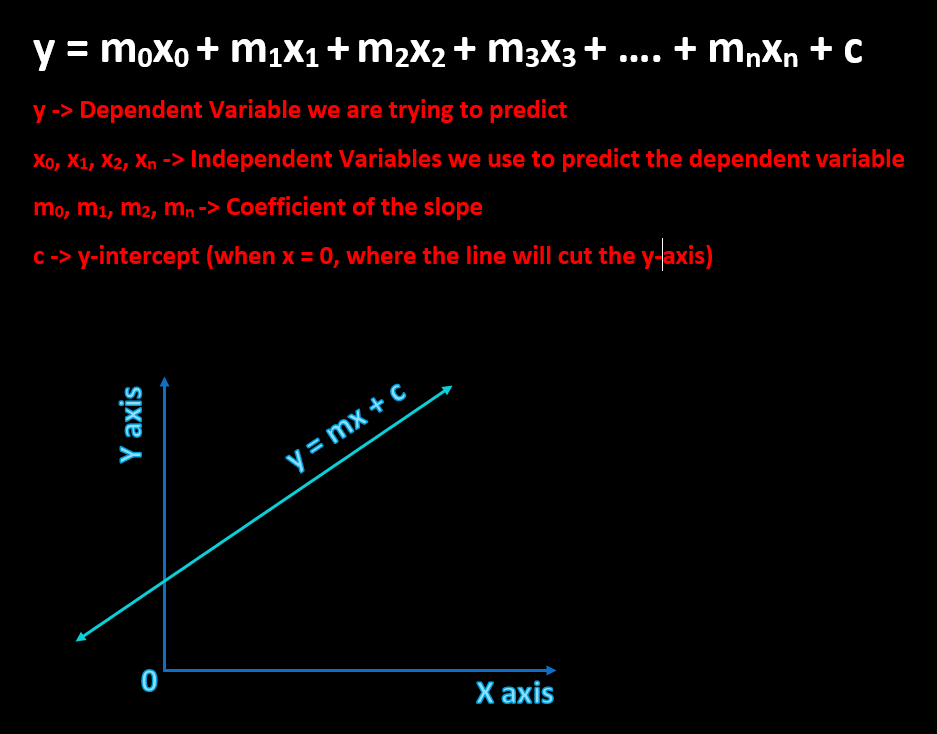
Logistic Regression uses the formula that is used in Linear Regression.
The formula => y = m0x0 + m1x1 + .. + c
The difference is when this same formula is passed through the SIGMOID FUNCTION.
The formula => y = m0x0 + m1x1 + .. + c
The difference is when this same formula is passed through the SIGMOID FUNCTION.
In logistic regression, the sigmoid function provides probabilities [0, 1]. Now, the output (y) is such that,
if y >= 0.5, then y = 1
if y <= 0.5, then y = 0
if y >= 0.5, then y = 1
if y <= 0.5, then y = 0
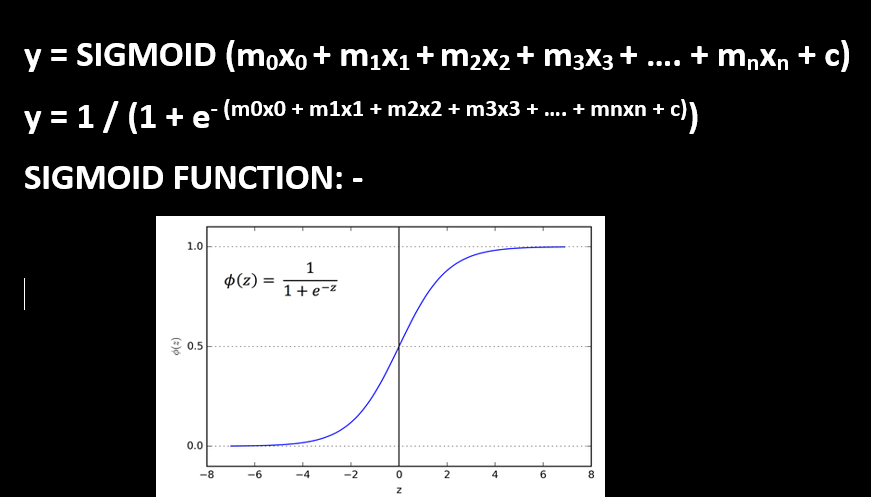
Therefore, logistic regression uses the same formula as linear regression, but it is for the probability of a definite outcome.
In other words, Linear Regression gives continuous values, whereas Logistic Regression gives continuous values that are converted into 0 or 1.
In other words, Linear Regression gives continuous values, whereas Logistic Regression gives continuous values that are converted into 0 or 1.
• • •
Missing some Tweet in this thread? You can try to
force a refresh