
This is a valuable article about autistic strengths that I think everyone should read.

Autistic strengths aren’t limited to those of us who can speak, and some may be stronger in people who can’t.

Regardless of support needs, we all have strong suits.

spectrumnews.org/features/deep-…
Here are a few of those potential strengths, which are named in the article:

- Up to 11% of autistic people have perfect pitch, compared to 0.0001% of non-autistic people

- Autistic people are more likely to reject money that was obtained through immoral means
- Sighted autistic people are better than non-autistic people at quickly spotting and identifying details in the environment

Ex. “42 autistic people were significantly faster than 30 controls at recognizing which of two vertical lines, flashed briefly on a screen, was longer.”
Ex. “24 autistic children were better than 30 non-autistic children at identifying purple letters among black ones, presented sequentially at different speeds.”

The advantage increases with speed, and:

“This strength is also seen in minimally verbal autistic children.”
- Hearing autistic people are more likely to have enhanced auditory perceptual abilities

Ex. “15 autistic children were significantly more accurate than a group of non-autistic children at telling whether a series of notes played on a keyboard were going up or down in pitch.”
- We are better at noticing background information & details, regardless of the amount of information presented

Ex. “increasing the amount of material in a visual display makes finding a specific detail in that scene harder for non-autistic adults but not for autistic ones.”
Ex. of enhanced ability to perceive background information: In a 2019 study, 23 autistic and 50 non-autistic children wa
Autistic traits can often be strengths or weaknesses depending on the environment.

On a chaotic city street, attention to detail and enhanced perceptual abilities can become debilitating and lead to sensory overload.

But in a forest, those traits can help identify plants.
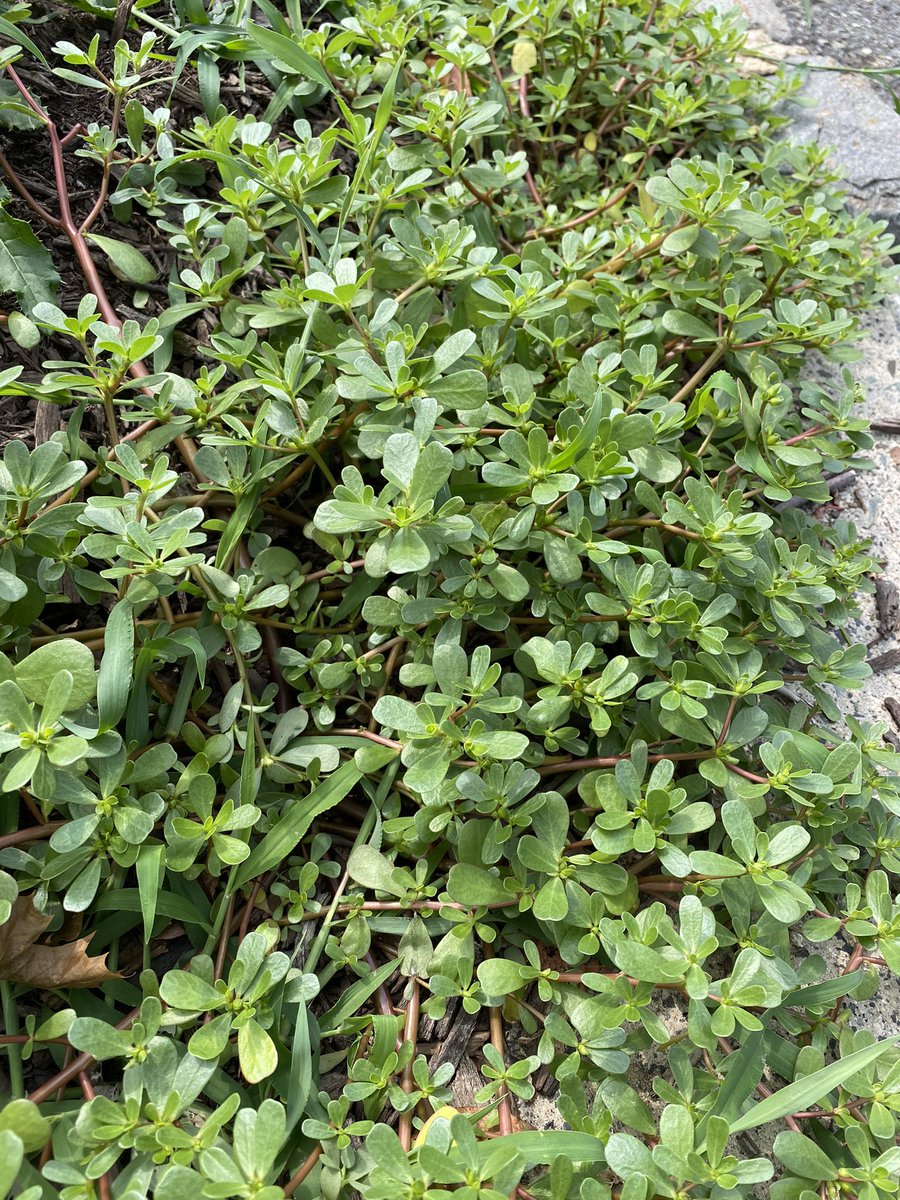
One of my favorite things to do when I’m outside is find purslane (a wild edible plant).

I can spot it easily, even when the plant is very tiny. People who are with me often say “How did you see that?”

Here’s a photo of a gigantic patch I found yesterday (not hard to spot): Photo of a huge patch of purslane
Studies on autistic people routinely overlook these positive traits, or instead frame them as negative.

That refusal to acknowledge strengths contributes to stigma and creates an inaccurate picture.

“Preventing” autism would prevent people with these qualities from existing.

• • •

Missing some Tweet in this thread? You can try to force a refresh

 

Keep Current with The Autisticats - #StopTheShock

The Autisticats - #StopTheShock Profile picture

Stay in touch and get notified when new unrolls are available from this author!

Read all threads

This Thread may be Removed Anytime!

PDF

Twitter may remove this content at anytime! Save it as PDF for later use!

Try unrolling a thread yourself!

how to unroll video
  1. Follow @ThreadReaderApp to mention us!

  2. From a Twitter thread mention us with a keyword "unroll"
@threadreaderapp unroll

Practice here first or read more on our help page!

More from @autisticats

21 Jul
This is a great example of what autistic & disabled people are talking about when we say eugenics is alive and well.

This paper, published in the Journal of Autism and Developmental Disorders in 2021, calls for the “prevention of autism” in order to… save the U.S. economy. 🤦🏼
The article uses fearmongering language, framing autistic people as “burdens” to our families and society.

Even the title alone is extremely negative:

“Autism Tsunami: the Impact of Rising Prevalence on the Societal Cost of Autism in the United States.”

Tsunami? Really?
And here’s the thing.

Within a capitalist framework, in an economic system where extraction and accumulation of wealth are the goal, what the authors wrote is semi-logical.

But it doesn’t fit the logic of morality and human rights.

So there’s an inherent contradiction.
Read 10 tweets
19 Jul
One of my lifelong special interests is language learning.

That might seem strange because autistic people are seen as uninterested in communication, and the whole purpose of language is communication.

But I actually think being autistic helps me learn new languages.
I am a native English speaker who had some degree of fluency in Spanish as a child (I lived in Texas and was in bilingual classrooms in elementary school).

For seven years, starting in middle school, I learned Mandarin Chinese.

Now, I’m learning Scottish Gaelic.
I’ve always loved language.

When I was in first and second grade, I voluntarily took Spanish spelling tests in addition to the English ones.

In middle and high school, my Mandarin teachers told me that I have a natural ear for language and a gift for language learning.
Read 9 tweets
12 Jul
What’s happening at the Judge Rotenberg Center is actually much worse than I knew.

The JRC is a facility in Massachusetts where autistic & disabled people are being given powerful electric shocks as punishment.

Those shocks are incredibly dangerous. More than you might think.
First, some background:

Milliamperes (or milliamps, abbreviated as mA) are a unit of measurement for electricity, which refers to the amount of electrical current passing through an object.

In this case, the amount of electrical current passing through a person’s body.
People can survive shocks at very high voltages as long as the milliamps and exposure time are low.

But the higher the milliamps and longer the time, the more dangerous a shock.

100 mA passing through the body for 2 seconds can be fatal, even at low voltages.
Read 9 tweets
5 Jul
If you’re averse to candid discussions about bathroom topics, this thread is not for you.

For everyone else, welcome to this thread about autism and using the bathroom.

This is an important topic that is often seen as too taboo to discuss openly, but it’s vital to talk about.
What are the reasons an autistic person might eliminate waste in places other than the toilet, even if they’re “potty trained”?

I won’t be going into details about my life and the lives of other autistic people I know, but I have a lot of personal experience in this area.
Let’s look at some reasons an autistic person might be eliminating waste in inappropriate places:

1. They have an underlying medical condition that is causing them to need to use the bathroom more frequently and/or urgently

(This reason should be investigated first)
Read 10 tweets
24 Jun
After an autistic person is officially diagnosed, their family members and friends may start noticing their autistic traits more.

This can lead to accusations that the autistic person is exaggerating for attention, being inauthentic, etc.

But that’s rarely (if ever) true.
The reason why others may notice the person “acting more autistic” is twofold:

1. Now that there’s a word to describe the person’s traits, they are ascribed to autism instead of just being seen as “weird,” and

2. The autistic person feels less pressure to mask who they are.
This dynamic is often especially present in people who were diagnosed later in life, or who have the ability to mask their traits.

I was diagnosed pretty early (between 8 and 9 years old), but I can mask my traits when I’m feeling pressured (though not always convincingly).
Read 10 tweets
22 Jun
Ableism and anti-autistic attitudes within families can have a significant negative impact on autistic people’s self esteem and mental health.

When the outside world is not accepting or safe, and home isn’t either, we have nowhere to turn.

Many autistic people are trapped.
My family has come a long way over the years, mostly due to my own stubbornness and self-advocacy.

In 2017 my dad said this to me (I wrote it down directly afterwards, so this is verbatim) when he heard me vocal stimming: “You need to stop making no...
I brought it up the next day and he denied that he said any of it, but when I pushed he admitted to some of it (then defended it).

Later that year, I ordered the book “Loud Hands” (an anthology by autistic authors) and forced him to read it.

Suddenly, his behavior changed.
Read 9 tweets

Did Thread Reader help you today?

Support us! We are indie developers!


This site is made by just two indie developers on a laptop doing marketing, support and development! Read more about the story.

Become a Premium Member ($3/month or $30/year) and get exclusive features!

Become Premium

Too expensive? Make a small donation by buying us coffee ($5) or help with server cost ($10)

Donate via Paypal Become our Patreon

Thank you for your support!

Follow Us on Twitter!

:(


