Uniswap Labs just removed a number of DeFi assets from their interface (the one most of us use on a regular basis).

Let's dive into this decision and bit and understand a bit more about the numbers of the assets delisted.

A thread 🧵
First off, let's be clear:

Uniswap *did not* delist these assets from trading.

Users can still trade the assets affected via contracts, decentralized interfaces, or aggregators. The liquidity still exists.

Uniswap as a protocol to list and swap assets remains decentralized.
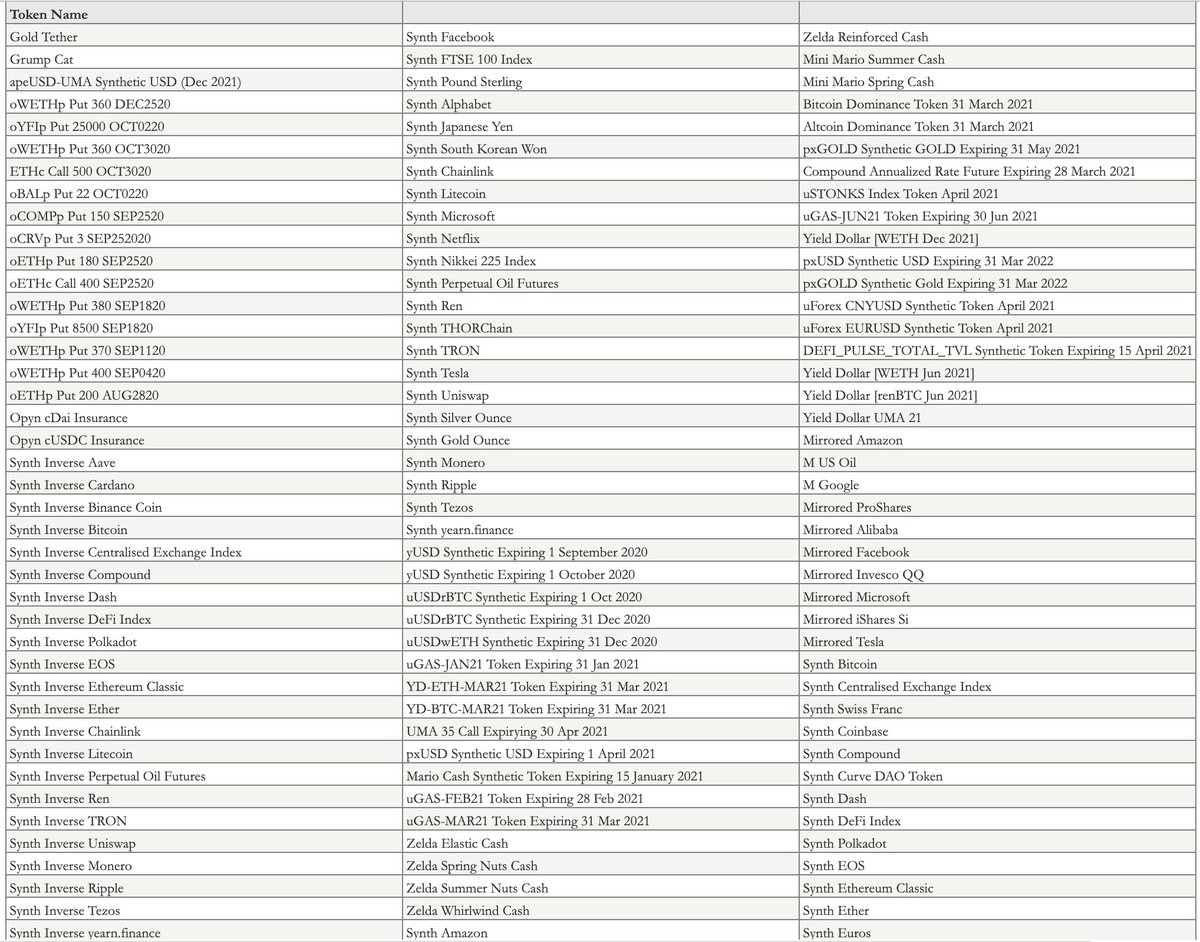
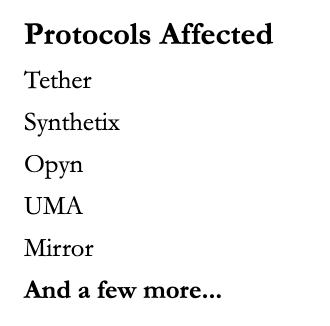
Below is a full list of assets affected.

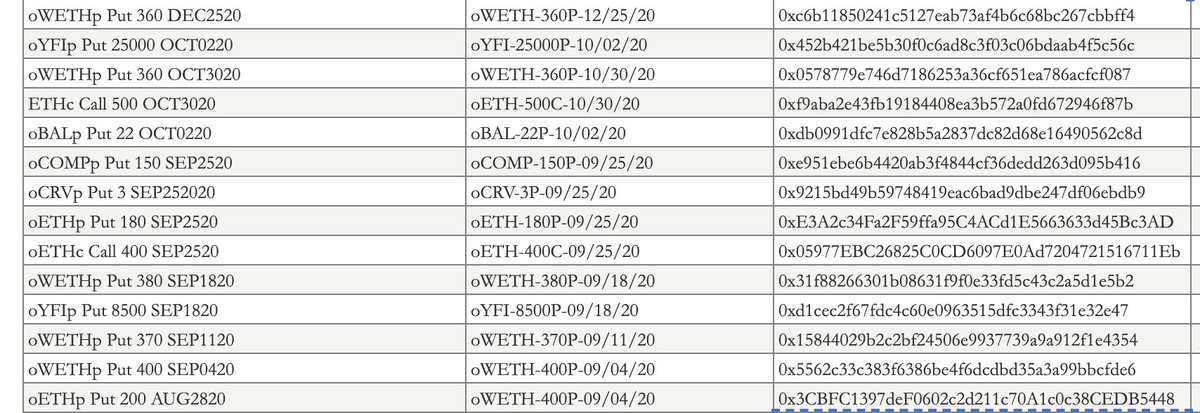
Some, I've never heard of. Others are community and yield farmer favorites :). To name a notable few: sBTC, sDEFI, Opyn's option tokens, and Mirror Assets.

Check them out 👇
As I was writing this thread, the community already went to work deploying ways to get around this issue.

Here's a token list (h/t @bantg) with the restricted assets.

There's a ton of alternative interfaces!

Now, on to some numbers. Volume for the restricted assets is unlikely to drop to zero, though let's gauge the potential impacts on Uniswap if these assets were entirely untradable.

👇
Uniswap (across v2 and v3) did $7.75b volume in the past seven days.

So how much of those billions in volume was for trades in the assets removed from the Uniswap frontend?
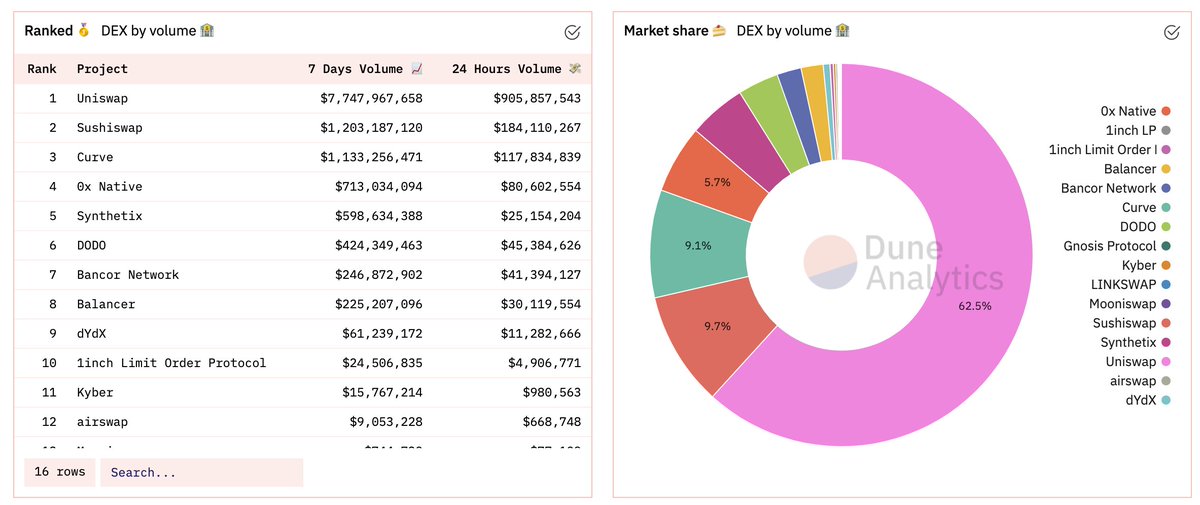
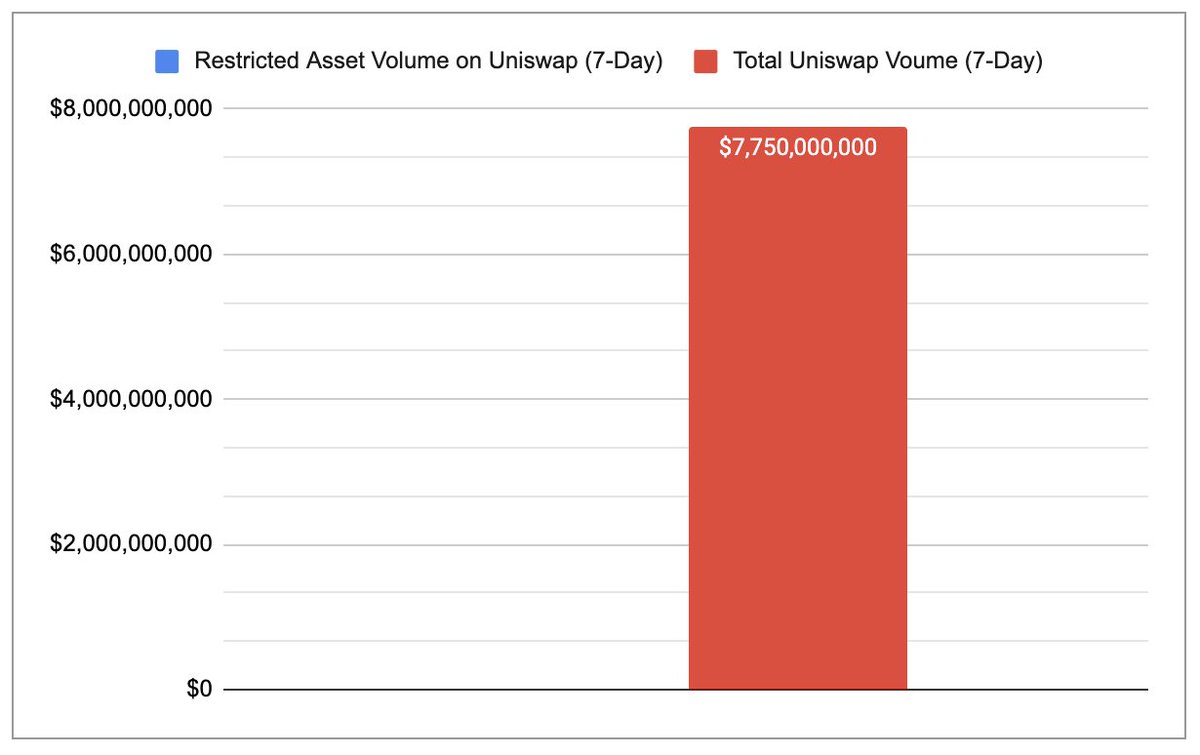
Per my quick analysis on Uniswap info data, the assets delisted accounted for a GRAND total of $5.9 million worth of volume over the past seven days.

Literally 0.076% of Uniswap's 7-day volume.

It's a rounding error.
Interesting how a number of the assets delisted are long expired or trade on Balancer, etc.

Seems like they were trying to send a v strong message about not directly supped restricted assets.

~40 out of the 129 assets are currently nonfunctional. A supermajority don't trade.
Increasingly, I think you're going to see AMMs increasingly used as a base.

Perpetual Protocol, for instance, is using v3's AMM design for their perpetual futures. Future options protocols could have derivs settle physically on-chain via v3 ranges.

lambert-guillaume.medium.com/uniswap-v3-lp-…
The world needs decentralized interfaces.

Wouldn't it have been bad if all non-power user DeFi traders woke up one day and the Uniswap Labs interface was gone w/ no alternatives?

This is a wake-up call! Bookmark the decentralized interfaces. Make them lindy. (h/t @anjan_vinod)

• • •

Missing some Tweet in this thread? You can try to force a refresh

 

Keep Current with Nick Chong

Nick Chong Profile picture

Stay in touch and get notified when new unrolls are available from this author!

Read all threads

This Thread may be Removed Anytime!

PDF

Twitter may remove this content at anytime! Save it as PDF for later use!

Try unrolling a thread yourself!

how to unroll video
  1. Follow @ThreadReaderApp to mention us!

  2. From a Twitter thread mention us with a keyword "unroll"
@threadreaderapp unroll

Practice here first or read more on our help page!

More from @n2ckchong

14 Jun
The last time Ethereum gas was this low—as far as I remember—was the start of 2020, around the time of the initial launch of Aave.

A lot has changed in that time for Ethereum and DeFi. Let's recap.

A 🧵 Image
Ethereum now settles over $45 billion in transaction volume each day, between ETH and stablecoins alone.

At the start of 2020, this value was closer to $900 million, lower than Bitcoin's $ throughput at the time as per CoinMetrics data. Image
There is now over $60 billion locked in Ethereum DeFi today.

At the start of January 2020, that value sat at $700 million, most of which was ETH and a smattering of ERC-20 tokens deposited in Maker to mint DAI. ImageImage
Read 10 tweets
9 May
We're in the phase of the market where there's a lot of retail inbounds but not enough education about the Ethereum ecosystem and DeFi.

Next on deck: @MakerDAO, DeFi's "central bank" and the issuer of the DAI stablecoin. Arguably one of the most important dApps.

A 🧵
TL;DR: MakerDAO allows users to collateralize their Ethereum-based assets to issue the $DAI stablecoin in a permissionless manner.

MakerDAO is often seen as DeFi's "central bank."
1) Bitcoin and Ethereum are inherently assets used for transaction fees. ERC-20 tokens were, at least prior to this cycle, also w/o much utility.

Users would thus hold most crypto assets in expectation of price appreciation, not in expectation of a native yield or dividend.
Read 29 tweets
7 May
As more retail enters DeFi, more capital will flow toward yield farms as users seek to capture the best return on their idle assets.

I don't claim to have it all figured out, though here are a few tips I've learned over the past year.

A 🧵
1) Watch your favorite follows' favorite follows and their likes.

While many DeFi chads may be tight-lipped in their feeds about the farms they're in, some (mistakenly?) follow the farms they enter or are watching on Twitter. Likes matter too.
2) Keep a close eye on this chad. He leaks alpha all the time.

Issue is, he isn't straightforward about it. Read his tweets closely. Google synonyms / related terms. Try out those terms then add a .finance or .fi.

twitter.com/Cryptoyieldinfo
Read 12 tweets
30 Apr
Over the past few months, both real-life friends and new Internet friends have asked how they can start getting involved in crypto & DeFi more professionally, even as kids my age.

I don't claim to have it all figured out, though I have some personal tricks & tips.

A quick 🧵
1a) Work on your Twitter!

Twitter is actually *the place* to network in crypto. Aside from the shills and low-effort shitposts, almost every person "in" the space is somewhat active here.

You can easily access founders, investors, innovators, programmers, and more.
1b) Leak alpha or post things that will teach some audience something.

Users will be inclined to follow you, engage with you, and in sm cases, offer you a job.

Take it from Ashwath—or me! Talent is needed in this space: Twitter is where you can find it.
Read 9 tweets
18 Apr
We're in the phase of the market where there's a lot of retail inbounds but not enough education about the Ethereum ecosystem and DeFi.

Next on deck: Uniswap (@Uniswap), a decentralized exchange built on Ethereum utilizing an Automated Market Maker (AMM) model.

A 🧵
TL;DR: Uniswap is a decentralized exchange that automatically matches buyers and sellers of Ethereum assets.

Any user can swap any between any asset, as long as there is a pool that can be routed through.

Any user can also provide liquidity to earn trading fees on assets.
1/ Centralized exchanges have long dominated crypto.

For years, users that wanted to swap between assets (e.g. ETH -> USDC) had to sign up for exchanges, be required to KYC, and risk losing their assets or face long service times.
Read 26 tweets
17 Apr
We're in the phase of the market where there's a lot of retail inbounds but not enough education about the Ethereum ecosystem and DeFi.

So, let's break down the basics of some of the top protocols.

First on deck: Aave (@AaveAave), an Ethereum-based money market protocol.

A 🧵
TL;DR: Aave is a protocol through which any user anywhere in the world can take decentralized loans by collateralizing their assets.

Aave also allows those will idle assets to earn a relatively safe return on capital from lenders, whose rates are determined by a curve.
1/ For years, most crypto assets had no indirect or direct utility.

Users would hold BTC, ETH, and other assets (including many ERC-20 tokens) with no expectation of a native yield or dividends.

ETH, for instance, was long just an asset for transaction fees, as was Bitcoin.
Read 24 tweets

Did Thread Reader help you today?

Support us! We are indie developers!


This site is made by just two indie developers on a laptop doing marketing, support and development! Read more about the story.

Become a Premium Member ($3/month or $30/year) and get exclusive features!

Become Premium

Too expensive? Make a small donation by buying us coffee ($5) or help with server cost ($10)

Donate via Paypal Become our Patreon

Thank you for your support!

Follow Us on Twitter!

:(