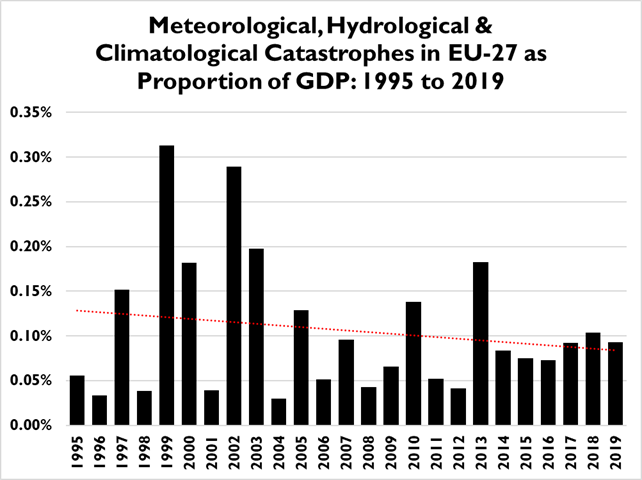
Weather & climate catastrophes in the EU-27 1995 to 2019 as a proportion of GDP
Here is the catastrophe data adjusted only for inflation
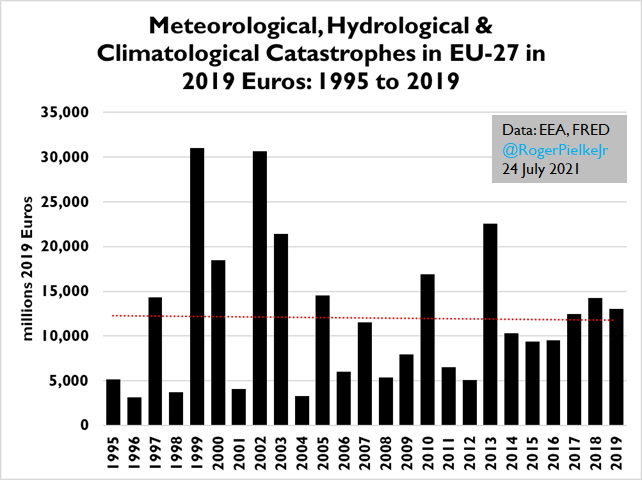
Data:
catastrophes = EEA (based on Munich Re) eea.europa.eu/data-and-maps/…
GDP = FRED (based on Eurostat) fred.stlouisfed.org/series/CPMNACS… & (based on OECD) fred.stlouisfed.org/series/NAGIGP0…
For context the recent flooding in Germany and Belgium will likely be ~ €10b or more

Average annual EU-27 catastrophe losses were ~€12b 1995 to 2019

insurancejournal.com/news/internati…
By request
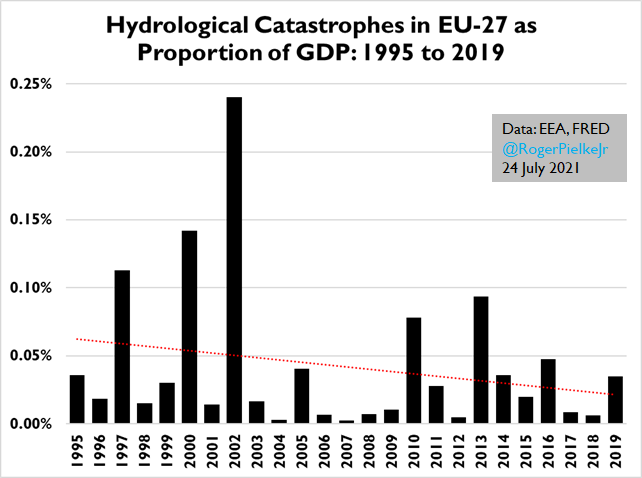
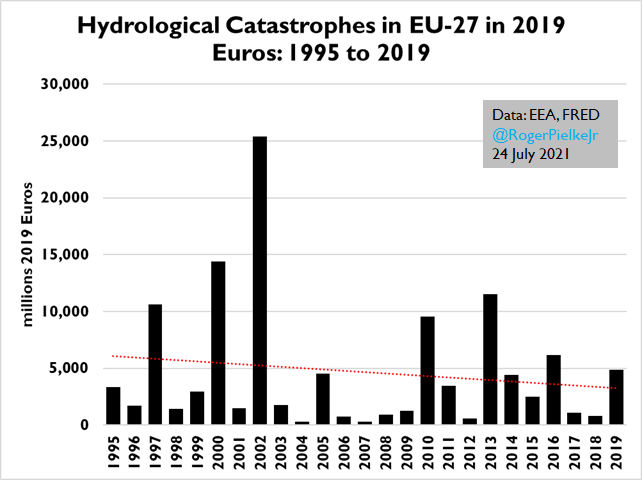
Just hydrological catastrophes in EU-27 1995 to 2019
L = % of GDP
R = damage in 2019 Euros
Both measures down over this period as EU-27 GDP increased by 50%
• • •

Missing some Tweet in this thread? You can try to force a refresh

 

Keep Current with Roger Pielke Jr.

Roger Pielke Jr. Profile picture

Stay in touch and get notified when new unrolls are available from this author!

Read all threads

This Thread may be Removed Anytime!

PDF

Twitter may remove this content at anytime! Save it as PDF for later use!

Try unrolling a thread yourself!

how to unroll video
  1. Follow @ThreadReaderApp to mention us!

  2. From a Twitter thread mention us with a keyword "unroll"
@threadreaderapp unroll

Practice here first or read more on our help page!

More from @RogerPielkeJr

23 Jul
A short 🧵 on my Senate testimony earlier this week
With key highlights

You can find the full text here:
banking.senate.gov/imo/media/doc/…
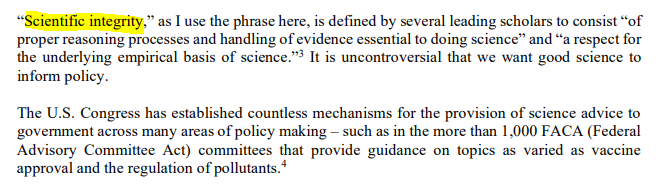
My focus is on the provision of robust science advice to policy makers on climate & evidence that scientific integrity has suffered in key ways

But first, lest there be any confusion. . .

1⃣ Those who are familiar with my views will know the below Image
2⃣ Scientific integrity would seem to a a topic that both Democrats and Republicans should be able to agree on

The US government generally (but definitely not always!) does an excellent job in soliciting and securing robust expert advice

Climate should be no different Image
Read 11 tweets
22 Jul
This is an interesting new paper
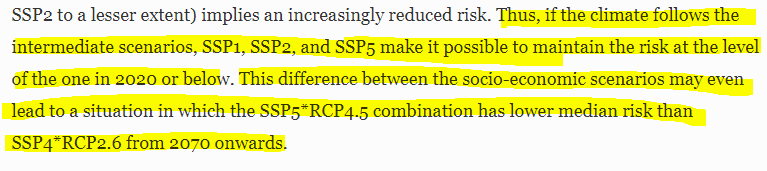
For heat outcomes, finds vulnerability reduction can be much more important than climate risk increase

Landreau et al 2021. Combining socio-economic & climate projections to assess heat risk. Climatic Change, 167(1), 1-20.
link.springer.com/article/10.100…
"The assessments of future climate risks are common; however, usually, they focus on climate projections without considering social changes"

True!

If you see a study with "no adaptation" used as a projection of the future, run away, fast!

This paper considers adaptation
How society develops will say more about how future heat risk evolves than will changing climate risk alone

The choices we make ... both emissions and societal will determine our collective future
Read 4 tweets
22 Jul
This is an important paper on flooding globally for several reasons

Do, H. X., Westra, S., & Leonard, M. (2017). A global-scale investigation of trends in annual maximum streamflow. Journal of Hydrology, 552, 28-43.

doi.org/10.1016/j.jhyd…
First, recognizing that there are regional differences, more locations saw decreasing trends than increasing trends

Overall, that means less flooding
Second - and this is really important - evidence of decreasing floods are contrary to evidence of increasing precipitation, and specifically maximum precipitation intensities

So YES extreme precip is going up (due to CC), but that does not mean that floods are also!
Read 6 tweets
21 Jul
There is no doubt that attribution claims have run far out ahead of detection of trends

"Since 1951, the number of heavy rainfall days per year for the whole of Germany has hardly changed, almost independently of their definition"
mdpi.com/2073-4441/12/7…

HT @AndrewSiffert
Similarly for Zhengzhou
doi.org/10.1002/joc.51…
I'm not sure how the current strong attribution claims (it's obvious, right?) can be reconciled with the observational data, but I'm sure there is an explanation

If certain extreme events have become much more likely, then evidence should show them being more likely? Or not?
Read 10 tweets
20 Jul
So that was fun

Thanks to @SenateBanking @BankingGOP for the opportunity to testify

Some thoughts on the hearing follow ...
Testimonies of

Frank Nutter @TheRAA
banking.senate.gov/imo/media/doc/…

@abdshafiee Abdollah Shafieezade
banking.senate.gov/imo/media/doc/…

Smart & w/ much solid policy recommendations to improve resilience & reduce vulnerability

(But both should stop confusing economic loss with climate trends!)
In most hearings I've been in Ds only engage D-invited witnesses & Rs w/ R-invitees

This wall of tribalism broke down today for just a brief moment

@SenatorTester listened to my testimony & express real surprise to learn that disaster losses are down as % GDP

Two points ...
Read 9 tweets
18 Jul
Sport is still rife with doping
Between 10% and 40% of athletes in Tokyo might be cheating
economist.com/science-and-te…
From The Edge
See the EPO?
Pielke, R. (2018). Assessing doping prevalence is possible. So what are we waiting for?. Sports medicine, 48(1), 207-209.

@TheEconomist notes the results of a 2011 WADA/IAAF study of doping prevalence

WADA/IAAF tried to prevent its publication
Details⬇️
Read 7 tweets

Did Thread Reader help you today?

Support us! We are indie developers!


This site is made by just two indie developers on a laptop doing marketing, support and development! Read more about the story.

Become a Premium Member ($3/month or $30/year) and get exclusive features!

Become Premium

Too expensive? Make a small donation by buying us coffee ($5) or help with server cost ($10)

Donate via Paypal Become our Patreon

Thank you for your support!

Follow Us on Twitter!

:(