

Recently, I’ve read some tweets about early Christians/New Testament authors and their positions on slavery. The point being made is that there doesn’t seem to have been a widespread condemnation of slavery by early Christians.
Ok…let’s be honest. We all know intent of these tweets isn’t to engage in an objective sociocultural examination of the attitudes/practices of a particular religious sect within the Roman Empire.
The message being conveyed is that if Christianity is this supposed “force for good” in the world, then we should expect to see a widespread opposition to slavery in the early Jesus movement. We don’t. So…gotcha!
What this attempted “gotcha!” fails to appreciate is the socioeconomic complexities of the world in which the early Christian movement found itself.
From it’s inception, the Jesus movement was immersed in a Greco-Roman world in which slavery was ubiquitous. It was ingrained in the fiber of daily life. It was integral to the Roman concept of the family.
In the parables preserved in the gospel accounts, we see Jesus using images of slavery to make certain points about the Kingdom of God.
Jesus doesn’t condemn or endorse the practice, as that wasn’t the purpose of the parable. Rather, he uses the daily experiences of the people who followed him to explain his vision of God’s kingdom.
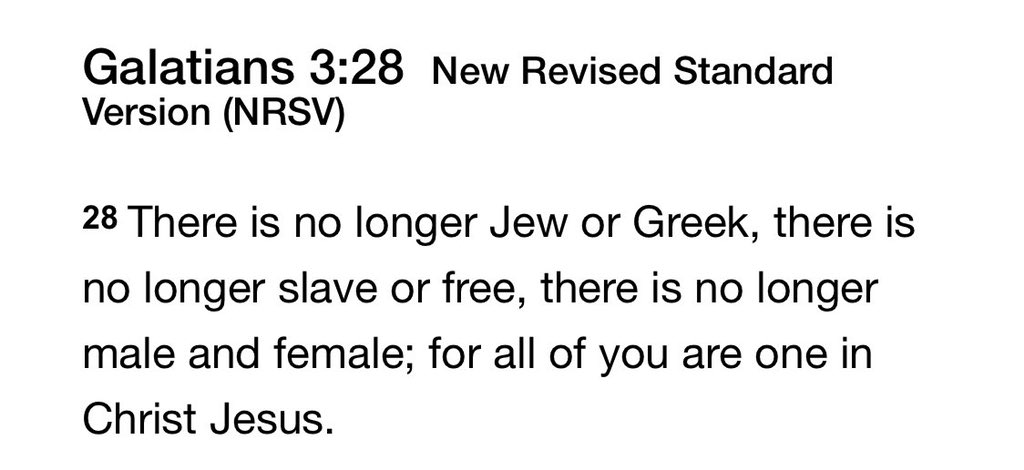
We also see the New Testament authors making mention of slavery and slaves. Let’s start with Paul… In one of his earliest letters, Galatians, Paul makes what is perhaps the first truly egalitarian statement in human history. ⬇️ 
In his letter to Philemon, Paul pleads with Philemon to welcome back his estranged slave, Onesimus, as a brother in Christ, rather than returning to the harshness of the previous (and expected) master/slave relationship.
Working within the constraints of the socioeconomic reality of the Roman Empire, Paul’s main focus was alleviating the brutality of the slave system through love.
Paul also found the familiar imagery of slave and master to be a useful tool in expressing the depth of commitment followers of Christ should have toward their master. ⬇️
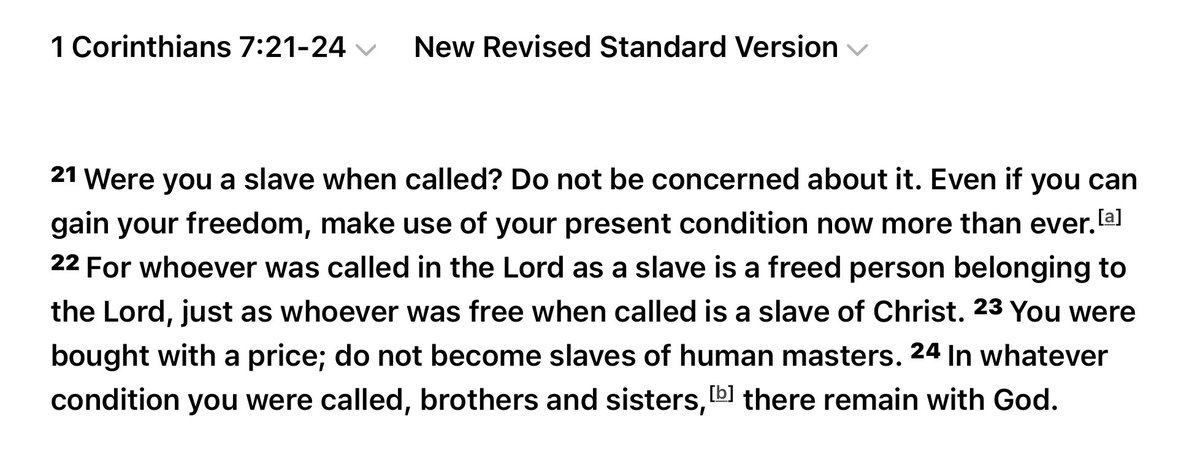
Therefore, his use of what was familiar to his readers to communicate a spiritual truth should then in no way be viewed as some tacit endorsement of slavery itself.
The New Testament writers sometimes directly addressed enslaved people (who seem to have often been drawn to the early Christian movement).
The NT writers sometimes admonish enslaved people in their congregations to obey and faithfully serve their masters, as if serving Christ. What?? Why not call for an end to the entire slave system?
Well… There were a couple of reasons.
Reason #1: The New Testament authors and early Christians in general were not in a position to affect structural change in a socioeconomic system that dominated the Empire.
That would be akin to you or I living in a capitalist system today, where the rich often get richer off the backs of the poor.
Since we have little ability to affect change in such a system, we might instead opt to use the system we have (injustice and all) to help those that suffer from the system.
We can persuade the rich to donate money (made via capitalism) to the poor. We can call for our elected officials to tax the wealthy at a higher rate to fund programs to alleviate poverty or homelessness.
We might encourage the poor to participate in programs that will train them to better work within a capitalist system.
Likewise, early Christian writers like Paul and the authors of Colossians and Ephesians appealed to Christian masters to treat their slaves with kindness and avoid threatening them.
Reason #2: When you were born into a system that is fundamental to your society, you often have blind spots regarding issues of injustice that exist within that system.
It’s easier for us to take a critical look at the injustices that exist in a system foreign to ours than it is for us to critique the injustices that exist within our own.
The same was true in the first few Christian centuries. How should one respond to the ubiquity of slavery…a system that seems so antithetical to the teachings of Jesus?
How do people typically react when faced with such incongruity? Often in various ways. Christian thinkers who did address slavery did so using diverse approaches.
Some like Basil of Caesarea thought the slave system could be a positive in society, but called upon masters to avoid harsh & excessive punishment. John Chrysostom called for limiting the number of slaves a slave owner had.
So in other words…slavery should be safe, legal, and rare. Sound familiar?
Others, like Augustine, tried to rationalize the practice by saying that although it was unnatural, slavery is a direct consequence of sin and the fallen nature of Man.
Gregory of Nyssa was the rare exception, an individual who could discern the injustice in his own world AND had the courage to speak out publicly against it.
Gregory preached a powerful sermon on Ecclesiastes (Fourth Homily) in which he strongly condemned the institution of slavery.
His argument against the slave system was based on scripture and Christian theology. Unfortunately, his words were largely ignored by a world unready to hear them.
Reason #3: There was no time to worry about the abolition of the slave system. Why? Because for many early Christians, the Eschaton (the end of human history) was right around the corner.
God was wrapping up human history and the Great Reversal of the Kingdom of God would take place. The first would be last and the least would be greatest. All would be put to right. That meant slavery wasn’t going to be around much longer anyway.
But why would early Christians assume that the end was quickly approaching? Well…this requires a brief digression.
Early Christians, including the NT authors, firmly believed that God had raised Jesus from the dead. They came to this belief based on the evidence of the apostolic testimony that had been handed on by the first generation of Christians.
In 2nd Temple Judaism (the religio-cultural milieu from which Christianity arose) the concept of “resurrection” referred to the final raising of the dead at the end of time.
There was no concept of a special resurrection prior to the end. Since God had raised Jesus from the dead, the earliest Jesus followers assumed that the general resurrection of the dead must be soon to follow. Makes sense.
As time went on and the much anticipated end never arrived, Christians began to contemplate the idea that God had other plans for the movement.
Maybe God wasn’t ushering in the end of the world…but instead bringing about the birth of something new in the world.
Anyway, this idea that the Eschaton was soon in coming led early Christians to focus on helping to alleviate the immediate suffering of individuals, rather than long term societal change. After all, there wasn’t going to be a “long term.”
Conclusion: So to those who would try to use the lack of a clear stand by early Christians against the institution of slavery as a means to bludgeon modern Christianity, I hope you will think twice.
I know many of you, here in the Twitterverse, are convinced that if you were transported back to the days of the Roman Empire, you would be marching in the streets, protesting slavery and screaming in the faces of slave owners.
I wonder if that’s what you would have really done…
Come on…it’s EASY to take a stand against an injustice when it’s popular within your society to do so. It takes WAY more courage to take a stand against injustice when it’s unpopular…when your livelihood or very life could be put at risk for doing so.
So let’s not be too quick to judge early Christian communities based on our modern standards of justice.
As a matter of fact, the social justice concepts that we take for granted today, that we should help the weak, poor, sick, the oppressed, etc, stem directly from Christian roots. For further reading, I’d recommend Tom Holland’s Dominion. amazon.com/Dominion-Chris…
• • •
Missing some Tweet in this thread? You can try to
force a refresh



