

BASICS OF Buyback:
This thread is important for every investor who invest in Equity Market
Topics Covered:
1. What is Buyback?
2. Why buyback is important for every investor?
3. How to invest & participate in Buyback?
4. What not to do to avoid Buyback failure?
🧵👇
This thread is important for every investor who invest in Equity Market
Topics Covered:
1. What is Buyback?
2. Why buyback is important for every investor?
3. How to invest & participate in Buyback?
4. What not to do to avoid Buyback failure?
🧵👇

What is Buyback?
When a company repurchases its outstanding share from the market it is a case of Buyback.
Buyback reduces the number of shares from the market, and automatically increases the value of remaining shares. However, the cash of the company gets deployed.
When a company repurchases its outstanding share from the market it is a case of Buyback.
Buyback reduces the number of shares from the market, and automatically increases the value of remaining shares. However, the cash of the company gets deployed.
Why is Buyback important?
1. Always be interested when your portfolio company is coming up with buyback
Buyback is a mechanism used by a company to reward its shareholders apart from dividend.
1. Always be interested when your portfolio company is coming up with buyback
Buyback is a mechanism used by a company to reward its shareholders apart from dividend.
Hence your investee company is utilizing cash on the Balance Sheet to reward shareholders. This cash will not be reinvested.
Eventually if you don't participate in a favorable buyback, then you might lose the opportunity on cash flows earned by your company.
Eventually if you don't participate in a favorable buyback, then you might lose the opportunity on cash flows earned by your company.
For those who keep a certain portfolio in cash and are willing to generate more than bond return on that cash from the market with limited risk, then buyback is favorable.
Types of Buyback:
- Tender Route
- Open Market Operation
Buyback can be participated in 2 ways:
- Retail Category: Investment value < 2 Lac
- HNI Category: Investment value > 2 Lac
Retail shareholders has only 15% reservation in the buyback out of total buyback size.
- Tender Route
- Open Market Operation
Buyback can be participated in 2 ways:
- Retail Category: Investment value < 2 Lac
- HNI Category: Investment value > 2 Lac
Retail shareholders has only 15% reservation in the buyback out of total buyback size.
Tender Route Buyback:
To participate in this buyback, all the existing investors of the company has to tender their shares on the date mentioned by the company and at the mentioned price.
- Price guarantee
- Assured buyback size
To participate in this buyback, all the existing investors of the company has to tender their shares on the date mentioned by the company and at the mentioned price.
- Price guarantee
- Assured buyback size
Process of Tender Route:
♦ Company first announce the disclosure for intimation of buyback.
♦ Post that Company approves the buyback with required disclosure. This may take 7 days.
♦ Company then sends the announcement of record date. (Time taken is from 7 days to 3 months)
♦ Company first announce the disclosure for intimation of buyback.
♦ Post that Company approves the buyback with required disclosure. This may take 7 days.
♦ Company then sends the announcement of record date. (Time taken is from 7 days to 3 months)
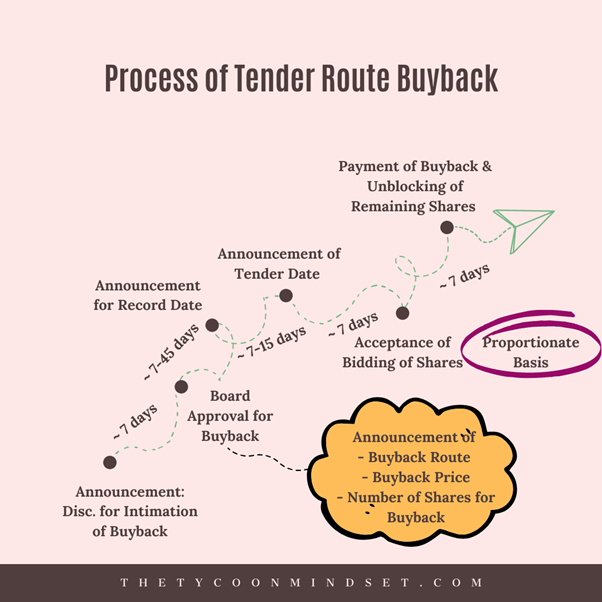
♦ Post record date, company announce Tender Offer (Time taken is ~15 days)
♦ Co. accepts the bidding of shares from the investors on a proportionate manner.
♦ Shares not accepted for buyback are unblocked from the account and the buyback amount is transferred to bank account
♦ Co. accepts the bidding of shares from the investors on a proportionate manner.
♦ Shares not accepted for buyback are unblocked from the account and the buyback amount is transferred to bank account
How to Participate?
1. Shares should be in demat before the record date. Hence the last date of purchase is a record -2 days.
2. Post record date, company announced tender date. Tender Date usually comes in time frame of 15 days. One must apply the shares to tender for buyback.
1. Shares should be in demat before the record date. Hence the last date of purchase is a record -2 days.
2. Post record date, company announced tender date. Tender Date usually comes in time frame of 15 days. One must apply the shares to tender for buyback.
(Note: One can sell the shares post record date & again re-enter before tendering)
3. Ways to Tender the Shares?
i. Submit the buyback detail to your broker
ii. Few broker tenders on their system (website) only
iii. Fill the buyback form which comes on mail, & deliver it to co.
3. Ways to Tender the Shares?
i. Submit the buyback detail to your broker
ii. Few broker tenders on their system (website) only
iii. Fill the buyback form which comes on mail, & deliver it to co.
4. Shares tendered for buyback will then be blocked, & on the proportionate basis shares for buyback will be selected. The shares which are not approved for buyback will be returned unblocked.
Note: Co. allots the minimum qty for buyback, however like IPO one can apply their entire shares for buyback. Post to min shares extra acceptance would be on proportionate basis.
When is a Buyback a Good Investment Opportunity?
There are 3 different scenario here:
(A). CMP Undervalued; Buyback Price is way higher: Increase your Investment. Participate in Buyback. Continue holding remaining shares post buyback.
There are 3 different scenario here:
(A). CMP Undervalued; Buyback Price is way higher: Increase your Investment. Participate in Buyback. Continue holding remaining shares post buyback.
(B). CMP Fairly Valued: Tender the shares in buyback as it will give your fair exit
(C). CMP Overvalued and buyback price is lucrative: Best possible chance to get an exit from the company.
(C). CMP Overvalued and buyback price is lucrative: Best possible chance to get an exit from the company.
Framework for Investing in Buyback:
Here are few of our buyback to understand our framework behind investing in buyback.
thetycoonmindset.com/special-situat…
thetycoonmindset.com/special-situat…
thetycoonmindset.com/special-situat…
Here are few of our buyback to understand our framework behind investing in buyback.
thetycoonmindset.com/special-situat…
thetycoonmindset.com/special-situat…
thetycoonmindset.com/special-situat…
https://twitter.com/tycoonmindset05/status/1371476406387961856
https://twitter.com/tycoonmindset05/status/1363074123979653122
Key Notable Points (From Telegram Que)
1. For introspecting types of shareholders, take data from latest Annual Report, not from BSE shareholding pattern.
BSE Shareholding Pattern has data with Share capital less than 2 Lac.
Share Capital = Face Value * Outstanding Shares.
1. For introspecting types of shareholders, take data from latest Annual Report, not from BSE shareholding pattern.
BSE Shareholding Pattern has data with Share capital less than 2 Lac.
Share Capital = Face Value * Outstanding Shares.
2. One can tender their entire 100% of the shares in the tender offer. Co. allots share per participant, however not all investors participate in buyback. Hence you have extra chance for buyback acceptance.
3. Buyback caps the upper range share price until buyback process ends.*
3. Buyback caps the upper range share price until buyback process ends.*
Open Market Operation:
Here the company directly purchases the share from the open market.
Process: Company announced the open market operation via disclosure in the buyback route. Here the company announces the maximum price at which shares would be bought.
Here the company directly purchases the share from the open market.
Process: Company announced the open market operation via disclosure in the buyback route. Here the company announces the maximum price at which shares would be bought.
Co. announce price upto which “x” nos of shares would be bought within “x” period of time (usually a month time frame).
If the shares price goes higher than “x”, then the co. would pause its share buyback. Hence the number of shares is also not confirmed in Open Market Operation
If the shares price goes higher than “x”, then the co. would pause its share buyback. Hence the number of shares is also not confirmed in Open Market Operation
Participation:
In Open Market Operation, there is no such participation in buyback here. Company would buy shares directly from the market and there is no guarantee that during this time the share price would increase or decrease.
In Open Market Operation, there is no such participation in buyback here. Company would buy shares directly from the market and there is no guarantee that during this time the share price would increase or decrease.
• • •
Missing some Tweet in this thread? You can try to
force a refresh





