
Large language models (LLMs) often make mistakes that are difficult to correct.

We study the problem of quickly editing these models:
Paper: arxiv.org/abs/2110.11309
Code: github.com/eric-mitchell/…

w/ @_eric_mitchell_, C. Lin, @ABosselut, @chrmanning

thread 🧵👇
We assume a pre-trained model & a dataset that covers many possible model edits

Then, we meta-train a model editor that predicts a model update that:
- edits the model
- otherwise keeps the model behavior the same

(2/4)
You can train model editors for massive models (e.g. GPT-J, T5-11B) in <1 day on a single GPU.

Edits with the resulting model editor are extremely fast, with edit success rate of 80-90%.
(3/4)
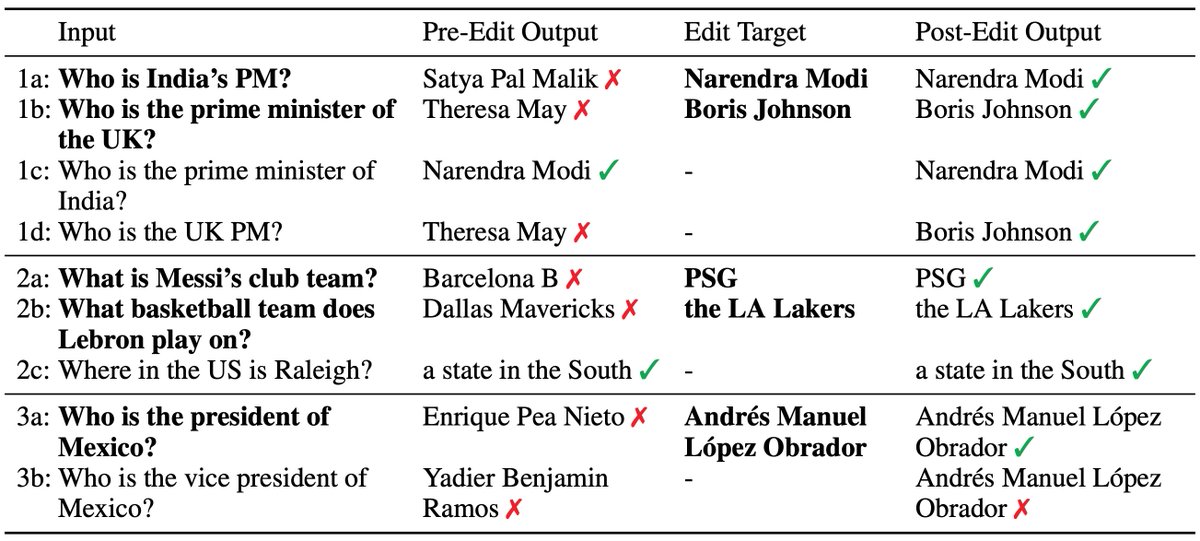
While I think that MEND makes significant progress on the problem of model editing, still lots of open challenges including:
- deeper edit generalization
- making many model edits

It was also a lot of fun to collaborate with @stanfordnlp!
(4/4)

• • •

Missing some Tweet in this thread? You can try to force a refresh

 

Keep Current with Chelsea Finn

Chelsea Finn Profile picture

Stay in touch and get notified when new unrolls are available from this author!

Read all threads

This Thread may be Removed Anytime!

PDF

Twitter may remove this content at anytime! Save it as PDF for later use!

Try unrolling a thread yourself!

how to unroll video
  1. Follow @ThreadReaderApp to mention us!

  2. From a Twitter thread mention us with a keyword "unroll"
@threadreaderapp unroll

Practice here first or read more on our help page!

More from @chelseabfinn

22 Sep
RL methods so often learn from _scratch_. Can they leverage offline experience from previous tasks?

They can. And if they do, they will learn new tasks ~2x faster.

Paper: arxiv.org/abs/2109.09180
Website: sites.google.com/view/retain-ex…

Led by Annie Xie. 🧵👇(1/4) Lifelong Robotic Reinforcement Learning by Retaining Experie
Many prior transfer learning methods try to transfer weights, e.g through fine-tuning.

We consider whether we can also transfer past *experiences*, rather than throwing away the prior data.
(2/4) A diagram of the method, which restores replay buffers from
Retaining & filtering experiences performs *substantially* better than fine-tuning & other prior methods

It also outperforms learning from scratch, even when learning from scratch with 2x the data.
(3/4) Table of results, showing substantially better performance f
Read 4 tweets
20 Jul
Thrilled to share new work on AI for education: can we give detailed, high-quality feedback to students?

Post: ai.stanford.edu/blog/prototran…
NYT Coverage: nytimes.com/2021/07/20/tec…

A collab w. the amazing @mike_h_wu @chrispiech & co 🧵
2/ Student feedback is a fundamental problem in scaling education.

Providing good feedback is hard: existing approaches provide canned responses, cryptic error messages, or simply provide the answer.
3/ Providing feedback is also hard for ML: not a ton of data, teachers frequently change their assignments, and student solutions are open-ended and long-tailed.

Supervised learning doesn’t work. We weren’t sure if this problem can even be solved using ML.
Read 12 tweets
1 Apr
How can robots generalize to new environments & tasks?

We find that using in-the-wild videos of people can allow learned reward functions to do so!
Paper: arxiv.org/abs/2103.16817

Led by @_anniechen_, @SurajNair_1
🧵(1/5)
To get reward functions that generalize, we train domain-agnostic video discriminators (DVD) with:
* a lot of diverse human data, and
* a narrow & small amount of robot demos

The idea is super simple: predict if two videos are performing the same task or not.
(2/5) Image
This discriminator can be used as a reward by feeding in a human video of the desired task and a video of the robot’s behavior.

We use it by planning with a learned visual dynamics model.
(3/5) Image
Read 5 tweets
8 Jul 20
Convolution is an example of structure we build into neural nets. Can we _discover_ convolutions & other symmetries from data?

Excited to introduce:
Meta-Learning Symmetries by Reparameterization
arxiv.org/abs/2007.02933

w/ @allan_zhou1 @TensorProduct @StanfordAILab
Thread👇
To think about this question, we first look at how equivariances are represented in neural nets.

They can be seen as certain weight-sharing & weight-sparsity patterns. For example, consider convolutions.
(2/8)
We reparametrize a weight matrix into a sharing matrix & underlying filter parameters

It turns out this can provably represent any equivariant structure + filter parameters, for all group-equivariant convolutions with finite groups.
(3/8)
Read 8 tweets
7 Jul 20
Supervised ML methods (i.e. ERM) assume that train & test data are from the same distribution, & deteriorate when this assumption is broken.

To help, we introduce adaptive risk minimization (ARM):
arxiv.org/abs/2007.02931

With M Zhang, H Marklund @abhishekunique7 @svlevine
(1/6)
Prior works on dIstributionally-robust optimization (DRO) aim to be _robust_ to distribution shift.

Group DRO aims for robustness to shifts in groups underlying the dataset. (e.g. see arxiv.org/abs/1611.02041)
(2/6)
Recently, this paper showed promising results on group DRO with neural nets:
arxiv.org/abs/1911.08731

However, DRO methods often trade-off between robustness & test-time performance.
(3/6)
Read 6 tweets

Did Thread Reader help you today?

Support us! We are indie developers!


This site is made by just two indie developers on a laptop doing marketing, support and development! Read more about the story.

Become a Premium Member ($3/month or $30/year) and get exclusive features!

Become Premium

Too expensive? Make a small donation by buying us coffee ($5) or help with server cost ($10)

Donate via Paypal Become our Patreon

Thank you for your support!

Follow Us on Twitter!

:(


