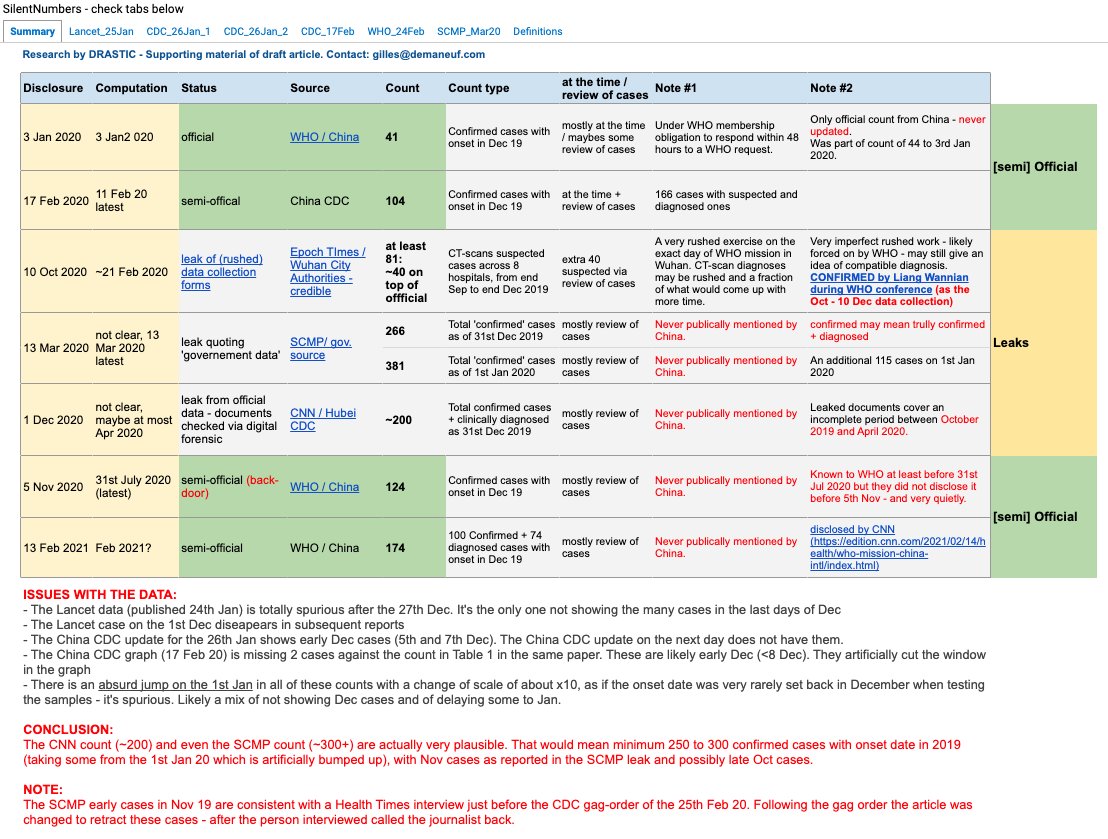
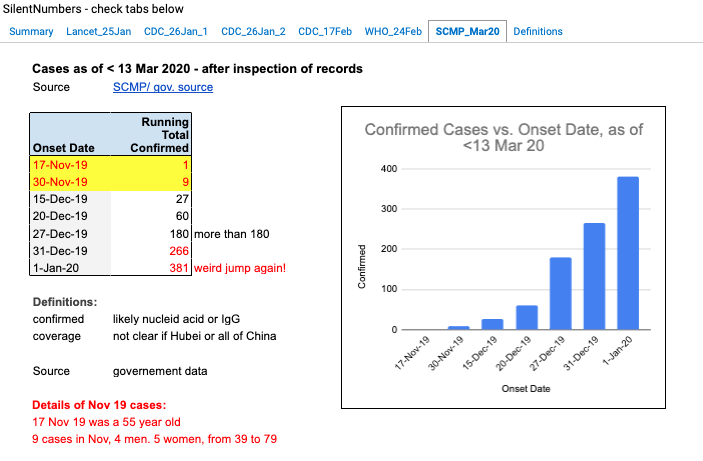
This was also the conclusion of a good Feb 20 paper by Chinese scientists + Cambridge educated Corlett.
I have been pointing to that paper many times. This was published within two months of the outbreak becoming public - and yet the conclusions are still valid.
I have been pointing to that paper many times. This was published within two months of the outbreak becoming public - and yet the conclusions are still valid.
https://twitter.com/jbloom_lab/status/1462231932989706245
All the sweet talking from China, joined on this by many Western scientists, has added actually little - mostly smoke screens.
20 months largely wasted on fake stories (pangolins, fish fingers, GoF semantics, Dec 19 patient zero, Ft Detrick, etc).
20 months largely wasted on fake stories (pangolins, fish fingers, GoF semantics, Dec 19 patient zero, Ft Detrick, etc).
https://twitter.com/gdemaneuf/status/1371622790634205185?s=20
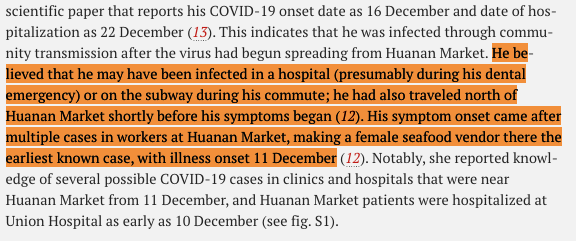
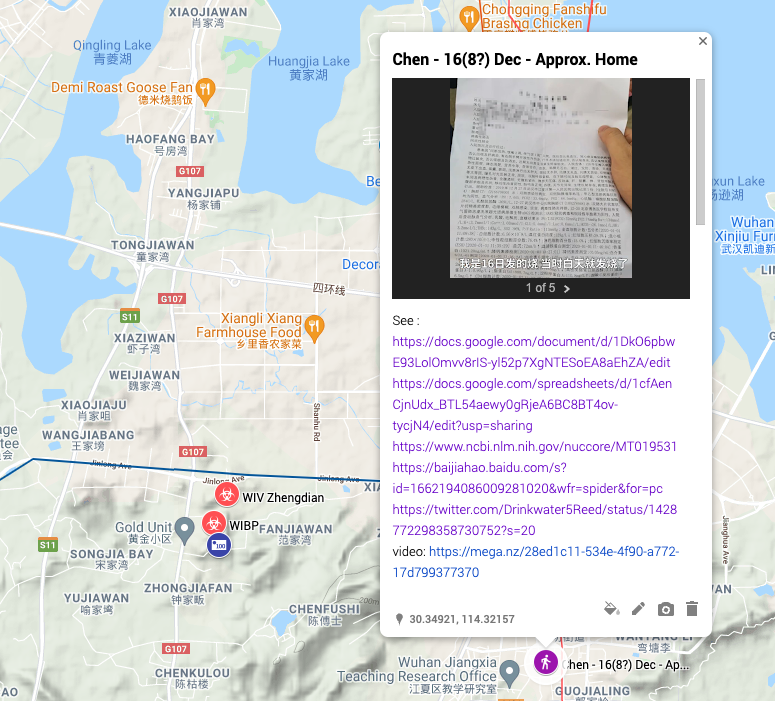
This 'cancelation' of early cases, and epidemiological tea-leaves reading - based on late data with a very likely sampling bias (early cases had to be connected to the market to be retained) and the same signature as a simple population density map - is not science.
It's baloney
It's baloney
Even Wang et al, with George Gao as co-author (chinaxiv.org/abs/202107.000…), properly concluded that the market was likely not the origin.
The ad-nauseum repetition of a compromised hypothesis will not make it more credible.
@MichaelWorobey @jbloom_lab
The ad-nauseum repetition of a compromised hypothesis will not make it more credible.
@MichaelWorobey @jbloom_lab
https://twitter.com/gdemaneuf/status/1421351232736612359?s=20
And for the mapping issues and the dangers of jumping to conclusions, this is an excellent analysis.
Please read, and thanks @danwalker9999 for the good work.
Please read, and thanks @danwalker9999 for the good work.
https://twitter.com/danwalker9999/status/1461591621749772292?s=20
@threadreaderapp compile
Ad-nauseam - typo.
• • •
Missing some Tweet in this thread? You can try to
force a refresh