The odds are not driven by a distance argument but by a location exclusivity argument.
In a well connected world, it is not difficult for a virus to find its way to a perfect place for a superspreader event, be it a Wuhan market or Wuhan itself.
The odds are driven by the location of the initial breakout out of all places, with regards to the putative causative agent.
For wildlife trade zoonosis a market makes perfect sense, but there are 100+ cities in China with wet markets, transport hubs and 1mln+ people.
At the same time at least 50% of the Chinese research on bat coronaviruses, with all the lab activity and samplers coming back, was done in Wuhan - of all places.
Hence the exclusivity argument has a *much* larger effect on the research-related scenario that on the market one.
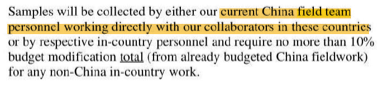
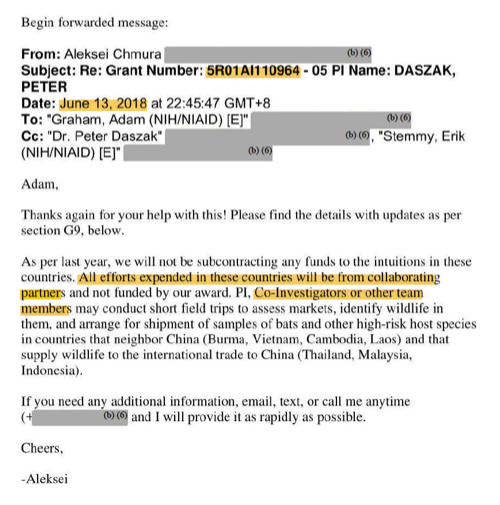
Because - guess what - that's exactly what Alexei and Daszak were telling the NIH would happen:
"Samples will be collected by either our current China field team personnel working directly with our collaborators in these countries or by respective in-country personnel"
And they will be no extra expense under the grant, since it will be done by collaborating partners and existing co-investigators:
"All efforts expended in the countries will be from collaborating partners and not funded under our award".
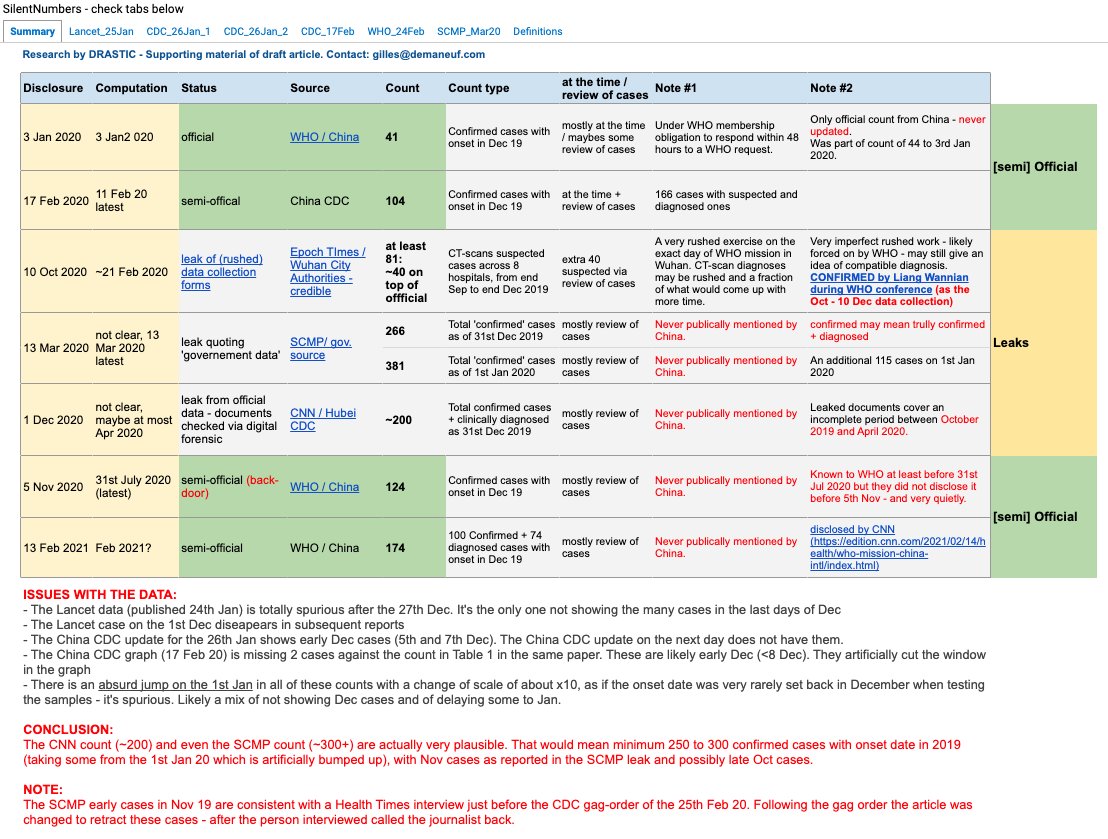
Going back to the existence of Nov cases that have since then been 'cancelled' by China, please remember the US intel Nov 19 warning. researchgate.net/publication/35…
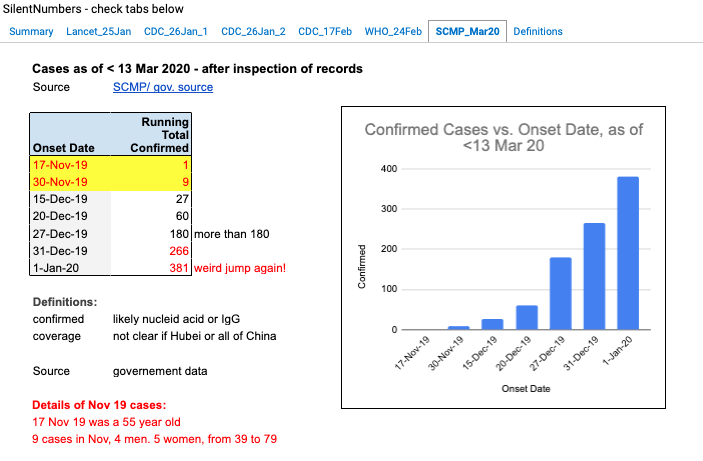
Also remember the nine Nov confirmed cases from the SCMP (based on official Chinese sources).
My Silent Numbers give you all the sources (inc. the SCMP without firewall).
I also graphed the SCMP numbers (SCMP tab at top)
One of the best papers I read about dating the index case is actually co-authored by Worobey himself.
That's Pekar et al with its mid-Oct to mid-Nov estimate - which we referred to extensively in our 'October Surprise'.
Pekar et al: science.org/doi/10.1126/sc…
Here is a thread that looks at the zoonosis evangelists main argument that:
** since zoonosis happens all the time we should just use that hypothesis as the default one - the burden of proof must be on the research-related side **
First let me state that this argument is a fallacy that makes the most of the fact that people don't intuitively have a good grasp of probabilities.
One can explain this this way: Suppose that there are two lotteries in China: a zoonosis lottery and a research-accident lottery.
Let's say that the zoonosis lottery sells 20 times more tickets over China, and also that each ticket has the same chance of winning a top prize (whatever the lottery).
So on average you get 20 zoonosis top prizes for one accident top prize across China.
This was also the conclusion of a good Feb 20 paper by Chinese scientists + Cambridge educated Corlett.
I have been pointing to that paper many times. This was published within two months of the outbreak becoming public - and yet the conclusions are still valid.
This 'cancelation' of early cases, and epidemiological tea-leaves reading - based on late data with a very likely sampling bias (early cases had to be connected to the market to be retained) and the same signature as a simple population density map - is not science.
Just stating the obvious that THE FIRST CASE WAS NOT IN DECEMBER exposes the mendicant analysis of that recent piece, which feeds of the scraps of data left by China and then props itself up on odd logical shortcuts.
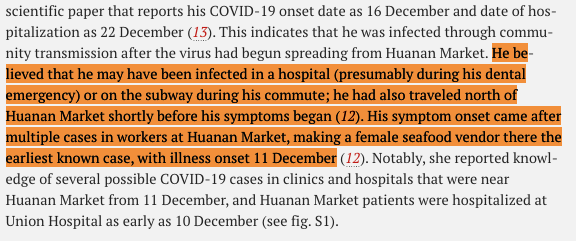
One could hardly think of a more conflicted sentence than this one for instance:
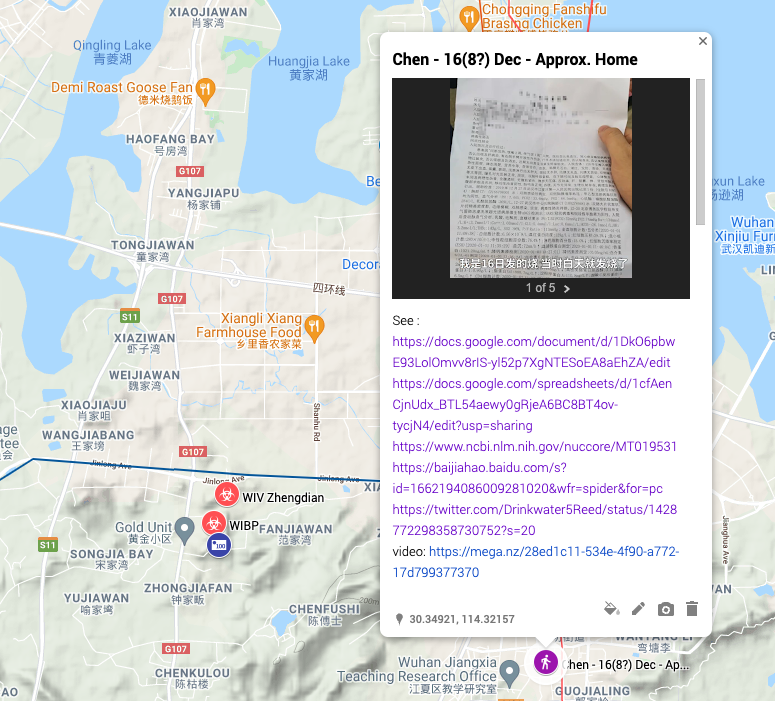
First, if indeed Mr Chen was infected during his hospital trip on the 8th Dec (as he suspect may be the case), then the whole logic implodes. @MichaelWorobey
It would mean that Jinxia, about 28km away from the market, had community transmission in hospital setting by the 8th.
(by the way our DRASTIC map had these documents and the 16th as likely onset date - and we all made it public ages ago) @sciencecohen