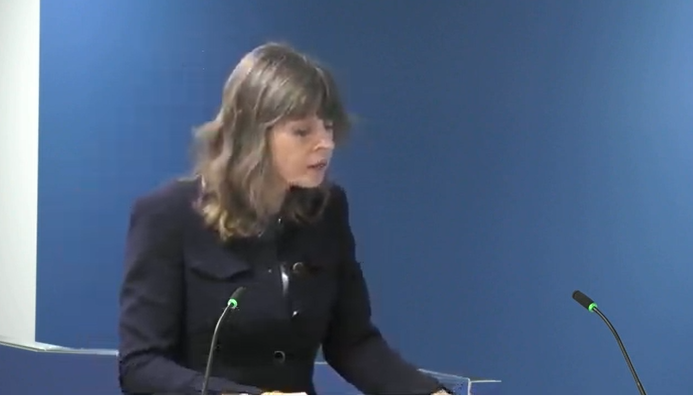
Stephanie Barwise, appearing for bereaved and survivors, says Grenfell was the result of govt "unbridled passion for deregulation" and a "prolonged period of concealment" making it "one of the major scandals of our time".
Here are ::just a few:: of the revelations:
Here are ::just a few:: of the revelations:
Following two fires in the 1990s, the government received an estimate that the cost of fixing dangerous cladding was £500m. The bill today for all buildings is estimated at well above £15bn.
In order to avoid this bill (Ms Barwise says) reports into these fires prepared by the BRE which could have exposed the danger of combustible cladding were "covered up" or "entirely neutered"
The government acknowledged that a 'budget moratorium' in rule introduced in March 2011 which prohibited new regulations for the building industry put it in breach of its duty to protect the right to life. It went ahead anyway.
The government suppressed information about the combustibility of cladding used on Lakanal House after a fire killed six people in 2009, with officials noting the need to “avoid giving the impression that we believe all buildings of this construction [are] inherently unsafe”.
The investigation into this fire was shut down by government without explanation in a “grotesque abdication of responsibility” which “raises the spectre of a deliberate cover up”.
After Lakanal, despite outwardly promising to implement the coroner’s recommendation to encourage the use of sprinklers, civil servants wrote that it was simply seeking “to be able to say that DCLG is taking action” and it had prepared “a defensive line against them” [sprinklers]
A senior civil servant warned in May 2017 – just a month before the Grenfell Tower fire – that “We or ministers are increasingly vulnerable to some or all of these risks becoming material and [government] being held to account for being inactive”.
On the day of the Grenfell Tower fire, another civil servant emailed internally: “Some of the stuff about disproportionate burdens feels uncomfortable today.”
Government elected not to drop the weak Class 0 fire standard for cladding in the early 2000s out of fears that tougher European standards would “discriminate against” foil faced insulation
Cladding industry lobbyists warned that replacing this standard with a large scale test would mean rainscreen cladding systems were effectively banned and warned this would have “economic consequences for the building industry and the UK as a whole”.
Insulation manufacturer Kingspan wrote in 2003 that the government would not introduce the tougher European fire standards “until the industry is ready to adopt it”.
Kingspan "leant on" the NHBC in order to push it to produce more lenient guidance for accepting cladding systems with combustible materials in the mid 2010s, amid a big society initiative which allowed industry to "write its own rules"
A government-commissioned test on the specific cladding product used on Grenfell Tower in 2002 failed five minutes into its 30-minute duration but in a move which Ms Barwise says "beggars belief" the product was not banned.
"Grenfell is a lens through which to see how we are governed," she says The failures are systems failures." While the failures span political parties "certain political ideals, principally deregulatory policies entwined with a radical housing policy" bear primary responsibility
Earlier, appearing for the inquiry, Richard Millett QC had urged public bodies to approach the process with candour not as a game of cat and mouse. Said their submissions suggest they were written with their fingers crossed
I now have to get all of this into a single news story and there's still two statements to come, so tuning out for the time being...
• • •
Missing some Tweet in this thread? You can try to
force a refresh