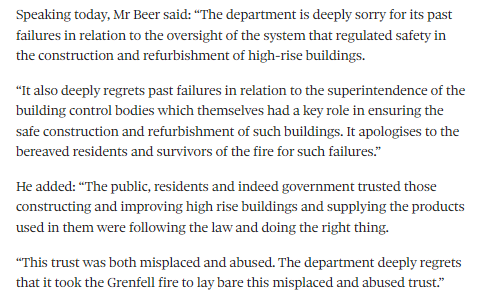
The government has said it is "deeply sorry" for failures in its oversight of local authority inspectors before Grenfell - but has stopped short of accepting flaws in its own guidance or regulations
The core of (the department formerly known as) DCLG's argument is that it honestly believed regulations were being properly enforced at a local level and that product manufacturers and builders were "doing the right thing". It is apologising for this mistaken assumption.
It is fair to say that this makes the apology a bit of buck pass and ignores the substance of what survivors have accused the department of: presiding over deficient guidance, prioritising deregulation over safety and covering up the risk from cladding from the 1990s onwards
Remember: English standards were so low that Arconic (the cladding manufacturer who sold the panels) viewed us as "a market" for its cheapest, most combustible panels. This is about more than poor investment and dodgy industry practice (although both are relevant as well)
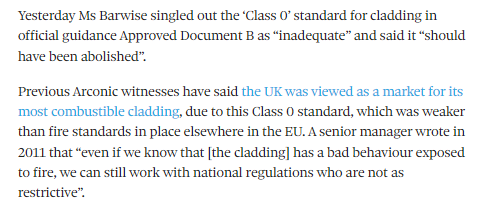
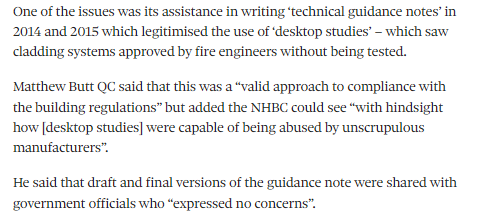
Also this morning: the NHBC (our largest building inspector and warranty provider for new homes) addressed its role in producing guidance which legitimised the use of untested cladding systems (desktop studies). It says this was done with the effective consent of government:
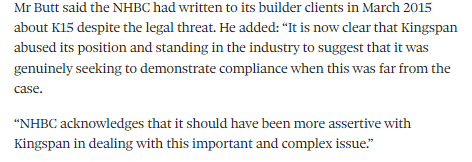
It has also accused insulation manufacturer Kingspan of "abusing its position and standing in the industry". NHBC is under scrutiny for accepting Kingspan's K15 for use on high rise buildings, despite raising questions about its fire performance
We get the first witnesses for this module tomorrow, starting with Local Authority Building Control - the membership body which provided 'misleading' certificates for both insulation products used on Grenfell Tower
Oh - and one other thing from the govt opening (which didn't get into my story). Their QC trumpeted how they are "fully supportive" of the inquiry and have provided "tens of thousands of documents" and "witness statements from junior officials to former cabinet ministers"..
... this however is less of a boast and more a statement of their basic obligations under the Inquiries Act. A better way of looking at it might be to compare what these documents show with the public statements made by ministers/officials in the four years since Grenfell (ends)
• • •
Missing some Tweet in this thread? You can try to
force a refresh

LABC was warned that its misleading certificate about Kingspan's K15 insulation and told it was "extremely important with regard to life safety" that it was corrected. It did not act. The letter was also forwarded to a senior govt official
LABC is a membership organisation represting council building inspectors. It also had a sideline where companies paid it to provide certificates confirming the status of their products. These then helped get the products signed off in construction projects.
In 2009, LABC provided a certificate to Kingspan. It said the product can be considered a material of limited combustibility and could be used on high rises. Both LABC and Kingspan witnesses have accepted this was misleading. Previous report here: insidehousing.co.uk/news/news/king…
I think it is probably worth explaining in a bit more detail why the government's 'apology' for Grenfell yesterday was inadequate and disingenuous... 🧵
In its opening statement the government ultimately accepted two failures:
- Not realising local authority building inspectors were failing to properly enforce the rules
- A 'misplaced' trust in product manufacturers and contractors which was 'abused'
The implication was that it learned of these issues after the Grenfell Tower fire. However, the evidence simply does not support that claim. It is clear it knew, in some cases in quite specific terms, about both problems before the fire. Let's take the misplaced trust first.
Stephanie Barwise, appearing for bereaved and survivors, says Grenfell was the result of govt "unbridled passion for deregulation" and a "prolonged period of concealment" making it "one of the major scandals of our time".
Here are ::just a few:: of the revelations:
Following two fires in the 1990s, the government received an estimate that the cost of fixing dangerous cladding was £500m. The bill today for all buildings is estimated at well above £15bn.
In order to avoid this bill (Ms Barwise says) reports into these fires prepared by the BRE which could have exposed the danger of combustible cladding were "covered up" or "entirely neutered"
On Monday the Grenfell Tower Inquiry will hear opening statements covering the failures of government in the years before the fire.
Here is some of what we already know about one of the most appalling failures of the British state in modern history 🧵
We can start the story in the 1980s, with the government of Margaret Thatcher and the decision to deregulate the building industry with a sweeping piece of legislation that introduced new headline 'standards' instead of local prescriptive rules.
The purpose was clear: to strip away restrictions on industry to allow them to maximise profits. “Maximum self-regulation, minimum government interference,” was how then secretary of state Michael Heseltine sold it.
Amid the discussion about Kingspan's sponsorship deal with Mercedes, here's a brief run through of what the Grenfell Tower Inquiry has revealed about them 🧵
Kingspan's K15 insulation product was only a very small part of the cladding system on Grenfell, and was only there because of a product substitution. But Kingspan's relevance to the story is larger than that. Lawyers for the families say the firm 'set the precedent'...
... for the use of combustible insulation on high rises.
In 2005, English regulations changed to allow cladding systems to be used on buildings if they passed a 'large scale test'. This opened up a potential backdoor route to use combustible insulation in these systems.
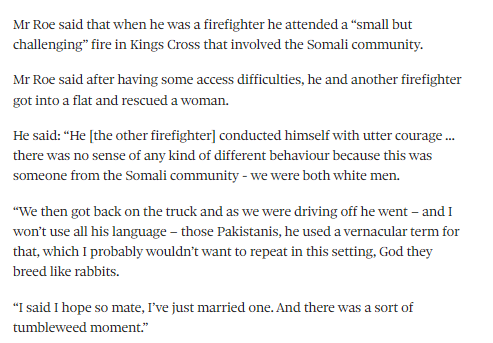
The commissioner of the London Fire Brigade today described hearing a colleague refer to Somali residents they had rescued from a fire as 'P**is' and saying they 'breed like rabbits'
Andy Roe was being questioned about an interview he gave the Guardian in which he said people "come back to the station and express themselves in casually racist terms". He was asked to give a concrete example.