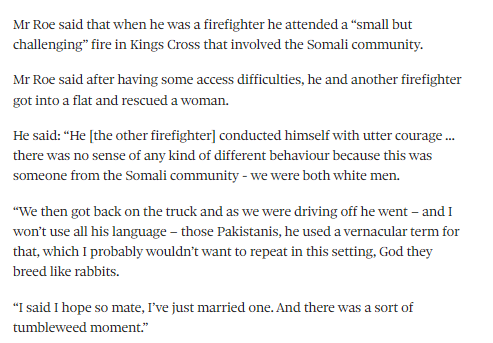
I think it is probably worth explaining in a bit more detail why the government's 'apology' for Grenfell yesterday was inadequate and disingenuous... 🧵
https://twitter.com/PeteApps/status/1468360465940205571
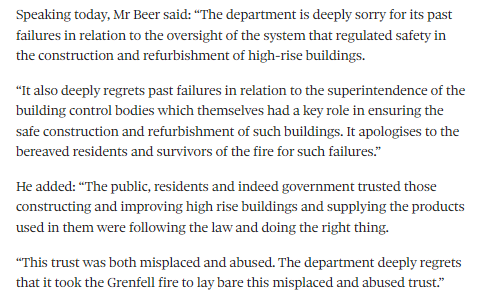
In its opening statement the government ultimately accepted two failures:
- Not realising local authority building inspectors were failing to properly enforce the rules
- A 'misplaced' trust in product manufacturers and contractors which was 'abused'
- Not realising local authority building inspectors were failing to properly enforce the rules
- A 'misplaced' trust in product manufacturers and contractors which was 'abused'
The implication was that it learned of these issues after the Grenfell Tower fire. However, the evidence simply does not support that claim. It is clear it knew, in some cases in quite specific terms, about both problems before the fire. Let's take the misplaced trust first.
Ultimately, this is a reference to the misleading marketing which led to the sale of highly combustible cladding materials for high rises. The government was repeatedly warned this was going on before Grenfell.
Brain Martin, its lead civil servant for the fire safety guidance, was told in July 2014 that combustible insulation was being widely used on high rises. He warned the country's largest building inspector (the NHBC) about this. They responded with a detailed explanation...
... of how Kingspan's K15 was being used on high rises even though "testing carried out to date does not bear this out”.
What was done? With specific govt consent, guidance was weakened to make it even easier for these products to be specified.
insidehousing.co.uk/news/news/key-…
What was done? With specific govt consent, guidance was weakened to make it even easier for these products to be specified.
insidehousing.co.uk/news/news/key-…
They had also been warned by the London Fire Brigade in 2009, following the Lakanal House fire, that the panels on that building did not meet the standards advertised. LFB said it believed this type of panel had been "supplied by more than one company".
insidehousing.co.uk/news/governmen…
insidehousing.co.uk/news/governmen…
It said ministers should instruct providers to check for similarly combustible materials. The govt rejected this advice, shut down the investigation and said it wanted to “..avoid giving impression that we believe all buildings of this construction are inherently unsafe”.
Not to mention that in 2002, it ran tests on a cladding system with polyethylene-cored ACM (the material later used on Grenfell) which failed so badly the 30 minute test was stopped in less than six minutes. It did nothing to ban the use of this product or warn about it.
It was warned again in 2014 that this material was in wide use in the UK due to a perceived weakness in our regulations and did not even write an FAQ to make clear that it was banned. This followed a series of large fires with the same product in the Middle East. 
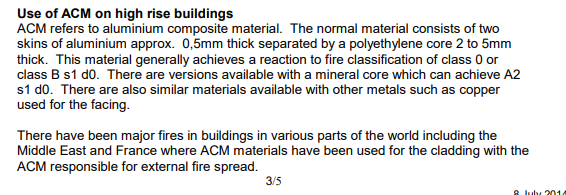
Not to mention further that in 1991, the government instructed that a huge a fire in a cladding pilot project it was funding in Knowsley should be "played down" and never published a report revealing the cladding panels were combustible.
insidehousing.co.uk/news/news/gove…
insidehousing.co.uk/news/news/gove…
Put all of this together and you can say that the government ::knew:: its trust in industry was 'misplaced'. It elected not to act.
What about building control? It's notable that many of the corporates have moved to blame building control. It's the easiest scapegoat - the organisation which was supposed to ensure compliance has admitted not doing so.
But once more, this does not sit easily with government. They were repeatedly warned over the years that building control were struggling. Take this response to a 2010 consultation for example:
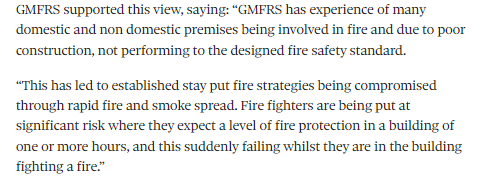
How did govt respond? With austerity cuts to local authorities which helped reduce the number of building control inspectors by 27.4% in the next decade, at the same time as increasing their workload by pursuing policies to increase house building
insidehousing.co.uk/news/news/hund…
insidehousing.co.uk/news/news/hund…
It was also an active decision in the 1980s to marketise building control by making local authorities compete with the private sector for work. It was warned at the time and since that this would reduce standards but never lifted a finger to change this position
You also have to ask: what standards were building control actually being asked to enforce?
The govt knew guidance could allow dangerous cladding products through. It knew combustible insulation was being used in untested systems.
The govt knew guidance could allow dangerous cladding products through. It knew combustible insulation was being used in untested systems.
You can't set the rules up like this and then blame the inspectors for not enforcing different ones. If it thought the statutory provisions should not have permitted combustible cladding systems, it should have said so. Anything less was tacit consent.
Really, yesterday's apology was a means to point the finger towards other parties and spin the government's role as an unknowing outsider rather than an active participant in causing the crisis. It needs to be understood in that light (ends)
• • •
Missing some Tweet in this thread? You can try to
force a refresh