

Few thoughts on this piece by Shepherd gaaru. Won't link. Those really keen can Google.
He tries to draw a wedge between Brahmins as a representative of civilization of the book and Shudras as a civilization of the spade.
+
He tries to draw a wedge between Brahmins as a representative of civilization of the book and Shudras as a civilization of the spade.
+
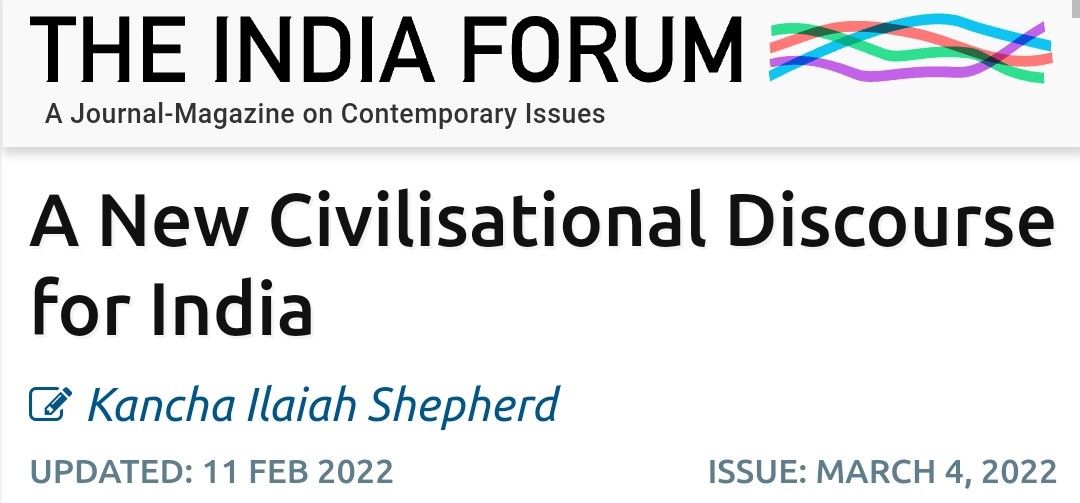
This is a very popular Marxist trope and there is so much irony there. Needs some elaboration.
"A book is not an instrument of civilisation building. On the other hand, the spade is an instrument with which civilisation is built" shepherd gaaru says.
+
"A book is not an instrument of civilisation building. On the other hand, the spade is an instrument with which civilisation is built" shepherd gaaru says.
+
So he says Outsider invader Aryan Brahminical Vedic civilization is a book civilization.
Pre-Vedic Harappan civilization is a spade civilization. Workers of the world, unite kind he imagines perhaps. Classless egalitarian utopia until evil wily Aryans came.
+
Pre-Vedic Harappan civilization is a spade civilization. Workers of the world, unite kind he imagines perhaps. Classless egalitarian utopia until evil wily Aryans came.
+
Firstly we weren't a book civilization. We were a civilization strongly anchored in oral literature and a strong focus on praxis. Practice.
And that Aryan outsider vs Indigenous spade civilization is a false dichotomy.
+
And that Aryan outsider vs Indigenous spade civilization is a false dichotomy.
+
So long as Hindus believe in Chronological obsession no one can save them out of this. Sooner Hindus realise this the better.
+
+
Also this thing of dissing the 'Book' is quite rich coming from Shepherd gaaru.
Saar gets along with those who celebrate someone as an icon of sorts for umm errrr being part of writing a "book" called Constitution?
+
Saar gets along with those who celebrate someone as an icon of sorts for umm errrr being part of writing a "book" called Constitution?
+
I have full respect for them all who were part of constitution writing. Don't get me wrong.
I believe in the power of intellectual labour. On the power of ideas. Good and bad.
Shepherd gaaru's stance is the one which is a bit ironic here.
+
I believe in the power of intellectual labour. On the power of ideas. Good and bad.
Shepherd gaaru's stance is the one which is a bit ironic here.
+
That too coming from an academic whose sole claim to fame is that he also wrote umm err some "books"?
Underestimating the task of building, nurturing knowledge commons by someone from "intellectual" class is very ironic.
+
Underestimating the task of building, nurturing knowledge commons by someone from "intellectual" class is very ironic.
+
He asks:
"If Brahmins who memorised the Vedas were human libraries, what about those people who kept the whole production and construction knowledge in their memories and passed it on to several generations? Were the minds of Shudras, Dalits, or Adivasis not human libraries"
+
"If Brahmins who memorised the Vedas were human libraries, what about those people who kept the whole production and construction knowledge in their memories and passed it on to several generations? Were the minds of Shudras, Dalits, or Adivasis not human libraries"
+
Now that is a fair question to ask. I support him there. The blame goes to this Indological/Colonial gaze which had a disdain for certain forms of knowledge.
"They" had a very Brahminical Sanskrit focussed understanding of Hinduism.
Not "us" Hindus.
+
"They" had a very Brahminical Sanskrit focussed understanding of Hinduism.
Not "us" Hindus.
+
Hindus acknowledge diversity in everything. We had so many pockets of various forms of knowledge across all forms of communities. Everyone had their sphere of influence and control.
+
+
E.P.Thompson wrote this in his book "The making of the English working class"
"Every weaving district had its weaver-poets, biologists, mathematicians, musicians, geologists, botanists"
+
"Every weaving district had its weaver-poets, biologists, mathematicians, musicians, geologists, botanists"
+
Hindu India was also like what E P Thomson wrote above about pre-Industrial Britain.
Infact so many societies across the world were that way. Can provide enough references if needed.
+
Infact so many societies across the world were that way. Can provide enough references if needed.
+
You know another person who had a disdain for such? Your friend Karl Marx. He called Hindoo spinners and weavers as those who lived in semi-barbarian, semi-civilized communities.
+
+
He said destroying the economic base of these societies has heralded the only and greatest social revolution in Asia (India) so it is a good thing even if there was collateral damage. Anyway barbaric uncivilized existence they had so it's okay. That was his feeling perhaps.
+
+
So you ask those people saar on why they destroyed the Sudra human libraries and why they celebrated the destruction.
Will give you full support.
+
Will give you full support.
+
Shepherd gaaru that also reminds me of D.R.Nagaraj on your earlier books
"The theme of victims of the ‘machine-vaad’ should be taken up as seriously as we take the communities suffering under ‘manu-vaad’, at all levels of theory and practice"
+
"The theme of victims of the ‘machine-vaad’ should be taken up as seriously as we take the communities suffering under ‘manu-vaad’, at all levels of theory and practice"
+
I don't think you have elaborated on this Shephered gaaru. Why don't you do that. Will give full publicity for your book on that topic.
So please stop this spade civilization vs book civilization nonsense
+
So please stop this spade civilization vs book civilization nonsense
+
Let's talk the real deal.
Who destroyed the Sudra human libraries and why?
Let's talk machine-vaad forget about manu-vaad for sometime. We will get there later.
D R Nagaraj is also sub-altern scholar vonly saar. He is also from spade civilization vonly.
+
Who destroyed the Sudra human libraries and why?
Let's talk machine-vaad forget about manu-vaad for sometime. We will get there later.
D R Nagaraj is also sub-altern scholar vonly saar. He is also from spade civilization vonly.
+
I know you won't do it.
Because rozi roti ka maamla hain. Also I understand criticising Marx, criticising Machine-vaad and hence Europe-America who are paymasters for most activists and academics is tough.
+
Because rozi roti ka maamla hain. Also I understand criticising Marx, criticising Machine-vaad and hence Europe-America who are paymasters for most activists and academics is tough.
+
No political mileage to be gotten either with such discourse either.
Ok saar. Thanks for triggering me with this Book vs Spade article.
/End
Ok saar. Thanks for triggering me with this Book vs Spade article.
/End
• • •
Missing some Tweet in this thread? You can try to
force a refresh



