Here are some thoughts / documents on the "broken promise" of NATO enlargement, which (I hope) will constructively contribute to our debate. First of all, I will not go into great detail about the Feb. 9, 1990 Gorby/Baker conversation and Baker's "not one inch" remark.
This is because the facts of the story are well-known. I would suggest reading @e_sarotte and @shifrinson in particular, who are detailed and brilliant, and of course the relevant documents are downloadable here: nsarchive.gwu.edu/briefing-book/…. Be sure also to read Mary's new book.
In a nutshell, it's clear that Baker's "promise" had to do with NATO's jurisdiction in East Germany as the GDR was absorbed by the West Germans. I am interested in what happened next.
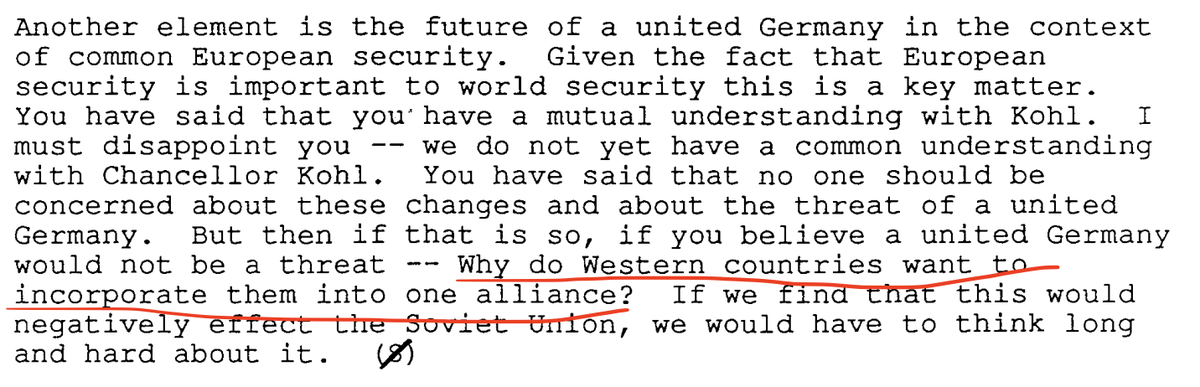
Why is this important? Because if Gorbachev struck a deal with Baker, you would expect him to act accordingly, i.e. to drop his opposition to united Germany joining NATO. This is not what actually happened. He continued to insist that united Germany should stay neutral.
Check out his comments at a meeting at CC CPSU on February 13, 1990. If he had just reached a deal with the US, you'd expect him to tell this to his party comrades. You'd expect him to say: oh yeah, they promised not to enlarge NATO beyond its current borders. He doesn't do it.
Instead, he talks about the importance of maintaining the "international equilibrium." This is a euphemism that refers to his opposition to united Germany's membership in NATO.
He continued to express opposition to united Germany's membership in NATO, e.g. in this conversation with George H.W. Bush, on February 28. Again, if a deal had been reached, you'd expected Gorby to say: we have a deal, and I drop my opposition. But thise was not even mentioned.
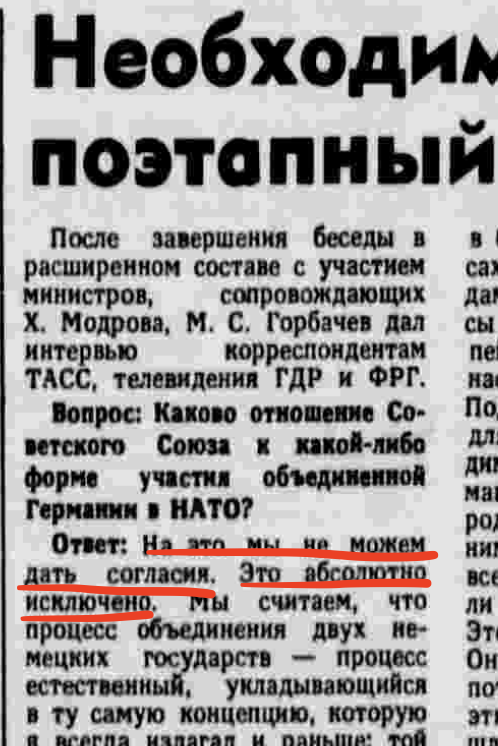
On March 7, 1990, Pravda published an interview with Gorbachev, which included the following question: "What is the Soviet Union's attitude towards any form of united Germany's participation in NATO?" To which Gorbachev said: "We cannot agree to it. This is completed ruled out."
Just to repeat: if Gorbachev *accepted* Baker's "not one inch" promise, he would *not* be insisting that united Germany must stay out of NATO - and yet he continued to insist.
Here's, for example, what he said in his speech to the Congress of People's Deputies on March 15, 1990. (United) Germany's membership is NATO, he said, is "unacceptable." Would he have said that if he had struck a deal re Germany's NATO membership with a non-enlargement pledge?
And on and on it goes. Historical facts show that while it is possible to argue that assurances were being offered re NATO's non-enlargement (into GDR or further East), it is *not* possible to argue that these assurances were a part of a deal with Moscow.
It is true that in the end Moscow agreed to allow united Germany's membership in NATO. The reason Gorbachev did it was not because he had been promised anything but because he had no choice. The GDR had collapsed, and Kohl was offering money for good behaviour.
Moreover, as Gorbachev's aide A. Chernyaev argued, Moscow's security situation was "defined by the nuclear balance between the USSR and the USA.” “Real security of the USSR,” he concluded, “did not depend on the amount of forces in the West and in the East, and their armaments.”
What are we to conclude from the above? When Putin says that assurances were made and the Soviets were duped, he is peddling a one-sided narrative. Have you noticed that Russian officials do not cite internal documentation on the question of NATO enlargement?
Even when they argue that promises were made, they do so by citing (mainly US) documents published by Tom Blanton and Svetlana Savranskaya at the National Security Archive: missiontonato.mid.ru/web/nato-en/na….
Looking at the Soviet side of the story reveals that Gorbachev was not a fool, nor was he naive. He attempted to prevent united Germany's membership in NATO, and he failed because he had a bad hand to play, and he played it badly. And, most importantly, there never was a deal.
• • •
Missing some Tweet in this thread? You can try to
force a refresh

A very interesting article. The debate will continue. I'd agree with @shifrinson that it's pretty clear that key Western players thought certain assurances had been offered - and, indeed, the records of Gorby/Baker talks in Feb. 1990 had long shown that much. That said...
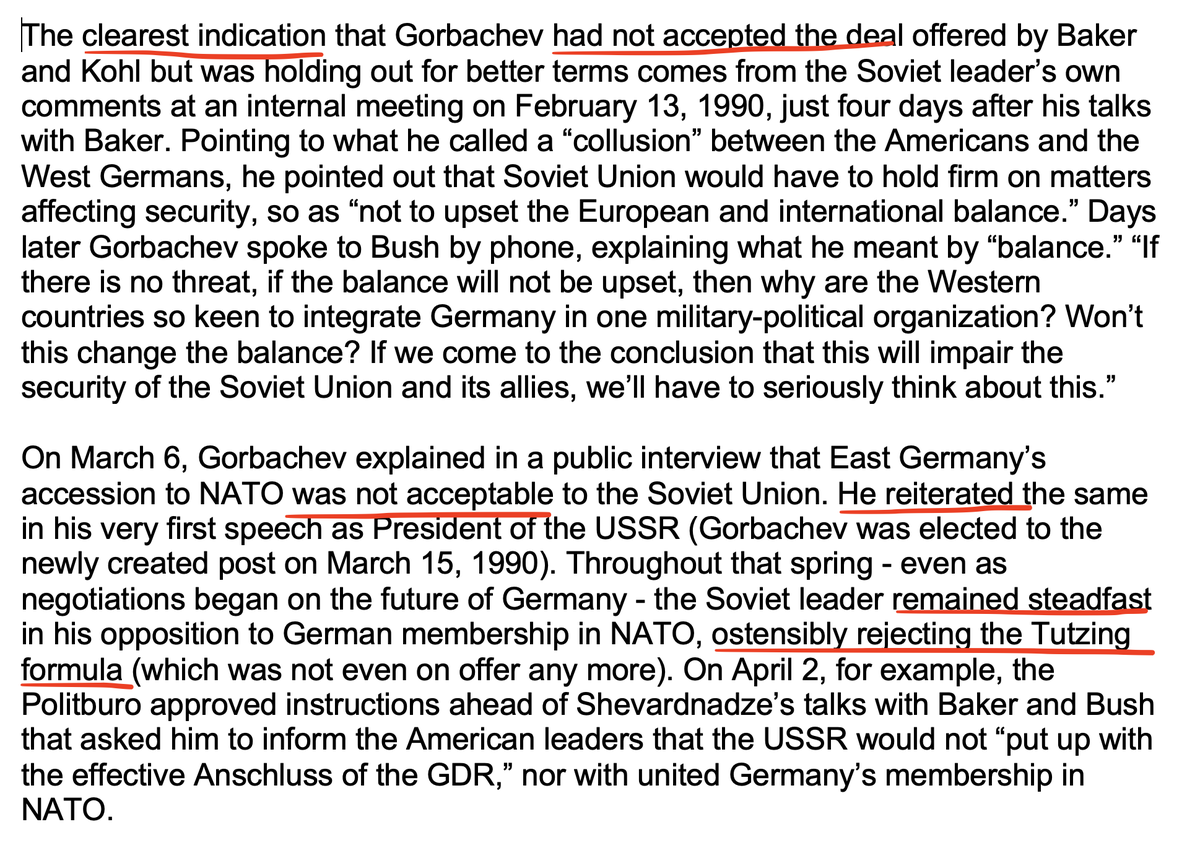
What strikes me is that Gorbachev never accepted these assurances, and continued to hold out for better terms well into the spring of 1990. I deal with this issue in my forthcoming book. Here's an excerpt.
So when Putin argues that "we were promised" that NATO would not enlarge, he is not entirely wrong. But he tells only one part of this story (the one that's useful to his narrative). The reality was much more complicated. I'd argue, there never was a deal.
The Sino-Russian joint statement, signed in Beijing, is an extremely interesting programmatic document. I am sure we'll soon have the English translation but here's the link to the Russian version: kremlin.ru/supplement/5770. Some observations. 👇🏿
1) This is a major effort to construct a globally-relevant ideological narrative to legitimise Beijing's and Moscow's bid to rework the international order. This is done by semantically challenging widely accepted terms like "international community" and "democracy."
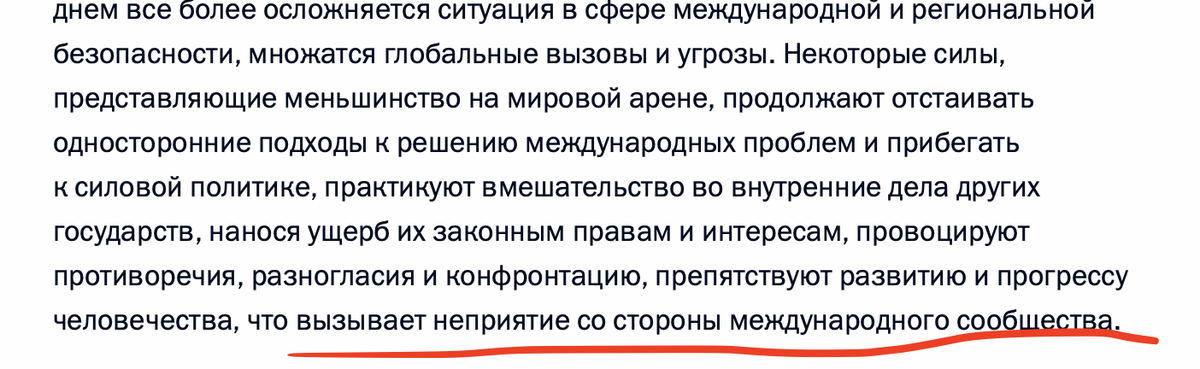
We see this in the preamble, where they talk about Western / US interference in other countries' internal affairs, which is "rejected by the international community."
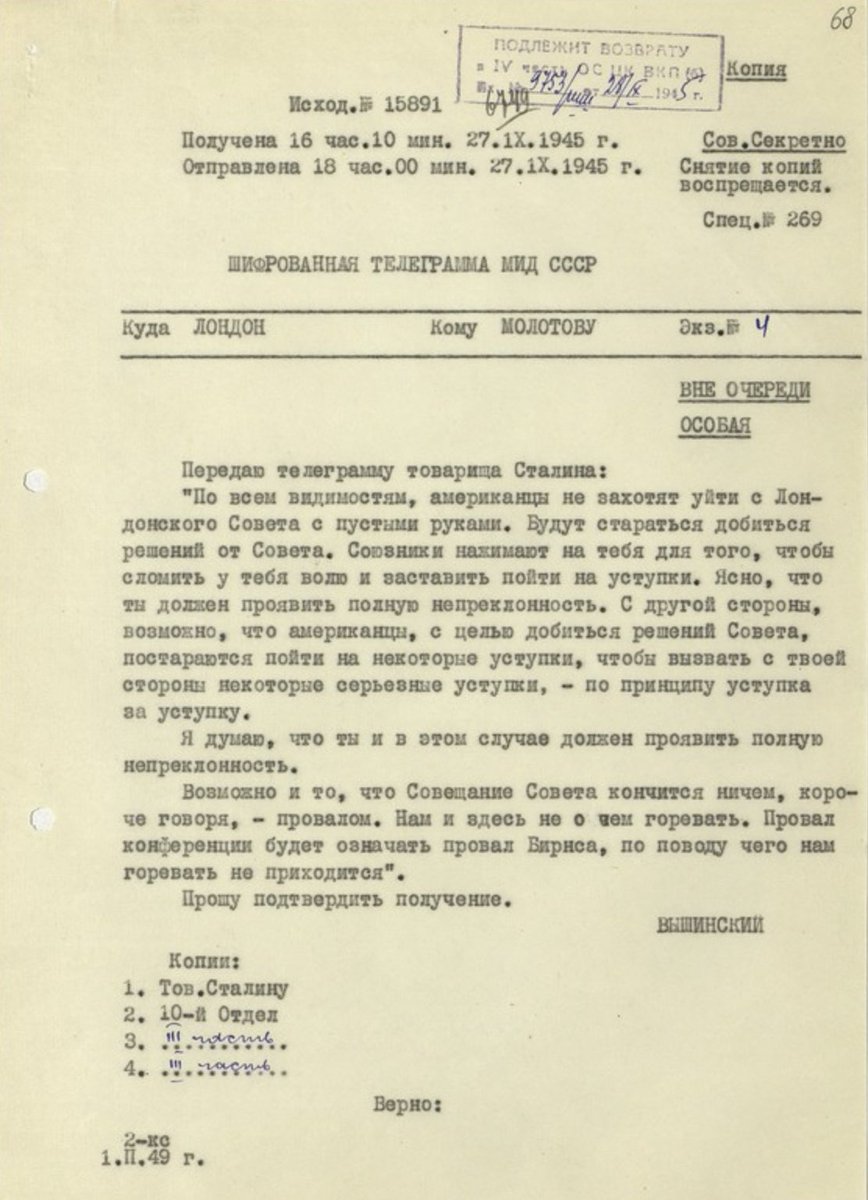
If you asked, what is the most important document from the early Cold War that helps understand Soviet approach to the West, I would say it's this telegram from Stalin to Molotov, dated September 27, 1945.
This was where he famously coached Molotov (who was then at the London Conference of Foreign Ministers): "The Allies are pressing on you to break your will and force you to make concessions. It is clear that you must display complete obduracy."
The reason for Stalin's obduracy was that he realised that he held a bad hand of cards. The US possessed atomic monopoly. The USSR was in ruins and could not possibly support another war. So he bluffed by refusing to yield - on virtually anything. It was a psychological game.
While I am tempted to agree with @McFaul on emotional grounds, I would take an exception on academic grounds, for two reasons. First, Western colonial enterprise in Africa and Asia was based on economic exploitation underpinned by a racist ideology.
Russia, as a colonial power, partook of this enterprise insofar as it was directed towards non-European peoples (Central Asia, Caucasus). Ukraine does not fit this pattern. The pattern of domination is much more in line with, say, English-Irish or English-Welsh relations.
If you don't agree, you might ask yourself if you know of any cases where, say, an ethnic Vietnamese would hold a position of power in Paris, or an Angolan in Lisbon. Also, compare economic relationship between Ukraine and Russia in the Soviet context with, say, Italy-Somalia.
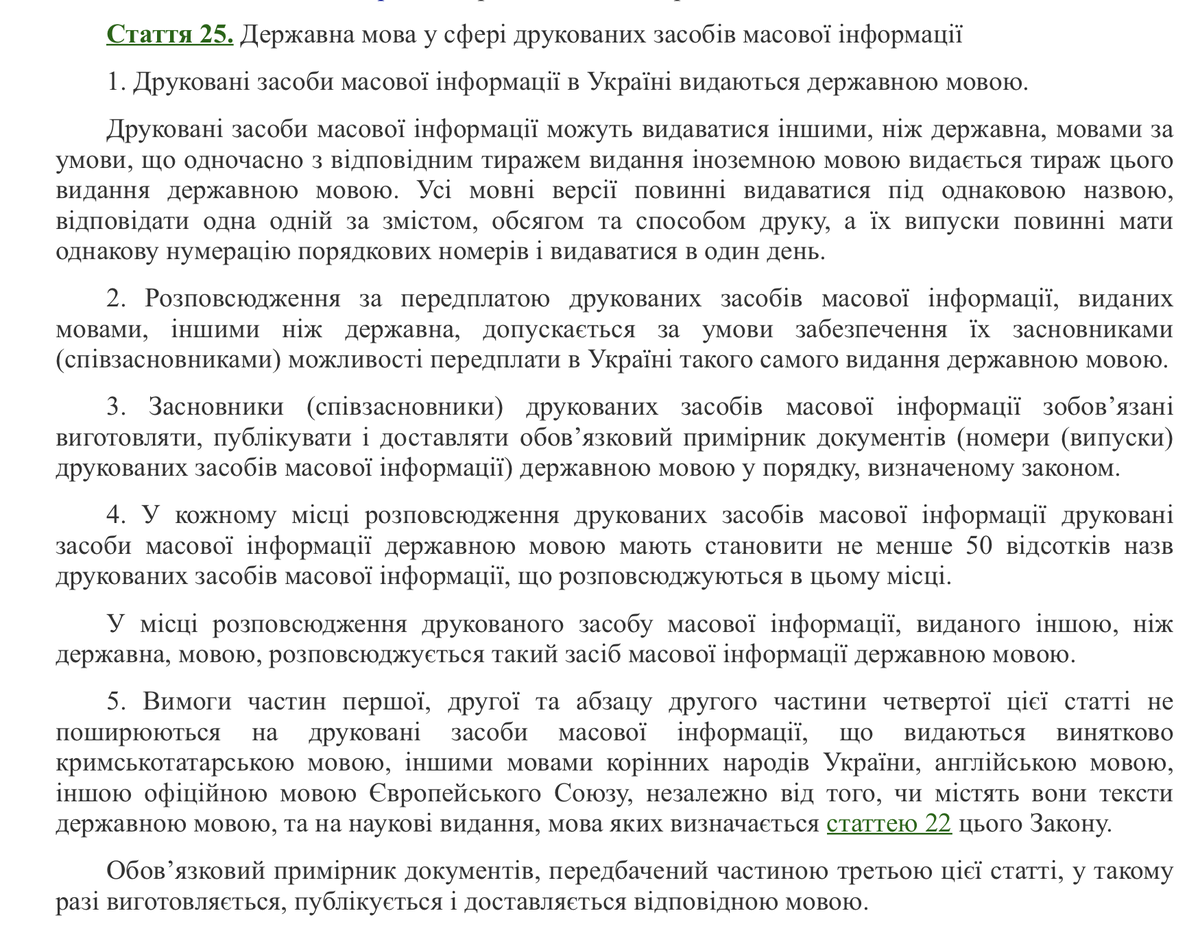
An interesting development in Ukraine today that will go under the radar for most country watchers but which is badly-timed from the point of few of diffusing Russian-Ukrainian tensions: provisions of Art. 25 of the Ukrainian Language Law go into effect.
These require that the minority language print media furnish Ukrainian versions of their publications. Here's the relevant provision. This does not apply to publications in English and "EU languages" and mainly affects Russian publications.
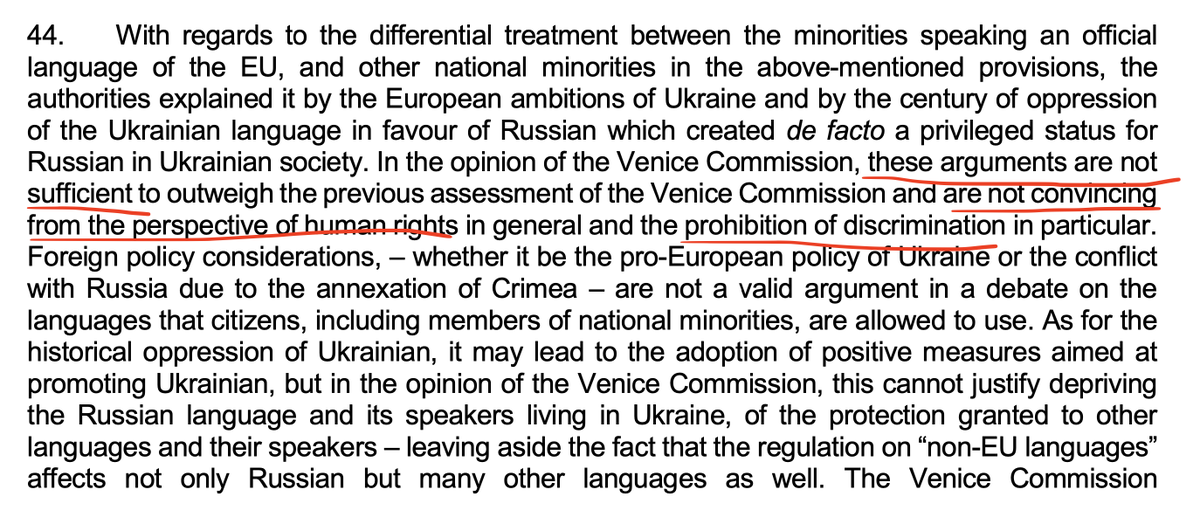
I re-read the Venice Commission verdict on this law, which is (predictably) highly critical of provisions that discriminate against Russian, including Art. 25.
A mistaken view imho. Rhetoric in CEE, including in the Baltics, was very much that Russia's weakness represented a unique opportunity to escape Moscow's grip. The (not unreasonable) fear in the early-mid 1990s was that Russia would eventually succumb to its imperial fantasies.
After Zhirinovskii showed stunning results in the 1993 Duma elections, Lech Walesa memorably told Clinton that "every second Russian thought like Zhirinovskii." There followed a prolonged, brutal war in Chechnya that cast further shadow on Moscow's post-imperial credentials.
Walesa basically represented the mood across the region. And when I read this today - as someone who despised Zhirinovskii back then - I know that Walesa exaggerated. But the burden was on *us* to prove him wrong. And did we? What imperial fantasies do we still nurture?