Thread: Dan Campbell was one of the workers who operated Nanticoke, North America's largest coal facility. He wasn't sure what to think about climate change & whether his workplace was contributing to childhood asthma or shortening the lives of Ontarians from air pollution 1/
He had worked hard to become very good at his job, enjoyed the challenge of his work and took pride in keeping the lights on across the province. 2/
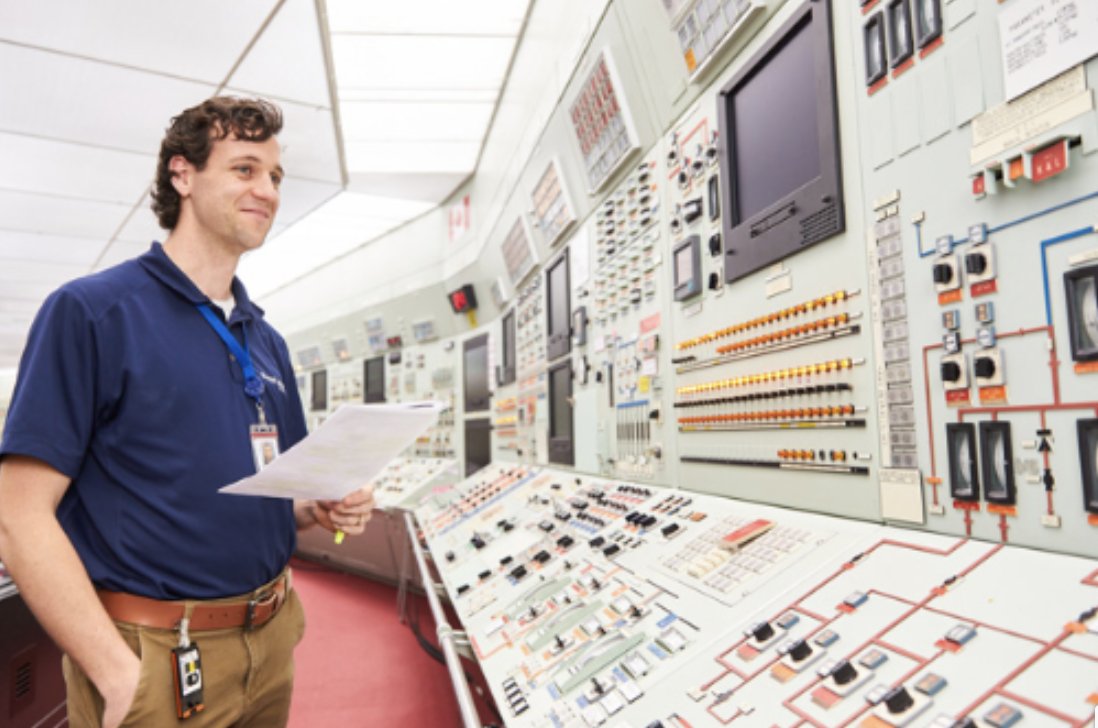
Luckily when the Ontario government decided to shut down the #coal fleet, Dan, a highly skilled worker, had the opportunity to find work of similar caliber and pay operating a #nuclear reactor @Bruce_Power . 3/
He is proud to have contributed to eliminating smog days in Ontario and to have participated in North America's greatest greenhouse gas reduction as well as producing life saving #medicalisotopes. 4/
Nuclear energy, because of its made in Canada supply chain, concentration of high skilled #union labour and long term integration with the economies of thriving local communities offered Dan a #justtransition. 5/
#CANDU#nuclear’s 96% made in Canada supply chain from the uranium mines, fuel fabrication, heavy industry, operations and maintenance to spent fuel handling offers a vast array of high skills job opportunities to Canadian workers. 6/
This Canadian supply chain coupled with the high wages available in the sector leads to an unparalleled economic multiplier effect meaning that every dollar invested in #CANDU#nuclear generates $1.40 in GDP. 7/
If our government can set a cohesive evidence based industrial policy building off of CANDU and the Ontario coal phaseout we can have a credible #justtransition for Canadian fossil fuel workers which will drive decisive climate action with prosperity across the whole country. 8/
Ras Laffan and the Arctic Metagaz: How two drones changed the calculus of global LNG dependence
A Mega 🧵based on my @DecoupleMedia conversation with @SStapczynski
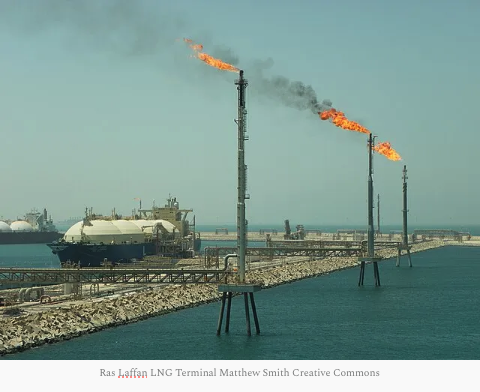
Qatar is roughly the size of Connecticut, a narrow peninsula jutting into the Persian Gulf on the wrong side of the Strait of Hormuz. For decades, this geography was considered a manageable risk, because Qatar had cultivated a reputation for perfect reliability.
When Japan shut down its reactor fleet after Fukushima in 2011 and scrambled to replace the lost generation with gas, Qatar delivered. When spot and short-term suppliers, including an Italian energy major and at least one trading house, voided their flexible contracts with Pakistan during the 2022 price spike and rerouted those cargoes to European buyers willing to pay more, Qatar delivered those too.
Then a $50,000 Iranian drone struck Ras Laffan.
The attack came in the broader wave of Iranian retaliation for the US-Israeli bombing campaign against Iranian nuclear and military infrastructure. Qatar, which had maintained som
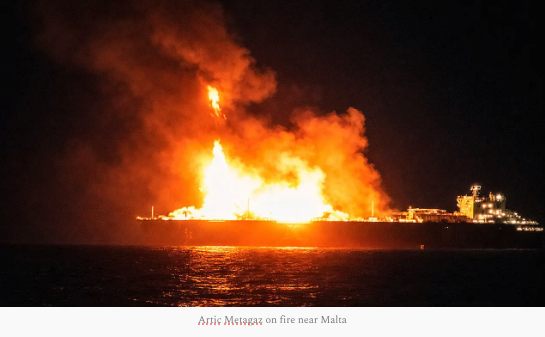
Artic Metagaz on fire near Malte of the warmest relations with Iran of any Gulf state and had served as broker for the first Israel-Hamas ceasefire, was hit anyway.
The strike forced an evacuation of the facility and the first force majeure declaration in Ras Laffan’s history. The complex produces 77 million tonnes per year (Mt/y), roughly 19 percent of the 411 Mt traded globally in 2024. The North Field East expansion, the first of three planned phases that would nearly double Qatari capacity to 142 Mt/y by 2030, was approaching its first commissioning when the drone hit.
That same week, in the Mediterranean, a Ukranian drone boat struck the Arctic Metagaz, a Russian LNG carrier transiting toward the Suez Canal. The ship was not difficult to find. It was on a known route, visible on commercial vessel-tracking platforms, its name painted on the hull.
LNG tankers had already been rerouting around the Cape of Good Hope since the Houthi attacks made the Red Sea dangerous in late 2023, absorbing the extra transit time and cost rather than risk the strait. But no LNG carrier had been successfully struck. The Arctic Metagaz was the first. For Russia, losing one vessel from a fleet of sixteen shadow tankers is not a rounding error.
The two attacks came within days of each other, from different actors hitting different kinds of targets with different customers, but they broke the same assumption. The cascade that followed is not limited to European gas futures. It includes fertilizer plants in Pakistan going dark, rice farmers in Thailand who cannot get diesel, and nine days of reserve supply sitting in South Korean LNG storage tanks.
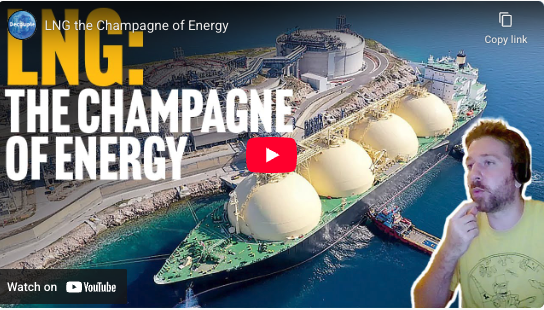
The Champagne of Fuels
To understand why the disruption hit so asymmetrically, it helps to understand what LNG actually is and why its supply chain concentrates risk the way it does. Natural gas, cooled to roughly minus 162 degrees Celsius, compresses to about one six-hundredth of its original volume, dense enough to ship economically across oceans.
That compression is the whole business: the liquefaction trains at Ras Laffan are the refrigerators, enormous industrial machines that chill gas into liquid and run continuously, taking weeks to months to restart after a cold shutdown; purpose-built cryogenic tankers are the thermoses, keeping cargo at minus 162 degrees Celsius across thousands of miles of open ocean; and the regasification terminals in Japan, South Korea, and Pakistan are the toasters that warm it back into pipeline-ready gas.
In a previous episode with Stephen we called LNG the champagne of fuels, and the analogy holds: it is expensive to produce, requires extraordinary handling at every stage, and arrives at the table only because an elaborate and costly infrastructure exists to get it there without incident.
Nuclear Fuel Is The Swiss Watch of Energy and The Most Sophisticated Industrial Product You've Never Heard About.
Buckle up for a mega-🧵
There is a peculiarity at the heart of nuclear energy that rarely gets the attention it deserves. Every other thermal power plant in history destroys its fuel.
Coal goes in as a black rock and comes out as CO2, water vapor, and ash. Natural gas barely leaves a trace at all, just heat and gaseous combustion products dispersed into the atmosphere.
The fuel is gone, irreversibly transformed, its chemical identity obliterated in the furnace.
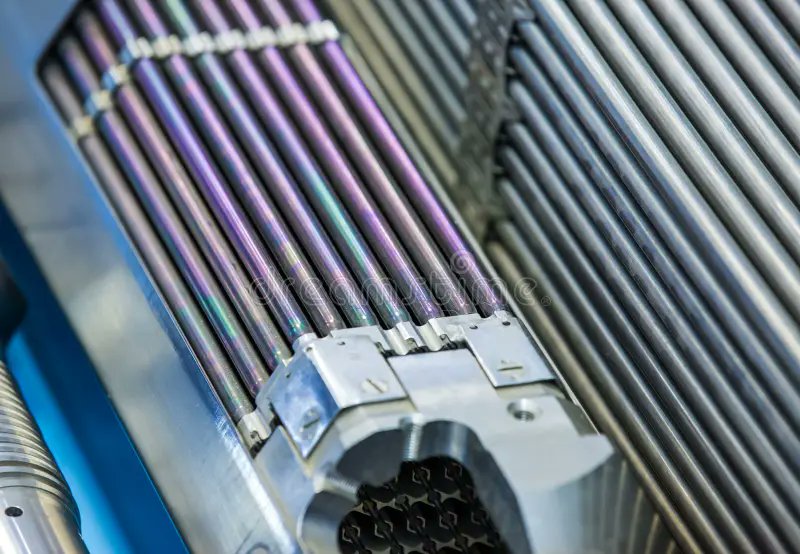
Nuclear fuel does almost none of that. The fuel elements that go into a reactor and the fuel elements that come out are, to a first approximation, the same material in the same geometry, sitting in the same place.
A spent fuel assembly pulled from a reactor after six years of operation looks nearly identical to the fresh one that went in.
The mass has changed by a tiny fraction of a percent, nuclear alchemy has occurred in which half the periodic table has been generated in the form of fission products within the ceramic pellets but the volume and geometry is essentially identical.
This one fact, that nuclear fuel must be preserved rather than destroyed, that the job of every layer of every system surrounding the core is to maintain the integrity of a material through years of radiation bombardment and extreme temperature gradients, shapes much of nuclear engineering.
It explains the cladding materials, the obsessive quality control in fabrication facilities, and the decades of slow, painstaking improvement that have transformed a fleet that routinely operated with failed fuel elements into one where a single leaker triggers a formal investigation.
I spent a long conversation with Michael Seely, the @AtomicBlenderYT, a nuclear enginner with a focus on fuel, going through what nuclear fuel actually is, how it is made, why it fails, and how the industry learned to prevent those failures.
What follows is my attempt to synthesize that conversation into something useful for anyone who wants to understand nuclear from the inside out.
What the Fuel Actually Is
The commercial nuclear fuel cycle, in its conventional form, converges on a single material: uranium dioxide, or UO2.
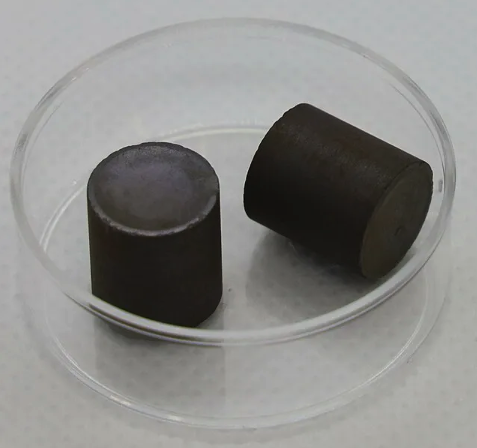
Regardless of reactor type, whether you are talking about a pressurized water reactor in France, a boiling water reactor in Japan, or a CANDU in Ontario, the fuel pellet sitting at the centre of the fuel rod is almost certainly a dense ceramic cylinder of uranium dioxide roughly the size of a fingertip.
UO2 ended up in this position for reasons that are easier to appreciate once you understand what you are asking a fuel material to do.
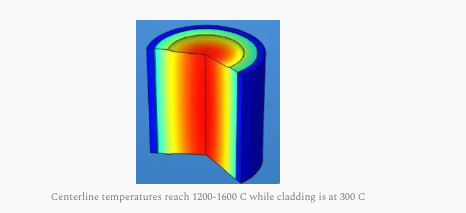
You need something that can withstand centerline temperatures of 1,200-1,600 degrees Celsius under normal operating conditions, while the coolant immediately outside the cladding sits at around 300 degrees, a gradient of nearly a thousand degrees across a pellet roughly a centimetre in diameter.
You need something that will not chemically react with zirconium cladding or the pressurized water flowing over it.
You need something that will trap the fission products, the gases and solids generated as uranium atoms split, inside its crystalline matrix rather than releasing them into the coolant.
And you need something that can be manufactured reliably, in quantity, at a cost that keeps nuclear electricity commercially competitive. In fact the key differentiator between nuclear and fossil power generation is that despite its complexity nuclear fuel remains a relatively very small contributor to operating expenses.
Uranium dioxide satisfies all of these requirements tolerably well, which is distinct from satisfying any of them perfectly.
It is a ceramic, which means it has an extremely high melting point, around 2,800 degrees Celsius, providing enormous safety margin even under severe accident conditions.
Its crystalline grain structure traps fission products reasonably effectively: the krypton, xenon, and iodine gasses generated by fission mostly stay embedded in the UO2 matrix rather than migrating into the gap between pellet and cladding.
And the manufacturing process, while technically demanding, has been refined over seven decades into something industrial routine.
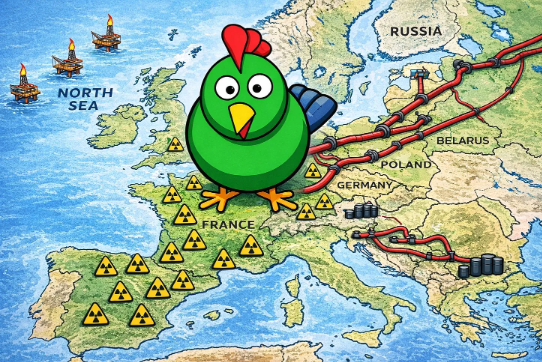
1/ Energy, industry, and sovereignty are inseparable. If Europe wants to be a truly independent pole in an emerging multipolar world, it must reindustrialize—not deindustrialize. That starts with reversing nuclear phaseouts. 🧵
2/ Germany, the industrial powerhouse of the EU, built its economic might on two things:
⚡ Cheap nuclear power
🔥 Cheap Russian gas
Now that Russian gas is gone, nuclear must return.
3/ Instead of securing its own energy future, Germany is swapping one dependency for another—replacing Russian gas with expensive American LNG.
Why is China electrifying its economy at such dizzying speeds?
3 words
Straits of Malacca.
While the US leans into its hydrocarbon advantage, China is decoupling from severe oil dependence & geographical vulnerability. a 🧵based on @DecoupleMedia w @pretentiouswhat
When Western climate analysts look toward China, in some sense they see the future, where fantasies of large-scale renewables deployment and EV adoption are playing out.
But far more than climate considerations, the geopolitics of oil dependence are shaping China's energy future. With 80% of its oil imports flowing through the narrow Strait of Malacca, China faces an existential vulnerability.
This maritime chokepoint, flanked by Indonesia and Malaysia, could easily be blockaded in a conflict. The ring of U.S.-aligned nations and military bases encircling China's eastern seaboard only heightens these anxieties.
Major crude oil trade flows in the South China Sea (2011), illustrating the importance of the Strait of Malacca and the vulnerability it creates. Source: US Energy Information Agency.
Tritiated water behaves just like H2O and is excreted from the body quickly with a biological half life of 3.5 days. For this reason it doesn’t bioaccumulate up the food chain and diffuses and dilutes rapidly in lakes and oceans.
It may come as a shock to some journalists but the natural world, including our lakes and oceans, are naturally radioactive thanks to cosmic rays and the decay of naturally occurring radionuclides like Potassium 40.
Its all doom and gloom for Nuclear in @BentFlyvbjerg's new book "How Big Things Get Done"
But did he miss some nuance when conflating the Korean/UAE collaboration which will have delivered four 1400MW reactors in 12 yrs with the unfolding fiasco of Vogtle 1/
In the book @BentFlyvbjerg and @dgardner contrast the Guggenheim museum and the Sydney Opera house to draw important lessons from two very cutting edge buildings. 2/
The Guggenheim is the product of meticulous iterative planning by a mature dreamteam of architects & engineers who routinely pull off complex projects on budget/on time, the Opera House a couple of sketches by an inexperienced architect which balooned into a budgetary fiasco 3/