#Russian forces continued efforts to advance on #Slovyansk from the southeast of #Izyum and made marginal territorial gains north of Slovyansk on June 9.
#Russian forces continued to fight for the #Azot industrial zone in #Severodonetsk under the cover of heavy artillery fire.
#Russian forces are likely engaged in limited fighting along occupied frontiers in northern #Kharkiv Oblast.
#Russian forces continue to focus on strengthening defensive lines along the Southern Axis and are intensifying ground attacks in northeastern #Zaporizhia Oblast with the support of troop and equipment rotations.
• • •
Missing some Tweet in this thread? You can try to
force a refresh

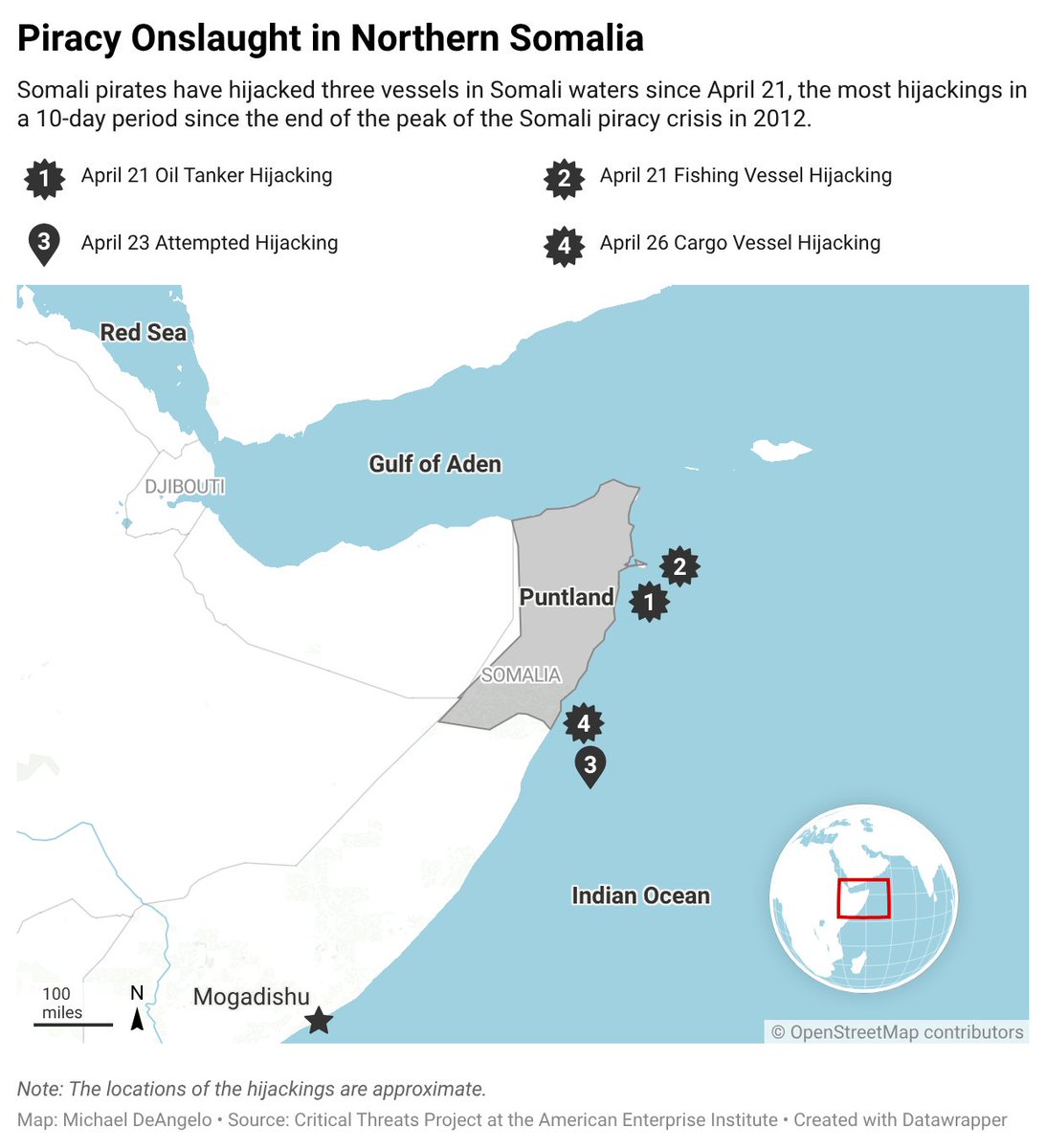
NEW | Somali pirates have conducted the most hijackings in Somali waters in a 10-day period since the end of the peak of the Somali piracy crisis in 2012.
Sustained piracy off the Somali coast would degrade security in another vital global shipping lane amid the fallout from the Iran war and create opportunities for al Shabaab to benefit financially and further its ties with the Houthis. 🧵⬇️
Somali pirates have attacked one vessel and hijacked three others since April 21, including two international commercial ships.
A US-led multinational maritime force and the EU’s maritime force in the Indian Ocean have upgraded the threat level for the Somali coast, recommending that vessels exercise increased vigilance. 2/5
Sustained piracy off the Somali coast would degrade security in another vital global shipping lane amid costly global supply disruptions from the Iran war.
Up to 30 percent of global container traffic uses the Red Sea route, but Somali piracy and Houthi strikes on commercial ships have caused increased insurance costs and reliance on less efficient, and therefore more expensive, alternate routes in the past. 3/5
NEW | The United States is increasingly involved in direct competition with Russia in Africa as the United States seeks to cultivate influence with Russian-aligned, authoritarian regimes in Africa as part of its transactional approach to the continent.
These African states have shown openness to US engagement as part of efforts to diversify their partnerships but are ultimately seeking to balance ties among several countries. ⬇️🧵
US President Donald Trump’s approach is a departure from that of former US President Joe Biden’s administration, which oscillated between pragmatic engagement and more confrontational approaches with non-US-aligned authoritarian or coup governments.
Russia and the United States are also competing with increasingly prominent “middle power” actors, such as Turkey and the United Arab Emirates (UAE), as these African countries look to diversify their partnerships and balance several external partners. 2/6
In West Africa: The Alliance of Sahel States (AES) countries have continued increasing defense and other cooperation with Russia so far in 2026.
The AES countries have also been gradually diversifying ties with other actors, however, including the United States, as the United States looks to reenter the Sahel. The United States is primarily pursuing security-related interests, in addition to exploring opportunities for cooperation on critical minerals and other economic areas.
Turkey has also strengthened economic and defense partnerships with the AES countries, particularly Niger.
These same external partners are battling for influence in Togo, which is also seeking to diversify yet balance its external partnerships, and other coastal West African countries. 3/6
NEW: The Iranian political officials who will reportedly negotiate with the United States in Islamabad, Pakistan, on April 21 neither have the authority to independently determine Iran’s negotiating positions nor are driving decision-making in Tehran.
US Special Envoy to the Middle East Steve Witkoff and Jared Kushner will attend the talks. Iran’s negotiating delegation is expected to include Foreign Minister Abbas Araghchi and Parliament Speaker Mohammad Bagher Ghalibaf.
The upcoming talks appear focused on extending the ceasefire, which is set to expire on April 22. Iranian sources familiar with the negotiations stated that Iran expects that the ceasefire will be extended and that additional talks will occur if the negotiations on April 21 go well.
NEW: The IRGC appears to be controlling Iranian decision-making instead of Iranian political officials who are engaging with the United States in negotiations, particularly Foreign Affairs Minister Abbas Araghchi. (1/7)
Araghchi previously announced on April 17 that the strait was “completely open” to commercial traffic. The IRGC, however, harshly criticized Araghchi’s statement and outlined specific conditions for vessels to transit the strait that amount to Iran retaining control over maritime traffic through the strait. (2/7)
The Khatam ol Anbia Central Headquarters, which is functionally controlled by the IRGC, announced that Iranian forces have reinstated strict management and “control” over the Strait of Hormuz. The headquarters cited the US naval blockade on Iranian ports as the reason for the reimposition of Iranian "control" over the strait. IRGC-affiliated Fars News previously warned on April 17 that Iran would “close” the strait if the United States continued its blockade. (3/7)
NEW | Turkey has recently advanced economic and security ties with Niger and Somalia, viewing both countries as its African anchor states through which it can further its strategic interests in Africa.
These partnerships aim to address several domestic concerns, such as patronage and energy security, and bolster Turkey’s international standing vis-à-vis global competitors.🧵⬇️
Turkey and Somalia have continued advancing maritime resource agreements in March 2026 that the two partners have signed in recent years.
The two countries signed a deal enabling a joint Somali-Turkish company that a Turkish military-linked entity manages to regulate fishing in Somali waters, after having established the joint company in December 2025.
Turkey is also bolstering its long-term military presence in Somalia through the deployment of advanced weaponry, such as F-16s, and exploration of new aerospace and naval bases. 2/5
Turkey has taken advantage of efforts to recognize Somaliland to further its close relationship with the FGS at the expense of the United Arab Emirates (UAE) since 2024, brokering deals to secure economic and military influence in Somali waters and support greater Ethiopian sea access via Turkish-linked ports in Somalia.
These moves reinforce Somalia as Turkey’s anchor state in the Horn of Africa as Turkey competes for favorable positioning in the Indian Ocean and near the Red Sea and access to regional economic markets. 3/5
NEW | US Central Command (CENTCOM) announced that no vessels have breached the US blockade on Iranian ports since CENTCOM implemented its blockade on April 13. The US blockade on Iranian ports does not have a defined geographic boundary and the United States can interdict vessels almost anywhere in international waters until they arrive at their final port. It is unclear whether any of the vessels that left Iranian ports on April 14 were authorized to do so under CENTCOM’s “limited grade period.” (1/6)
The United States’ decision not to renew a 30-day sanctions waiver for Iranian oil exports, which is set to expire on April 19, will further constrain Iran’s ability to export oil in addition to the US blockade on Iranian ports. Two US officials told Reuters on April 14 that the US Treasury Department will enforce sanctions on Iranian oil after April 19. (2/6)
Iran is reportedly considering temporarily pausing shipments to avoid testing the US blockade on Iranian ports and raising tensions ahead of possible talks, according to a person familiar with Iranian decision-making on the Strait of Hormuz speaking to Bloomberg on April 14. Iran would only be able to pause shipments for a limited period of time before it would start to run out of room to store oil. Iran could also pursue several other courses of action in response to the US blockade, including agreeing to a deal acceptable to the United States, attempting to run the blockade, or resuming the war. (3/6)