
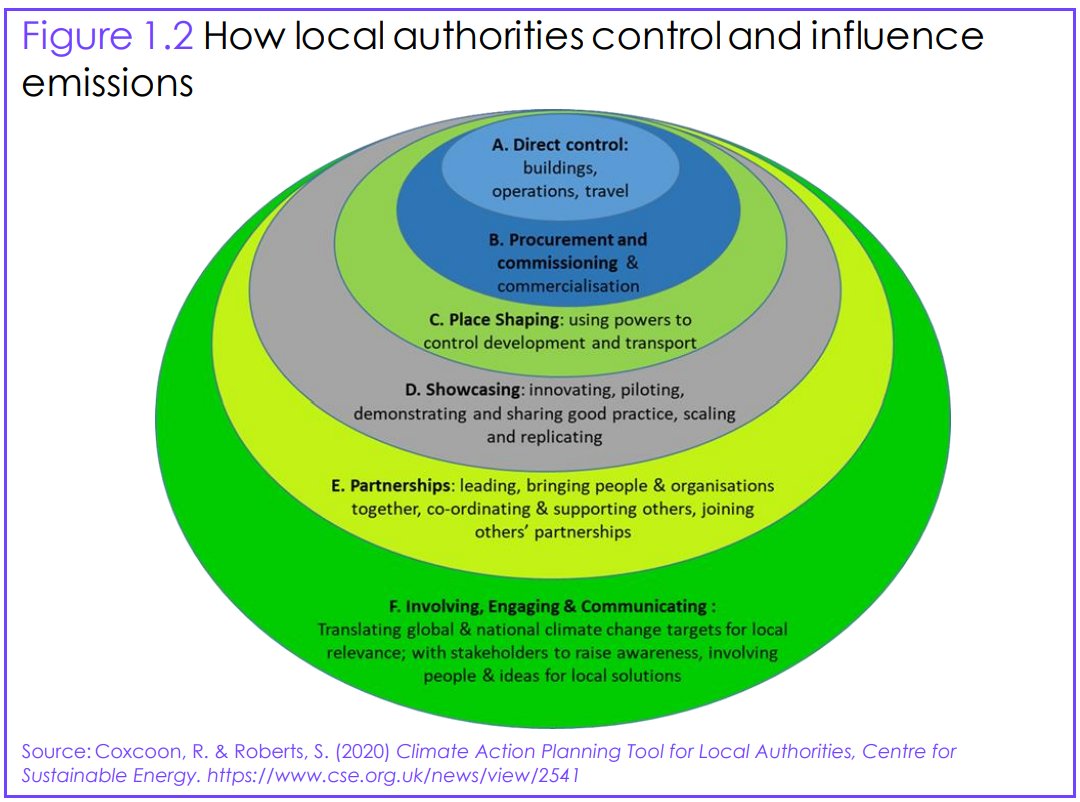
Since late 2020, I regularly have my own work presented to me as someone else's, as the 'Onion Diagram' on pg 5 of @theCCCuk 's local authority guide is a minimally amended version of a bigger tool I developed while at the Centre for Sustainable Energy. A🧵
The original comes from work we did to support Local Authorities responding to the #ClimateEmergency. But the original tool also contains an approach to actionplanning that uses these 'levers of influence' in the onion diagram, linking the levers the changes that we need to make.
We alerted @theCCCuk to the mis-attribution in the report on the day their report was published (the non existent Centre for Sustainability is named). But they responded that they had a policy of not changing anything in reports after publication.
While I'm happy that the work is out there, this bothers me for 2 reasons. Firstly, neither me or my colleague Simon Roberts, with whom I worked on this, are credited. This means I have had people accuse me of plagiarising the CCCs work when using the original.
Second, correct attribution would lead people to the full tool that we had originally come up with, which contains other helpful things that Councils might choose to use. It's not perfect, but it's useful. You can find it here: cse.org.uk/news/view/2541
Fundamentally, I just think it's wrong not to credit people with the work they have done. In academia, this would be a cardinal sin and a correction would have been issued to show the work being 'Coxcoon & Roberts, Centre for Sustainable Energy, 2020', or something similar.
I still use this tool in the work I do now with local authorities. Video here for any council officer/councillor who is looking for some inspiration on how to structure a holistic #ClimateEmergency action plan:
End of Moan.
UPDATE 16/2/23
Well that was sorted quickly! Wish I had moaned more about it in 2020! Thank you @ChiefExecCCC
for the call this morning and for getting this sorted in the midst of other far more important tasks!
• • •
Missing some Tweet in this thread? You can try to
force a refresh

A great science-based thread below for anyone who wonders why giving people more information, or creating a slight barrier to their travel behaviour doesn't actually make them change anything.
About 15 years ago, my husband and I moved to Bristol from the countryside. Not the 'burbs. Proper 'walkable-to-the-city-centre-in-about-20-minutes' Bristol.
We worked out how to get to our respective workplaces, and I dropped him-indoors off on the way to mine and picked him up, every day. A habit we imported from our rural 'why-the-fuck-are-there-no-buses' and 'hell-no-that-is-not-a-road-I-am-willing-to-cycle-on' lifestyle.
…and I’m not just talking about the mega-wealthy, I mean even just the moderately rich. But many councils are fearful of being seen to actively help the rich, so they conflate their #climateemergency work with work they are (often already) doing on tackling #FuelPoverty.
Don’t get me wrong, I’m not saying for one minute that councils should abandon efforts to tackle #FuelPoverty. That’s a social ill that should have been dealt with long ago and is a legacy of the UK’s largely crappy housing stock.
I’ve spent a lot of time thinking, talking about & worrying about the #PlanningWhitePaper & proposed #PlanningReforms over the last 6 weeks. I’ve seen lots of criticism that I agree with about loss of democratic control, but less about potential impacts on the #ClimateEmergency.
The White Paper presents an alarmingly reductionist view of the role of planning, focusing mainly on the delivery and appearance of houses as individual units, and the appeal of an attractive street-scene, rather than holistically #sustainable design and function of entire places
In a societal sense, this is worrying. How places function must be at the heart of planning, before any consideration of the aesthetics of individual buildings. But from a #ClimateEmergency point of view, this reductionist view is potentially catastrophic.
Recently, I was asked to give a seminar for @mhclg’s planners on the challenges faced by local authority planners delivering against the #climateemergency, because I work with lots of councils & I’m also Cabinet Member for Forward Planning at @CotswoldDC. So I know some stuff.
First up, I did the ‘we’re all doomed’ bit. You know, the rollercoaster graphs steeply going up and the even steeper graphs of how emissions need to come down.
Then I mentioned about how most plans are running for about another 10-15 years and they need re-writing immediately because most of them pay diddly-squat attention to the ‘what goes up must come down graphs’ from the ‘we’re all doomed’ bit.



