Raindrop shader. Three layers, two dynamic, one static. Packed tiling textures with normals and opacity mask. More detailed breakdown on the way, look for replies to this thread! #UE4#gamedev#indiedev
Streaks on top, a tiling tex, distortion is animated so you can see the influence of the distortion tex on the left. Drops on the bottom, I use a very small but uncompressed tex that holds different UV values per pixel, this is used to distribute another tex around. #UE4#gamedev
If you're fine with some quality loss you can strip out the blue channel of the normal and pack in another grayscale texture instead. Make sure compression is default and multiply the normal by 2 and subtract 1 to move it back to the right range. #UE4#gamedev
A lot of you have been asking so here's more info on impacts. Many ways of going about it but this is what I went with. I simplified this for clarity, I'm also distorting these textures to get a more natural result, nodes in the reply. #ue4#screenshotsaturday#gamedev#indiedev
Been a while since I promised a breakdown for this shot (no sims, all done with vertex offset). I finally got around to it, I'll be updating this thread shortly! #screenshotsaturday#gamedev#UE4
We'll need our mesh to have positions of it's individual fragments saved somehow. I do this by baking pivot data into UVs. I bake XY pos to UV1 and Z to UV2. This data is easily accessible in the shader, see below.
We've now essentially created a new coordinate expression, what I would call "fragment position", we can use this to pass unique values to separate fragments instead of distorting the vertices of the entire mesh as a whole.
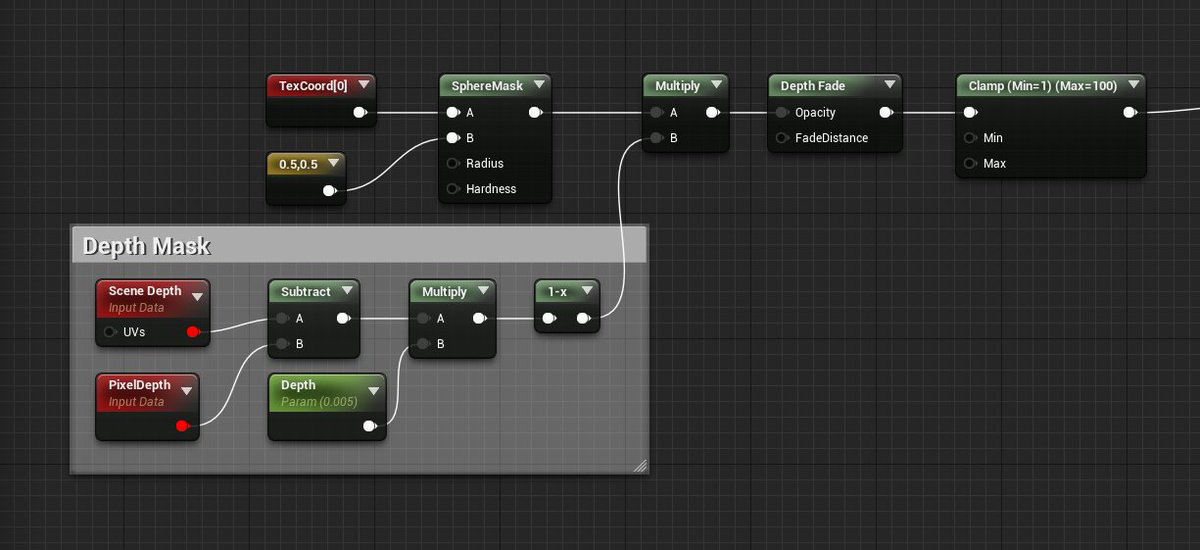
Dynamic lights are expensive, using sprites with a modulate blend material you can multiply screen colors behind the sprite and use depth masking to fake a light radius, cheap and can work surprisingly well. #screenshotsaturday#UE4#gamedev#indiedev
Using modulate blending, make sure you clamp the result in a range above 1 for this to work right. Modulate blending without depth testing is also great for various glow effects. #screenshotsaturday#UE4#gamedev#indiedev
Here's a more practical example, core of the sprite is not being masked by depth so it's always visible, depth masked glows around geometry look pretty convincing as impressions of lighting. #screenshotsaturday#UE4#gamedev#indiedev
Next breakdown will focus on this little scene I made. Almost has a simulated quality to it but you might be surprised to learn how simple it is. #UE4#gamedev#indiedev
First component, the stream, is a torus I deform and rotate. I use a world space radial gradient to gradually increase deformation away from the nozzle. Large part of the torus is just hidden behind geo, you could also collapse those verts to a point to remove them. #ue4#gamedev
At the heart of the the second element is a procedural pulsating texture which drives displacement and is also used to derive normals. Not mentioned in the gif but I'm also mixing in some random noise to break things up. #UE4#gamedev
You can use animated textures and some material tricks to create believable swarms of creatures out of simple sprites, a more detailed breakdown is on the way! #ue4#gamedev#indiedev#screenshotsaturday
I use a diffuse + normal animated texture to mimic 3D and add vertex animation to break up the motion. Each particle has randomized speed, period and frequency. Vertex offset is camera aligned so it looks interesting from any angle. #ue4#screenshotsaturday#gamedev#indiedev
Calcifer shader! Single noise texture used, everything is procedural including the eyes and mouth. I'll follow up to this thread with a breakdown for this type of procedural fire. #screenshotsaturday#gamedev#UE4
First part of the setup I like to use. On the left it's a UV distortion texture, I add this to the UVs of the noise texture on the right. For efficiency you could pack the noise texture into the blue channel of the dist texture, save a texture call. #UE4#gamedev#indiedev
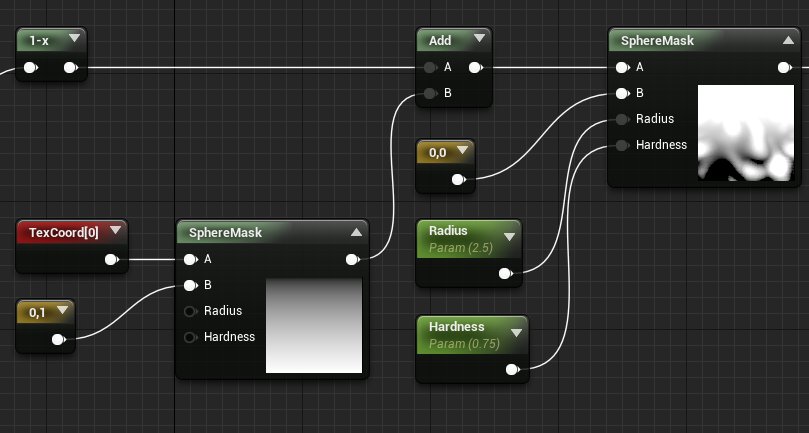
2nd part, I use a linear gradient for the fire transition and a 2nd sphere mask to control the length/hardness of the flames. Optional 1-x on the left, depends on your noise texture, it will change the look. You should invert the end result and color it. #UE4#gamedev#indiedev