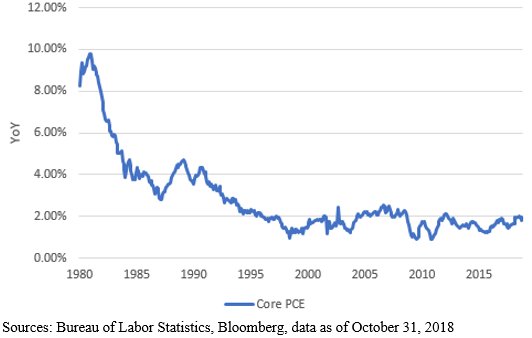
As we enter the holiday shopping season, the #Fed (much like Santa) increasingly has a keen eye on what’s naughty or nice for the economy. Yes, Santa Clause is coming to town, but #inflation is not.
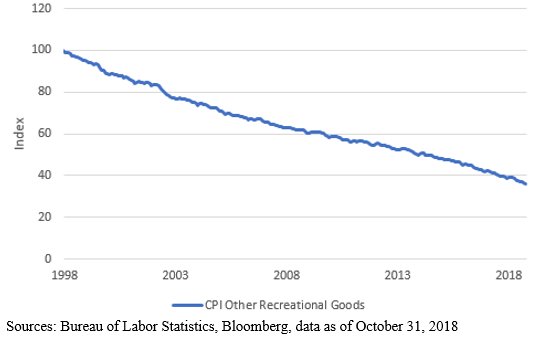
So while the overheating crowd has loudly warned us: you better watch out, you better think twice because #inflation is going to erode household spending power... the cost of many favorite gifts (TVs, phones, GPS, recreational games and electronics) continues to deflate!
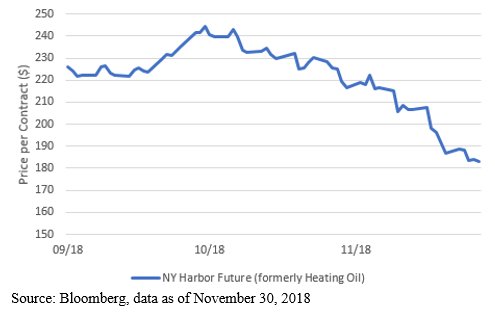
The weather outside may be frightful, but the #inflation hawks can’t deny the bargain prices of home heating oil as we enter the frigid winter months.
On a serious note, the holidays are a truly a season of giving, and keeping that in mind, there is no greater gift than full employment and rising wages for households. The #Fed acknowledges that spurring more jobs is the right policy and isn’t something to be curtailed.
Our workforce faces many future costs: rising U.S. debt burdens, underfunded #retirement plans, rising health care expenses and increased cost of education: yet growing #employment today does far more benefit to combat these issues than fighting the ghost of inflation past.
So while the Grinch would surely see higher #wages as inflationary, we see it as a gift in an economy where the cost of goods (food, energy, apparel, etc.) is in decline; meaning higher disposable #income for household savings, debt reduction, expenses, or a deserved vacation.
In short, higher wages doesn’t mean higher inflation (bit.ly/2FVCT89). So here’s a holiday cheer to a brilliant Fed that seems to realize this more than most!
• • •
Missing some Tweet in this thread? You can try to
force a refresh

Last week’s #JobsReport continued a recent weakening trend that we have seen for a couple of months, and which has been evident in some other recent labor readings: the country is hiring fewer people than in months past.
Indeed, with the top-line #payroll number of only 73,000 jobs added in July, the slowdown in hiring is becoming clear. Additionally, the prior two months of data witnessed considerable (258,000 jobs) downward revisions to payroll figures, suggesting that the labor market has remained flat for some time.
Further, we saw more evidence of labor market slowing in the recent JOLTS report, in which the job opening rate recently ticked back down to 4.6%, within a sideways recent range but down from a high of 7.7% in 2022.
With all the activity witnessed this year regarding tariffs and trade tensions, there has been a broad consensus that price levels (#inflation) in the U.S. would likely trend higher, as companies passed through elevated costs to consumers, in an effort to protect profit margins.
And while this still may occur to a degree in the back half of the year, through the June #CPI report released yesterday, there have been limited tariff effects displayed in the data.
This may be due to various lags in the flow through of tariff costs to the consumer, and perhaps most importantly to corporate adaptability.
Last week’s jobs report continued a non-stop barrage of information-flow. Indeed, it seems as if there have been very few times in markets where one has had to interpret so much disparate, and at times conflicting, data relative to the economy and influences on it.
In a way, it does harken back to the days of pumping quarters into the Asteroids video game while trying to assimilate all the material coming at you at once.
The payroll report also comes with a load of footnotes attached to it, in terms of assessing what it really means for the state of current labor conditions. For instance, the reporting survey was conducted following a period of significant job displacement in California related to the wildfires and other adverse weather conditions around the U.S., in the midst of a changing immigration picture, more labor strikes, and the beginning of the impact of DOGE on federal government employment.
Over the past few days, we’ve received information that is likely to hold an impact on the market’s perception of the trajectory of interest rates, and will have broader market influences as well. The Consumer Price Index (or #CPI) is the most followed of #inflation measures (it gained a greater than expected 0.47% on a headline month-over-month basis and 3.0% year-over-year), and particularly Core CPI (which excludes volatile food and energy components), which increased strongly at 0.45% month-over-month and 3.29% year-over-year.
Yesterday’s CPI report, as always, was interesting in that there was a mix of strength in some areas and trend-developments in others. Both Core CPI and Core Services (ex-shelter) displayed significant gains, while the shelter category picked up by a smaller amount. Even within shelter, the much-followed Owners’ Equivalent Rent measure (or OER) was well behaved at 0.31% month-over-month, but lodging saw a big gain after having declined in the previous month.
As a result, to us the most critical element in the recent CPI reports has in fact been OER, and the trajectory of shelter inflation. That’s because both we and the market had been expecting that figure to trend lower.
The world continues to watch for a pathway to lower interest rates, but despite a modestly softer headline in nonfarm payrolls last week, of 143,000 jobs gained, underlying employment conditions continued to display a resilience that makes any @federalreserve rate cutting in the near- to intermediate-term appear unlikely.
Indeed, at 0.48% month-over-month and more than 4% year-over-year the wage growth looked solid, unemployment declined slightly to 4.0%, and prior month payroll revisions were 100,000 jobs greater than previously reported. So, all in all, the labor markets still appear to be in a good place.
In our view, for a Fed rate cut to be back on the table, we would need to see two, or so, consecutively softer employment reports, and that is for the central bank to even consider resuming its rate cutting cycle.
As we have argued in recent months, a great deal of progress has been made in combatting high levels of post-pandemic inflation. Still, the likelihood is that most of the meaningful progress is behind us at this stage, and inflation may remain sticky at levels higher than the @federalreserve would ideally like.
Indeed, yesterday’s headline CPI increased 0.39% month-over-month, greater than its gains from last month, largely due to energy price gains. That resulted in headline CPI rising to 2.89%, from 2.75% the month prior, on a year-over-year basis, amid unfavorable base effects.
The core CPI measure gained 0.23% month-over-month, and 3.24% year-over-year. Taking a step back to provide some context, the average annual rate of core CPI inflation from 2000 through 2023 was 2.37%, but for 2024 this measure resided at 3.24%, illustrating vividly why the #Fed wants to see further progress on #inflation.