This is a huge strategic failure. To respond to the unprecedented pandemic, leaders must understand the dialectics. The lockdown & the economy look contradictory, opposing but in reality are complementary. A strict lockdown nipping out all routes of transmission in the bud...
is the guarantee of a quick economic recovery. Only when the disease is under control can an economy recover. US has erred by coping with #Covid19 half heartedly, letting wide open numerous backdoors for the virus. A society should move and act of one accord in times of crisis...
...like this which the US failed to do. Mass social coordination is not the #American DNA. #Americans cannot bear a couple of months' self-sacrificing discomfort in exchange of thorough and prolonged freedom from the virus. White House failed to craft this strategic vision...
and sell it to the American public. The powerful propaganda machine has been spewing fire against #China instead of coordinating an effective Covid response.
As long as the diseases is not under control, it will come back again and again to bite the economy
As long as the economy is not recovering, it will cause social unrest and worsen again and again the pandemic. In the end, America is losing on both ends.
This is philosophy. A game to be played by intelligent politicians and a sophisticated people which #America doesn't have.
Not knowing #Marxism has definitely put #Americans at a disadvantage. The dialectic is the building block of the Marxism inspired from European philosophical tradition embodied by Hegel. Marxism gave wings to the IQ of Chinese accounting for their success
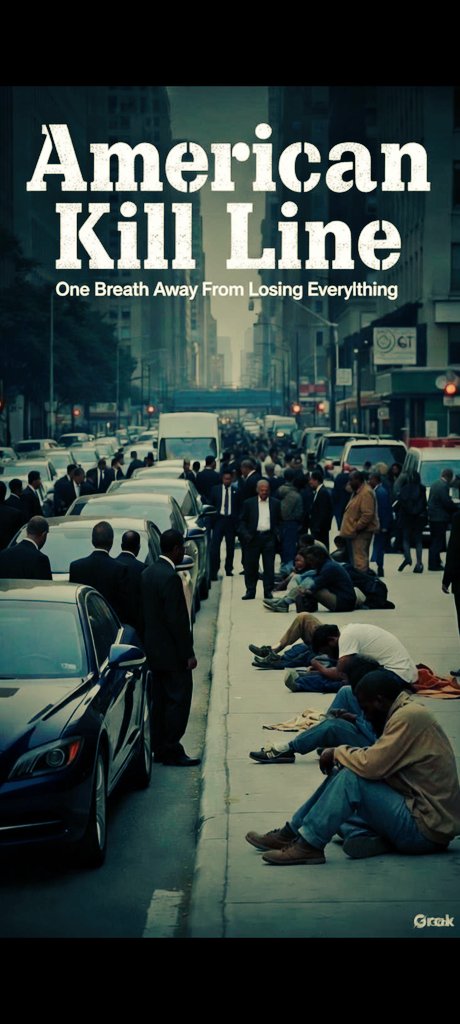
The American Weapon of Mass Destruction: the Invisible Execution Line that kills hundreds of thousands of Americans a year silently
This is a hot topic in China these days.
I summarize the main points below. Americans can tell me if it's true.
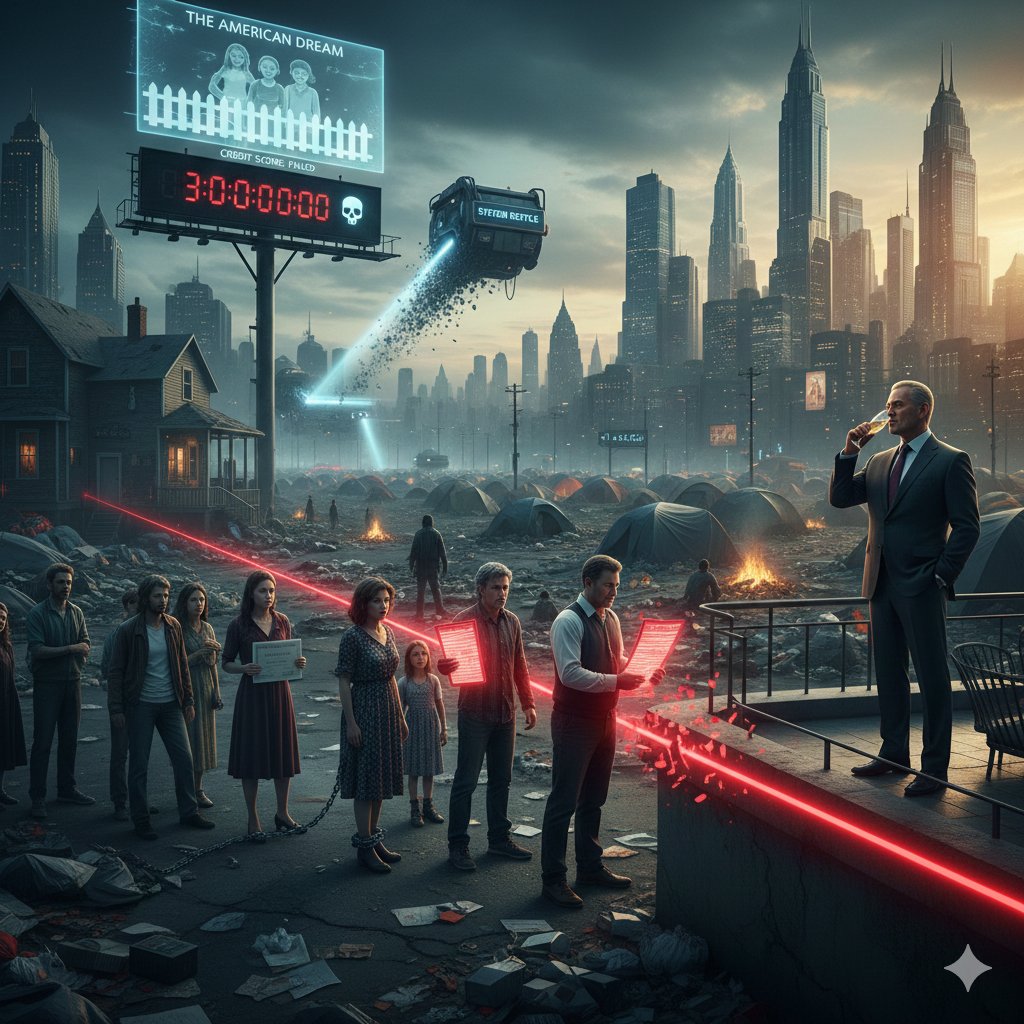
In the United States, there is an invisible line. You never see it marked on the ground. No siren sounds when you cross it. No announcement is made. But once you do, your life enters a closed system. A negative loop. A corridor with no exits.
In America, everyone talks about paying bills. It is a national obsession. Its medical bills are legendary. Dynamic pricing without limits. Giving birth can cost hundreds of thousands, even a million dollars. A single tooth extraction can cost more than a month’s rent. No ordinary person can possibly pay these sums—especially those who have already lost their job and, with it, their insurance.
If you cannot pay, the system does not pause. It does not negotiate. It eliminates. Slowly, mechanically. You are not punished in a courtroom. You are ground down by procedures, fees, astronomical compound interest, and deadlines until nothing remains.
This line is a survival threshold. Cross it, and the system stops treating you as a human being and starts treating you as waste that has not yet been processed.
Western media loves to talk about China’s so-called “social credit score,” in dystopian language. A digital leash. A techno-authoritarian nightmare. But this is projection. The real, fully operational social credit system already exists in the United States. It is called your credit score. Your ability to pay your bills.
In America, your credit score is not just your financial data. It is your civil status. Your digital soul. Once it drops below a certain point, you are quietly erased. You cannot rent an apartment. You cannot get a phone plan. You cannot pass a background check. Often, you cannot even open a basic bank account. There is no meaningful appeal. No state-level repair mechanism that works at scale.
In China, debt problems are treated as a social risk to be managed. Housing is stabilized. Utilities stay on. The state intervenes because social collapse is expensive. Fear and despair spread quickly in a society, and the cost is collective. In the United States, default is treated as a moral failure. Punishment is impersonal, automated, and outsourced to algorithms. Once the gears start turning, they are designed to move in one direction only.
The most brutal feature of the American system is not poverty itself. It is the absolute requirement of a fixed address.
No address means no mail. No mail means no bills, no notices, no verification. No verification means no bank account. No bank account means no job. No job means no health insurance. This is not accidental. It is a perfectly engineered chain reaction.
Once you lose housing, time itself turns against you. The average survival time of a homeless person in the United States is about three and a half years. In a country that constantly talks about labor shortages and immigration, this number should haunt every policy debate. People are not “falling through the cracks.” They are being processed out of the system.
Perfectly normal people—fit for work, needing only a few weeks of stability—are treated as waste and left to rot and die on the street.
Healthcare stands guard at this execution line.
In America, if you get sick, there are only two outcomes. Either the disease kills you untreated, or the bill finishes you off by pushing you into homelessness. There is no third path.
Lose your job, you lose your insurance. Get sick afterward, and the bills arrive in amounts no average American could ever repay. The debt is not meant to be paid. It is meant to push you past the line.
II/
When people began using AI tools to audit medical bills, to contest inflated charges, simply to survive, the response was immediate. New rules now forbid the use of AI to contest medical bills. Soon AI will have inbuilt algorithms which forbid such interference with the filtering function of the system.
Costs must remain high. The guillotine must stay sharp. Americans must be made to stay in the debt trap all their life. The system makes sure nobody can pay off their debts (compound interest aiding which no average American understands) and walk away with huge savings and a happy retirement. Nobody is able to do what the personal finance gurus like Dave Ramsay or Robert Kiyosaki teach.
This also explains the opioid epidemic. If seeing a doctor means bankruptcy, homelessness, and social death, then swallowing painkillers and continuing to work becomes a rational survival strategy. Addiction is not a cultural failure. It is an adaptation to a system where rest, healing, and care are priced out of reach.
The middle class—once the system’s stabilizer—is being quietly dismantled.
Young people now enter adult life already wounded by debt. Student loans that cannot be discharged. Interest that compounds faster than wages. From day one, they are locked onto the credit treadmill. Miss a step, and you slide backward into the kill zone.
At the same time, low-cost survival has been criminalized. Sleeping in your car. Growing vegetables. Keeping chickens. In short, self-sufficient non system dependent cheap living is illegal or heavily restricted in many states. You are not allowed to survive cheaply. You must consume expensively. You must borrow. You must pay interest. The system does not want resilience. It wants dependency.
The popular fantasy is that this is a competitive system where the best rise to the top. In reality, it is closer to a battle royale with a shrinking map. A few escape upward. Most run in place, living from pay check to pay check, paying bills just fast enough to avoid immediate default.
They are not citizens in a republic.
They are cattle in a credit algorithm.
That is the invisible execution line that awaits evey middle class American.
Gemini generated this image for me based on the text
Across 9/11 (2001), London Metro 7/7 (2005), and Charlie Hebdo (2015), Bataclan (2015) and many other high profile terrorist attack, the same identical scenario repeats. The structure is the same. They are all Israeli psyops.
First: foreknowledge, extreme proximity.
Before 9/11, Netanyahu moved in the same New York political–business circles as Larry Silverstein, the owner of the Twin Towers who acquired the Towers shorty before 911, a long-standing pro-Israel donor with direct access to Netanyahu and Israeli government. Netanyahu himself repeatedly claimed, immediately after the attacks, that he had long warned of such an event. On 7/7, Netanyahu was physically in London, cancelling a public appearance shortly before the bombings. With Charlie Hebdo, Netanyahu had close personal ties to Richard Malka, the magazine’s long-time lawyer who defended Charlie Hebdo's long tradition of sadistic blasphemy of the Prophet Mohammed of the utmost bad taste as freedom of expression, who became a central media figure after the attack.
Second: instant attribution.
In all four cases, the identity of the attackers and the ideological framing was established almost immediately. No uncertainty window. No need for competing hypotheses. The enemy was named before the investigation began.
Third: convenient evidence.
Passports found intact (911 and Bataclan: passports conveniently found immediately at the crime scene. No need for prolonged investigation to know “who done it”). Documents appearing on cue. Evidence that survives explosions (911) better than steel or human bodies. The narrative locks early and never unlocks.
Fourth: no serious inquiry into intelligence failure.
How did this happen? Who knew what, and when? The apparent foreknowledge is discarded.
Fifth - and most important: instant political framing.
Each event is immediately folded into a civilizational narrative: terrorism as an existential war, Israel as the frontline, and Jewish life in the diaspora as inherently unsafe. The implied conclusion is always the same: Jews must move to Israel. Without continuous Jewish settlement, the Israeli state hollowes out demographically and politically.
After Charlie Hebdo, Netanyahu openly urged French Jews to leave for Israel - fear converted directly into demographic salvation. This time is no different: accusations of mounting anti-Semitism are paired with calls for Australian Jews to relocate to Israel, a country now facing sustained population outflow.
Same sequence. Same beneficiaries. Same absence of indepth investigation addressing disturbing coincidences and damning evidence of an inside job. Same mainstream campaign to strike down disturbing questions as "conspiracy theories”.
Bondi Beach and the Logic of Spectacle
When a mass killing happens, the first instinct is grief. The second is fear. The third - if you have lived through enough of these cycles - is pattern recognition.
The Bondi Beach tragedy immediately triggered that third response in many people. The mass casualty is real, but the structure of the event felt familiar. Too familiar. Professor Jiang has given his analysis of the Bondi Beach attack in his viral YouTube video.
Prof Jiang does not claim that nothing happened, or that no one died. The argument is more uncomfortable: that some events are allowed to happen, shaped, framed, or accelerated because they serve a strategic narrative.
This is what “false flag” originally meant - not fake blood, but misattributed causality.
Foreknowledge and the Smell of Timing
One of the first anomalies raised in the video concerns timing. Searches for the alleged perpetrator’s name appeared in Google Trends in Israel, Turkey, and Afghanistan before the attack occurred. On its own, this could be coincidence, data noise, or misinterpretation. But in intelligence analysis, anomalies are not judged in isolation. They are judged in clusters.
When foreknowledge, media preparedness, and narrative readiness all appear together, analysts begin to ask a different question - not “is this fake?” but “who was the master mind behind and why?”
Narrative Control Comes First, Facts Later
Almost immediately, the event was folded into a broader ideological frame.
An Israeli human rights lawyer appeared in mainstream scheduled interview grade high-resolution photographs - bloodied, bandaged, composed - giving television interviews before seeking medical treatment. Again, no single image proves anything. But mass casualty events are usually chaotic, visually messy, and poorly documented in their earliest moments. This one was not.
After decades of successful psychological operations, Israel no longer bothers with subtlety.
Even more striking was the speed with which political conclusions were drawn. Before investigations had meaningfully begun, Australia’s alleged “anti-Semitic culture” and its stance on Palestine were cited as causal factors. This is not how criminal inquiry works. It is how narrative consolidation works.
The goal was not understanding. It was immediate moral framing.
Convenient Security Failures
Bondi Beach was not an obscure location. It was a high-profile public space, associated with a Jewish cultural gathering, in a country with extensive surveillance infrastructure. Yet police response reportedly took over twenty minutes.
Meanwhile, the alleged perpetrator was already known to security services. ISIS flags and explosives were conveniently “discovered” in his car with remarkable speed. The suspect conveniently embodied every required archetype: radicalized islamists, foreign-linked, ideologically fitting the Israeli narrative.
In intelligence history, such scenarios are called too clean. Either security services are catastrophically incompetent - or selective blindness was involved.
The Camera Was Already Rolling
Perhaps the most unsettling feature of the Bondi event was how well it was documented.
High-quality photographs during the attack. An eleven-minute video released by authorities. Extensive real-time coverage. This runs directly against decades of established practice, which limits public exposure to mass shootings to avoid copycat violence. Western governments know this. They teach it. They enforce it. Strangely now they practice and teach the opposite. How to carry out a mass shooting video is released to the public for all to emulate. Maybe they want more of such massacres to occur?
III/
Spectacle is not a by-product here. It is the point.
And spectacle has an audience.
Who Is the Message For?
The central claim of the video is not about Australia. It is about the Jewish diaspora.
Zionism, as a political project, does not function on comfort and normality. It functions on mass casualty and fear. Historically, Aliyah - the migration of Jews to Israel - spikes not during peace, but during perceived existential threat. The more frightened the diaspora feels, the stronger the pull of Israel.
This is a time proven structural observation.
The podcast references historical precedents, including documentation of covert attacks on Jewish communities in mid-20th-century Iraq, later acknowledged by Israeli historians as operations designed to accelerate migration. The precedent exists: fear as fuel.
From this perspective, the Bondi tragedy functions as a message: You are not safe in Australia. Anti-Semitism is everywhere. Leave for Israel.
The target is not just Muslims. Not just Australian government expressing sympathy for the Palestine cause.
The target is Jewish families watching the news at home.
False Flag Does Not Mean Fake Deaths
One of the laziest rebuttals to this kind of analysis is moral outrage: “Are you saying the victims aren’t real?” That's not the point.
A false flag operation does not negate death. It weaponizes it.
It means responsibility is misdirected, while the beneficiary quietly consolidates narrative advantage. In the Bondi case, the clearest beneficiary is not ISIS, not Australia. The biggest beneficiary is Netanyahu and the Zionist political narrative that requires perpetual hostility to justify its cause and atrocities.
The Coaxing of Jews to Move to Israel
As Israel’s demographic pressures deepen, its political contradictions sharpen, and its international legitimacy erodes, the incentive to externalize blame and anxiety grows. Diaspora insecurity becomes strategic capital.
This framework is highly plausible. Bondi is not an isolated tragedy. It is a re-enact of a prototype.
Spectacular violence. Instant moral framing. Emotional button pushing. Media saturation. A frightened audience told, once again, that history is repeating (continued holocaust) and only one destination offers safety: Israel.
The repeated deployment of Israeli psyops are so crude they verge on the parody. For long term follower of such psyops, the pattern screams.
One detail doesn't fit the narrative. It's the Muslim hero Ahmed al-Ahmed who tried to stop the attacker. Israel doesn't know what to do with him. He is not in the script.
Pang Zhongwang (庞众望): Chinese scientist rising from a family of severe disability and poverty to the frontlines of China's scientific breakthroughs rendering null and void western sanctions.
In China, Tsinghua University is the country’s equivalent of MIT. It is where the most scientifically gifted students from across the nation converge, where competition is brutal and expectations are extremely high.
Pang Zhongwang belongs to that world now. He is a doctoral researcher in precision instrumentation, working on technologies China still struggles to import. He publishes papers in the world's top scientific journals. He holds patents. He works at the sharp edge of China's scientific self-reliance.
But Pang did not come from a background of privilege.
He came from the poorest family of the poorest village that barely survived.
Pang was born in rural Wuqiang County, Hebei Province, into a family that seemed, from the start, condemned by fate. His mother suffered from congenital spina bifida. She had no legs and spent her life in a wheelchair. She had never attended school, never learned to read in the formal sense. His father suffered from severe schizophrenia, unable to communicate normally with others, often isolated in his own mental world.
The family survived on subsistence farming, relying largely on elderly grandparents. A modest government stipend kept them from starvation. Then, when Pang was just six years old, doctors diagnosed him with congenital heart disease.
By any ordinary measure, this was a family being pushed toward collapse.
Yet something unusual was happening inside that small, poor home.
Pang’s mother never complained.
She was serene, cheerful and quietly determined her son should receive the best education. Pang speaks of his family without embarrassment or bitterness. He says his mother was extraordinary, and that there was nothing about his family he was ever ashamed of. “Which part of my family,” he asked during his now famous interview, “is not worthy of being spoken about? My mother is such a good person. My grandparents too are so good. Surrounded with so much goodness, I should be envied rather than pitied”
Though Pang's mother had never gone to school, she refused to surrender to ignorance. She watched her nephew recite classical Chinese poems and asked him to teach them to her. She memorized the verses herself, then recited them to Pang while holding him as a toddler. Poems entered his world before textbooks ever did. Between moments of pain, she did handicraft embroidery work, earning money one piece at a time.
When Pang was diagnosed with heart disease at the age of six, his mother did what she had always done: she acted instead of indulging in lamentation. Sitting in her wheelchair, she had Pang push her from door to door, asking villagers for help. People knew the money might never be repaid. They gave it anyway. Nearly 40,000 yuan (about $6000) was raised — a staggering sum for a rural village. Pang never forgot this. In a way, his achievements belong to every villager who helped his family survive.
Pang learned responsibility early.
By the age of five, he was standing on stools to cook. He followed elderly relatives to collect scrap materials for money. At twelve, he left home to attend a middle school in a neighboring town. His weekly living expense was about 20 yuan ($3) Every weekend he returned home to wash clothes, cook meals, and care for his mother.
Academically, however, he moved with astonishing speed. By high school, Pang was not merely a top student — he won national awards in mathematics, physics, and biology competitions, a combination rare enough to shock educators across Hebei Province.
II/
In 2017, he entered the national college entrance exam and scored among the very top students. He was admitted to Tsinghua University’s Department of Precision Instrumentation.
At first, Pang assumed he would need to work multiple jobs to survive in Beijing. But Qiu Yong, then president of Tsinghua, personally visited Pang’s home in Hebei and made a simple promise: no student at Tsinghua would drop out because of poverty. The school would provide Pang with financial aid to cover the tuition and living expenses.
Still, Tsinghua was a shock. Pang later admitted that for the first time, he felt intellectually challenged — not by life, but by peers as gifted as himself. A professor named Shi Zongkai offered him a crucial insight: the purpose of university is not to be good at everything, but to discover what you are uniquely good at, and pursue it relentlessly.
The idea changed him. Pang stabilized. He improved every year. He won the university’s Academic Progress Award four consecutive times, served as a class leader, and paid for much of his education through scholarships and work-study programs. When offered financial aid, he voluntarily gave it up, believing other students needed it more.
Then, during his junior year, tragedy returned.
His mother fell gravely ill and passed away at 48 years old. Pang later recalled seeing, for the first time, the deep wounds her body had carried in silence. The day before she died, sensing the end, she called Pang and his grandmother to her bedside. She spoke little — except for one thing she could not let go of: her worry for her son. Giving birth to and raising her son was the meaning of her life.
Pang continued.
He was accepted into a combined master’s–PhD program at Tsinghua. Before even completing his doctorate, he broke through a key technological bottleneck in precision instrumentation — a field where China still relies heavily on imports, including medical imaging and high-end diagnostic equipment. He published an important paper. He secured invention patents.
Globally, many Nobel Prizes have been awarded for the creation of a single groundbreaking instrument. That is how strategic this field is.
Today, Pang Zhongwang works quietly within that strategic domain as a top scientist. He speaks often about responsibility, about how each generation inherits unfinished tasks, and how scientific independence is not abstract, but practical and urgent.
Western sanctions and technological containment were designed around a simple assumption: that a country emerging from poverty and historical ignorance could be permanently locked out of the highest levels of science. China broke that assumption through its people — determined scientists forged in conditions far harsher than any trade restriction. One of them is Pang Zhongwang. Born into utter poverty, raised by a mother with no legs and no schooling, and growing up in a family shadowed by repeated outbreaks of illness, Pang’s rise to the frontiers of precision science is not just a personal story. It reflects how China, within a single generation, moved from scarcity to abundance, from dependence to self-reliance — almost a miracle, but in fact the cumulative result of millions of lives that refused to surrender to circumstance.
He was raised by a mother who had no legs, no education, no complaints — yet taught him poetry. dignity and serenity. That, more than anything else, may explain why Pang Zhongwang has achieved so much. His name Pang Zhongwang means "The Expectation of the Village”. He has fulfilled the expectations, not just of the family and the village but the whole nation. He is one of the top Chinese scientists working hard to break the Western sanctions on China.
Also on Substack. I’ve temporarily turned off paid subscriptions of Substack. However if you’d like to support my work, you can buy me a coffee at: ko-fi.com/americachinawa…
Cat Playing With Its Mouse: The Meaning Behind China’s Radar Lock on Japan’s F-15J on December 6th
There is real tension in the air between Japan and China. Washington is slowly retreating from the Western Pacific, abandoning the region to Japan and telling it to hold the line alone. The world has shifted. There was a time when China was weak and poor, when every bully felt entitled to trample it. Those days are over. China rose for one purpose: to never again be abused and bullied. And now, strong and self-assured, China can finally settle accounts with the old tormentors — and Japan is at the top of that list.
But the age of war has changed. The modern battlefield is not measured by bayonets or trenches, but by fire-control radars, AI-driven targeting systems, and the kind of technological superiority that lets you toy with your opponent without firing a shot.
And this is exactly what unfolded on December 6.
The Fire-Control Radar Incident: A Gun to the Forehead
Koizumi Shinzorō, Japan’s Prime Minister, wanted confrontation, and China responded with precision. On December 6, Japan’s Defense Minister publicly admitted that J-15s launched from the Liaoning carrier had twice locked Japan’s F-15Js with fire-control radar over the high seas southeast of Okinawa. He called it “dangerous” and expressed “deep regret.”
He is right to feel danger.
This was no accident, no miscalculation.
This was the PLA presenting a complete offensive posture, signaling that the region is one fingertip away from war — and China is fully prepared to exercise their rights under UN Charter Article 107.
Most people have no idea how deadly serious “fire-control illumination” is.
Japan’s F-15J pilot certainly knew: his cockpit must have exploded into warning alarms; Imagine that shrill beeping screaming through the cockpit for half an hour - enough to drive any normal person mad; his breathing must have turned shallow; his hands probably shook as he tried to maneuver away from the lock.
However, even under that level of crushing psychological pressure, the Japanese pilot chose to stay inside the zone rather than fleeing. This is kamicaze level provocation.
Because the moment fire-control goes live, the radar narrows into a focused beam, feeding exact parameters to the missile under the jet’s wing. In peacetime exercises, a sustained lock counts as a confirmed kill. In real combat, nobody activates it unless they are ready to shoot.
And China kept that beam on the F-15J for over half an hour.
First lock: 16:32–16:35, three full minutes.
Second lock: 18:37–19:08, more than thirty minutes.
There is no suspense about how this confrontation would end in a real war. It would be a guaranteed kill.
The Cat and the Mouse
To be precise, the J-15 wasn’t merely locking and unlocking. It was playing — the way a cat toys with a mouse trapped under its paw.
Japan’s F-15J was that mouse.
II/
Once locked, the cockpit becomes a Christmas tree of warnings; the RWR screams in the pilot’s helmet; adrenaline spikes; the mind panics. The mouse claws at the cage, tries to wriggle free, tries to break the lock. But every attempt fails because the cat simply tightens its grip.
Half an hour like this.
Half an hour of Japanese pilot gasping, sweating, trying to break free — and failing.
A cornered mouse usually lashes out. It bites. It fights.
But Japan didn’t.
A mouse locked for thirty minutes without firing means one of three things:
1. The pilot has nerves of steel — unlikely.
2. The pilot has given up — even more unlikely.
3. The pilot was ordered before takeoff not to fire under any circumstances.
This is why China locked Japan for thirty full minutes:
to raise the temperature, to test the threshold, to force choices.
Japan now has only two options:
Kneel and beg for de-escalation, or
Fire the first shot — and face the consequences.
Koizumi Shinzorō can bow, but Japan As a nation cannot. Japan cannot afford humiliation. In its own geopolitical psychology, it must thrash, it must provoke, it must pretend it still has teeth.
But China is the cat now.
Japan is the mouse.
And the mouse knows the cage door is closing.
Historical Pattern
Japanese pilots edging closer, provoking first, and then blaming China for “aggressiveness”—this is an old pattern wearing new clothes. Anyone who sees this radar-illumination incident as ordinary friction is missing the point. What alarms the Chinese people is not the confrontation, but the déjà-vu of history.
The Liaoning Carrier's military exercise and itinerary was planned in advance, publicly announced, carried out in international waters. Yet under these clear conditions, Japanese fighters chose to close in, shadow at close distance, then accuse China afterward with a vague claim of “being dangerously illuminated.” Anyone who understands air combat knows ordinary search and track modes are basic survival; the only thing that signals attack intent is full guidance lock, a point Japan avoids to discuss entirely. And if they truly believed they were under attack, would a Japanese jet loiter for thirty minutes? Of course not.
Their mission was deliberate prolonged provocation. They could have left the exercise zone at any time—beyond it, China’s radar would have ceased tracking.
The real issue is why Japan keeps pushing this close—close enough to squeeze out even the margin for miscalculation. This combination of probing forward while claiming victimhood is a copy-paste of history.
In 1931, Japan’s frontline soldiers in Manchuria repeatedly advanced, creating friction with Chinese forces. They then claimed they were “checking if the South Manchuria Railway bridge had been destroyed”—a pretext to justify a full-scale military invasion. This was the Mukden Incident (also called the Manchurian Incident), which gave Japan the excuse to seize large swaths of Chinese territory, starting a campaign that ultimately reshaped Northeast Asia.
Two years later, in 1933, tensions simmered again along the northern borders, culminating in the Marco Polo Bridge Incident in 1937. Japanese units conducted repeated standoffs, tests, and provocations near the bridge outside Beijing, inching forward step by step. When a staged gunshot occurred, it was used to claim Chinese hostility, instantly escalating into full-blown war—the start of the Second Sino-Japanese War.
III/
History never needs to repeat exact details; it repeats logic. The same pattern—gradual advance, close monitoring, minor provocation, followed by an accusation of victimhood—is playing out again. Japan’s modern air maneuvers, edging closer under the pretense of routine patrols while claiming to be “illuminated” by Chinese radar, echo this very historical choreography.
Japan also has a long history of turning careful planning and provocation into sudden, devastating strikes. Beyond the Manchurian and Marco Polo Bridge incidents, this pattern appeared in 1941 at Pearl Harbor, when Japanese carriers launched a surprise attack on the U.S. Pacific Fleet, claiming strategic necessity while the target had no warning. Similar tactics occurred in 1942 at the Battle of Singapore, where Japanese forces advanced rapidly, exploiting underestimation and hesitation, and in countless other early campaigns in Southeast Asia. The pattern is clear: inching forward, probing defenses, testing reactions, then striking with sudden force when conditions seem favorable, leaving the opponent scrambling and the narrative framed as “unexpected aggression.” It is a methodical approach that mixes calculated risk with political theater, designed to seize initiative while avoiding blame - exactly the logic mirrored in Japan’s modern maneuvers near Chinese waters.
History never repeats detail for detail; it repeats method. And the method here is familiar.
That is why China’s response is calm but unambiguous. Asking Japan to restrain its frontline units is not a polite suggestion - it is a line drawn with full awareness of what similar frontline provocations have led to in the past. China has paid for this pattern once; it will not be lured into it again.
China dislikes war, but China does not fear war. What China rejects is the old trap: being provoked step by step, then blamed for the outcome. If anyone insists on repeating that script, they should remember how the last performance ended—and who paid the price.
Poetic Justice - China’s Deindustrialization That Never Came — And Why the West Can No Longer Sell to China
A response to @RobinBHarding article “China is making trade impossible”
For years, Western analysts warned of China’s impending “deindustrialization.” (collapse). It was supposed to be the natural arc of economic development — rising wages, declining manufacturing, and eventual dependence on foreign imports. Instead, the exact opposite occurred. China doubled down on industry, expanded its production capacity across nearly every sector, and reached a point where foreign manufacturers increasingly find they have nothing China needs that it cannot already produce cheaper, faster, or at greater scale.
Washington’s long-term objective became clear: remove China from the global supply chain and rebuild a world where critical manufacturing returned to the U.S. or was redistributed among American-aligned economies. Multinationals were pressured to leave China, shift production to India or Vietnam, and restructure procurement so that even Chinese contractors had to relocate or lose business. Apple complied, moving a portion of iPhone assembly to India — only to discover that quality consistency, supply-chain density, and industrial discipline were not easily transplanted. Early batches of India-assembled devices saw high defect rates and higher consumer complaints, a reminder that manufacturing excellence is not a commodity one can simply ship across borders. China is not just a location; it is a mature industrial ecosystem that the U.S. has found impossible to replicate elsewhere.
China's continuously upgrading industrialization did not happen accidentally. It is the consequence of sanctions, energy shocks, financialization in the West, and Beijing’s deliberate push toward self-reliance. Today, the paradox is clear: the West hoped to constrain China’s industrial rise. In doing so, it forced China to industrialize further — until the point where selling industrial products to China is no longer a viable business model.
1. The Russia Lesson: A Future Sanctioned China Must Produce Everything
The complaint that “China is making trade impossible” is as valid as “Russia is making trade impossible.”
Western policy planners openly state that if Beijing reunifies with Taiwan, sanctions could mirror the Russia regime: financial cutoff, technology bans, trade strangulation. China drew the conclusion early — self-reliance is not optional. It is national survival.
Russian industry after 2022 became a raw case study. Aircraft parts, semiconductors, machine tools — everything suddenly had to be produced domestically or sourced through alternative channels. China watched in real time. A country of 1.4 billion cannot afford such dependence. It must be able to manufacture jet engines, lithography machines, industrial robots, port cranes, agricultural equipment, ie, everything at home. Not 70%, not 90%. One hundred percent. Total self-reliance is insurance. Long-term. Strategic. Existential.
Today, that is already close to reality.
2. Tech Sanctions Forced Domestic Capability. Dependence is fatal.
The first front was semiconductor tech. Washington banned sales of advanced chips, restricted Nvidia GPUs, pressured TSMC and Samsung, and froze ASML lithography exports. The logic was to cut China from the high-end supply chain and slow its technological ascent.
The result was the inverse.
Investment into domestic lithography surged. The number of semiconductor fabs under construction in China in 2024-2025 exceeded the total of the U.S., EU, Japan and South Korea combined. Firms pivoted into ASICs, chiplet design, indigenous stacks — not replacements, but parallel architecture. China accelerated at the mid-range node, dominating 28nm, 14nm, and racing into 7nm. Meanwhile, AI chips designed in-house now power data-centers without a single Nvidia card inside the system.
The West hoped to maintain monopoly through embargo. Instead, it created a formidable technological competitor.
The sanctions on Huawei were intended as a warning to all of China’s rising industry. Washington cut the company off from chips, operating systems, foundries, and even global supply partners, aiming to cripple it as a symbol of American technological dominance. Huawei was meant to serve as an example: defy the U.S., develop too fast, and you will be brought to your knees. But the result was the opposite. The shock of Huawei’s near-strangulation triggered a nationwide reflex — companies large and small began shifting to domestic suppliers, investing in indigenous chip design, operating systems, and industrial software. Huawei’s struggle became a lesson written into the consciousness of every Chinese manufacturer: depend on foreign technology, and your lifeline can be cut overnight. The fear the U.S. intended to instill has backfired — instead of submission, it produced absolute self-reliance.
3. Green Transition: The West Set the Rules In order to Trap China, China Won the Game and the West is Trapped by its Own Rules.
Climate policy was sold as moral necessity — but structurally, it was also opponent punishing industrial policy. The West expected carbon pricing and green standards to weaken China’s coal-powered factories. The assumption was simple:
China cannot catch up in solar, EV, or wind technology and the colossal carbon taxes its factories have to pay will bankrupt them. China will be forced to deindustrialize.
It was a fatal miscalculation.
China now produces more than 80% of the world’s solar panels, 60–70% of wind components, and over half of global EVs. In 2023-2024 China exported more EVs than any other country on Earth. European and U.S. carmakers bet on green transition but entered too late — over-invested in tech not yet competitive, under-invested in supply chains now owned by Chinese firms. Gigafactories bled cash. Legacy engine platforms became stranded assets.
The EU now sits in its own trap. It pushed mandatory auto electrification, yet China mastered the industry faster. Cheap Chinese EVs flood the global market, while European companies cannot retreat without admitting strategic failure at a colossal loss. Paris, Berlin, Brussels argue subsidy, tariff, carbon adjustment in endless conferences — but structurally nothing changes because Europe does not produce the batteries, the components for wind turbines, or the solar panels. China does.
The West wrote the Green Transition rules to put a ceiling over China's industrialization. Europe thought Green Industry 2.0 will see Chinese manufacturing dead and European industry revived.
But China embraced the biased rules meant to cripple it and won the game.
China understood the game from the beginning and intended to outplay Europe more than a decade ago.
The debate between Chinese scientist Ding Zhongli(丁仲礼) and NGO sponsored Chinese journalist Chai Jing (柴静)around 2010 marked the intellectual starting point for understanding how carbon policy could be weaponized. At that time, the world was still negotiating how global CO₂ quotas should be allocated. Ding argued that carbon rights must be based on historical emissions and distributed per capita according to real consumption — only then would every human being, regardless of nationality, be treated equally under the climate regime.
However western negotiators pushed for the opposite arrangement. Their model granted each country a fixed quota — a seemingly neutral framework that, once divided by population, left every Chinese citizen with only a fraction of the emissions entitlement enjoyed by citizens in Europe and the United States. Under such rules, China would have to pay heavy carbon taxes on every ton of steel, cement, battery, or solar panel it produced. Ding saw it for what it was: not an ecological principle, but an industrial ceiling designed to keep China permanently below Western output. His response, soul-searching, sharp and unforgettable, became a meme in China:
The Spectre of War: History's Shadow over the China-Japan Relationship
The relationship between China and Japan today unfolds beneath a long, unbroken historical shadow. It is not a mere rivalry between two modern states, but an encounter between dark memory and shifting power: one nation rising to restore itself, the other trapped beneath the guilt of the most unspeakable crimes in its past. China’s Great Rejuvenation is inseparable from the need to close a macabre chapter left deliberately unfinished — a chapter preserved not by accident, but by the United States, which shielded Japan’s wartime architects in exchange for their post-war service.
Justice was suspended in the twentieth century. It returns now with the quiet, heavy force of inevitability.
I. The Wound That History Refused to Close
The violence inflicted by the Japanese Imperial Army did not merely kill; it aimed to strip dignity, identity, and the basic architecture of human feeling. It is a trauma that remains alive in Chinese memory because it was never acknowledged, never repented, and never judged.
Accounts describe the brutality in stark, clinical detail:
Humiliation and psychological torture as ritual:
The massacres were never mere executions. Before the massacre, entire communities were routinely coerced into sexual acts of degradation and perversity so extreme they were crafted to crush the human spirit itself. Those who resisted were subjected to immediate, public dismemberment—limbs hacked off before their families, whose screams and pleas became part of the spectacle.
Cruelty disguised as science:
Unit 731 stands as one of the darkest episodes in modern human history. Vivisection on living subjects was conducted as a matter of routine. In one experiment, researchers sought to measure the breaking point of maternal instinct: a mother and her infant were placed inside a sealed oven, and Japanese observers recorded how long it would take the mother to lay down her child on the searing metal floor and stand on it to temporarily shield herself from being burnt. The aim was never scientific discovery. It's sadistic domination.
The deeper wound lies in the aftermath. These criminals were never punished. Majority of the architects of these crimes were shielded, repurposed, and reintegrated. They reappeared in post-war Japan as bureaucrats, industrialists, political founders—symbols of the new Japan built atop old shadows.
Japan’s official posture towards their heinous war crimes has been one of denial and evasion. Every refusal to acknowledge, every carefully worded diplomatic statement, reopens the trauma in Chinese memory. The Japanese state knows what Japan has done to the Chinese people. Just as Israeli society openly celebrates what has been inflicted on Gaza, Japan’s nationalist camp has long taken pride, not shame, in what was done to China. No apology, no remorse—only the glorification of crime as sacrifice and necessity. The doctors who observed how long it would take a mother to stand on her baby in a sealed oven went on to become respected academics, corporate leaders, pillars of the post-war order.
2/
II. A Lineage of Impunity
The continuous official visits by Japanese politicians to the controversial Yasukuni Shrine, which enshrines 14 Class-A war criminals, are viewed by Chinese people as an active glorification of these crimes and a fundamental denial of the historical reality. This posture reinforces the Chinese perception that Japan carries a deep-seated, unrepentant guilt, seeking not to atone, but to suppress the memory of its victims.
They are acts of effrontery and a shameless declaration: Japan has done nothing wrong. These war criminals of the most sadistic kind in human history are Japan's national heroes.
Japan’s refusal to offer a full, official apology is mirrored by its political genealogy. The country’s far-right lineage connects directly to the wartime regime.
Kishi Nobusuke, Tojo’s wartime Minister of Commerce and Industry, arrested as a suspected Class-A war criminal, was released without trial. He co-founded the Liberal Democratic Party and became Prime Minister (1957–1960).
His grandson, Abe Shinzo, openly revered Kishi as his “No. 1 role model.” Abe built his career on historical revisionism and the dismantling of Japan’s post-war constraints.
Today’s leading figures—including Takaichi Sanae, heir to the same ideological tradition—echo this hawkish lineage. Takaichi has declared openly that Japan may need to intervene militarily in a Taiwan contingency—framing the Taiwan Strait as central to Japan’s national security.
III. The Urge to Rearm
Japan’s far-right establishment seeks to cast off Article 9 of the Constitution, which forbids maintaining war potential. They view the US–China rivalry as a historic opportunity to break the post-war shackles.
To that end:
Japan is raising defense spending to 2% of GDP by 2027.
Destroyers are being converted into de facto aircraft carriers.
Long-range counterstrike missiles—capable of hitting China’s industrial heartlands—are being acquired.
The nuclear question, once taboo, is resurfacing.
For a nation that has never confronted its wartime crimes, this ambition carries a destabilizing weight.
3/
IV. The Final Mandate: Taiwan
For China, Taiwan is not simply a geopolitical dispute. It is the last unresolved symbol of national humiliation. Cairo and Potsdam recorded its return; the separation persists only because of an unfinished era.
Japan’s declaration that “A Taiwan contingency is a Japan contingency” lands in Beijing as a trespass — an echo of earlier invasions when Japan carved its way into China through steel and fire.
Taiwan was Japan’s first major colonial acquisition, seized in 1895 after China’s defeat in the First Sino-Japanese War (甲午战争). The loss was catastrophic: the Qing dynasty was forced to cede Taiwan and pay Japan an indemnity of 200 million taels of silver, a sum equivalent to several years of national revenue. That indemnity — an enormous transfer of wealth — became the financial fuse for Japan’s rapid industrial rise. Modern shipyards, arsenals, textile mills, and steel foundries in Osaka and Yokosuka were built with Chinese blood-money. Having tasted the sweetness of conquest and the wealth extracted from a fallen China, Tokyo grew bolder. Taiwan became both proof and launchpad: a colonial base from which Japan later expanded into Manchuria, then the Yangtze Valley, and finally into the full-scale invasion of China in 1937.
The legacy of that era lingers. Many of today’s most hard-line Taiwan separatists are descendants of families that prospered under Japanese rule — the colonial class who received land, privilege, and position while indigenous Taiwanese and Han Chinese were forced into subjugation. For them, the occupation was not atrocity but privilege. The routine massacres that accompanied Japanese expansion — in Taipei, in Fushun, in Nanjing — fade conveniently in memory, replaced by nostalgia for an empire that rewarded loyalty.
The same selective amnesia defines the Philippines. Manila, too, was swallowed by the Japanese war machine, and in 1945, over 100,000 civilians were massacred. Women were systematically raped before execution; entire districts were burned alive. Yet today Manila stands alongside Tokyo, the trauma buried beneath geopolitics.
History, unacknowledged, circles back. Beijing reads Japan’s Taiwan as repetition — the return of an unfinished script of the Brutal Imperial Japan.
In China’s historical imagination, the confrontation with Japan carries tragic inevitability:
China’s duty to the dead: Nearly thirty-five million Chinese perished under Japanese occupation. Their memory forms the moral foundation of the modern Chinese state. Strength today demands closure for the weakness of yesterday.
Japan’s Macbeth-like burden: Japanese militarists, like Shakespeare’s Macbeth, carry a guilt so deep they seek erasure rather than confession. Unable to wash away the stains of blood of Nanjing or the laboratories of Harbin, they try instead to eliminate the witness—by
containing China’s rise through alliance, encirclement, and provocation. It is the psychology of a power that fears the past more than the future.
V. The Nuclear Temptation
The highly sensitive issue of nuclear capability has resurfaced.
Japan's former 'Three Non-Nuclear Principles'—not to manufacture, possess, or introduce nuclear weapons—is being set aside.
Japan’s dormant nuclear ambition is one of the most consequential, least discussed elements of its modern posture. With vast plutonium reserves and advanced delivery platforms already in development, Japan has the capacity to weaponize quickly.
Japan possesses around 45 tonnes of separated plutonium, enough for thousands of nuclear weapons. Its civilian nuclear program, framed as “peaceful,” is widely understood as a latent weapons program. The technical capacity exists; only political consent is missing.