- Manager of Kingspan's technical advice team grilled about information given to market relating to use of combustible insulation product on high rises

This morning we've been hearing from Andrew Pack - still employed by Kingspan as its global technical support manager, based in the Middle East. He has been mainly discussing his role as leader of the technical advisor team in the 2000s
This team were the advisors who would deal with queries from architects, consultants etc about the suitability of Kingspan's insulation for projects. So the thrust of the questioning is what advice was being given to the market re its use on high rises.
Spent quite a long time this morning on this 2011 email which shows Mr Pack advising re a project in Doha that was being built to compliance with UK codes. He implies that K15 was suitable for both masonry and steel frame + had tested to BS8414 parts 1 and 2
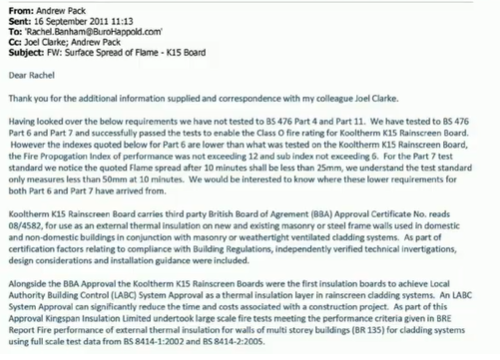
But this wasn't the case. K15 had only passed a test to BS8414 part 1 and was therefore only suitable for masonry buildings in the combination it had been tested. So why was he saying something different to the customer?
He explained that his belief was that there was a "consensus" in the market that you could use the testing for a steel frame building so long as non-combustible backing was used. He said he got this understanding from the technical team. But that's not what the email says
"In plain and simple terms what you have written here, that tests in plural have been carried out, and include tests to BS-8414 part 2 [the test for steel frame - which Kingspan had not passed] is not true is it," asks counsel.
"Correct," replies Mr Pack.
We've also heard that he wasn't shown actual test reports, and that he agreed they were kept "secret" by the technical team, even from others within Kingspan business. Said he didn't know why, but said this was common practice in the industry.
Repeatedly explained that his belief was that Kingspan's test (in 2005) allowed its use with any cladding panel which was limited combustibility or non-combustible and that this is broadly the advice his team gave to the market.
But he accepted also that he knew the test was a 'system' approval ie, it only referred to the specifc system tested and was not more widely applicable to lots of different systems.
He has talked down his role in all this, saying it was a matter for the technical team and that he was frequently copied into emails that he didn't even read with these sorts of questions about K15. This has been tested by counsel who has pointed to quite specific examples...
... of these queries being addressed to him. Before lunch we got onto to what will probably be a substantially meatier subject: the process by which Kingspan obtained a certificate apparently giving backing for its use on high rises from LABC. Continuing with that in afternoon
• • •
Missing some Tweet in this thread? You can try to
force a refresh
A final thought on Jenrick's announcement today. The route of the government's problem is a failure to distinguish the varying levels of risk in buildings and until that nettle is grasped this problem will never go away.
We've got to remember why all this is necessary. It's to stop a repeat of the absolutely appalling tragedy which took place less than four years ago. Fire deaths in high rises might be low, but that doesn't change the fact that the conditions for a repeat disaster still exist.
Any part of achieving this aim should be proactively assessing blocks of flats with a view to working out which are potential Grenfells, which are potential Lakanals and which are not perfect but are not that bad.
1. The loans offer will be a big problem for potentially millions in blocks below 18m. Not for repayment (if the cap works) but because it risks plunging them into negative equity on resale.
2. It does appear from his wording that this will "pay for the removal and replacement of unsafe cladding". The remainder of costs are, as we all know, very large. Without something on those, leaseholders very much will still be paying.
3. Jenrick justifies this based on reference to the 'expert panel' view. I feel this assessment should be made public so it can be scrutinised. I've never seen an adequate justification of the 18m rule and fire risk would appear to be far more complex.
NEW: Ahead of Jenrick's announcement later today, Inside Housing has polled 1,300 affected leaseholders about the impact of the cladding crisis. The picture is bleak:
- One in six actively exploring bankruptcy
- 62.5% face costs greater than £30,000
- Majority of those impacted (56.4%) are first time buyers
- Age is younger than you might expect for homeowners, 30.6% are 18-35 and 33.6% 35-50
- But this is a cross generational crisis: 18% are retired
- The majority are on middle incomes, 34.3% have a household income less than £35,000 and 59.5% earn less than £50,000
- Most flats are average not luxury: 57.2% had pre-crisis value of less than £250k
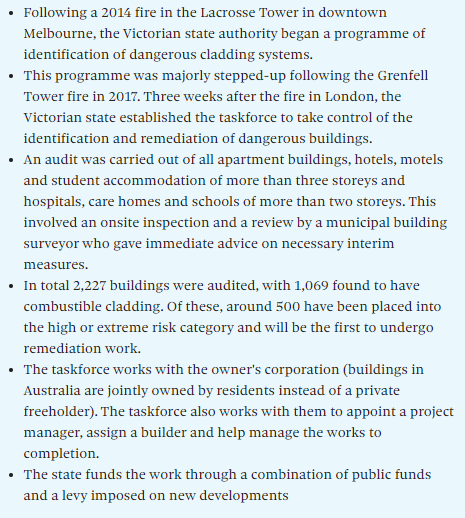
The approach Labour are calling for is essentially modelled on the approach in Victoria, Australia. This is sensible, because it's the only approach that has even remotely worked. Here's the basics of what the Victoria taskforce does:
Note with whatever emotion you want to pick on a range of exasperation to utter rage that they set this up ::three weeks:: after Grenfell and we're just now at the stage of the opposition party calling for it, but there we go
One of the key impacts of this is an attempt to make the govt face up to the fact that its rhetoric of the last few years (leaseholders shouldn't pay) doesn't match its actions (leaseholders are paying, will pay more)
Rhetoric has changed recently to protecting residents from "unaffordable costs" (prob due to the loans plan), but it has still allowed a position to continue where ministers talk about protecting leaseholders but don't protect them. This forces that contradiction into the open.
The Parliamentary maths mean there is unlikely to be a defeat on this or the Conservative backbench amendment yet, but that's not really the aim. Hope is Tory MPs getting a lot of heat from constituents won't enjoy being whipped against this amendment and will ask for changes
Ok, so here is a short thread on what this data really shows which is:
1. We are now making steady (but still slow) progress on ACM remediation ONLY 2. The wider problem of building safety won't be solved until there's up front funding
So first, what do these numbers relate to? We're talking here about ACM cladding (the material on Grenfell) on towers above 18m only. That constitutes 462 buildings. And 216 of them (46%) have now been remediated.
This is a TINY FRACTION of the building safety crisis which incorporates an estimated 2,500 buildings over 18m of other types and an as-yet-uncounted number of medium rise buildings. Govt doesn't even record stats showing progress on these.