Window panel supplier offered 'Class E' fire rated panels with highly combustible polystyrene core as default option, inquiry hears
A brief stint in the virtual witness box this morning for Chris Ibbotson, MD of Panel Systems, which sold window panels for the new window systems on Grenfell Tower. These are the panels which go in between windows and in the top corner with an extractor fan (below)
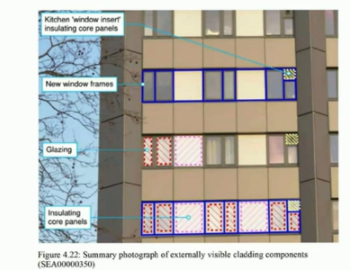
The majority of these panels were comprised of a thin aluminium skin covering 'styrofoam' polystyrene insulation. That's the same stuff as you find in your every day plastic cup and is very combustible (Class E rated, which is close to the bottom ranking possible)
So what were they doing on a high rise? Mr Ibbotson's evidence is that Panel Systems provided styrofoam panels as standard, unless they were specifically asked for something with a higher fire rating. This was because of their thermal efficiency.
We saw emails from Harley (cladding subcontractor) which showed it requested panels without mentioning a core in January 2015. So the polystyrene panels were supplied.
But did Panel Systems know it was supplying to a high rise?
No, says Ibbotson. He says the volume of the order would not have given that away and just because it was called "Grenfell Tower" on invoices didn't necessarily mean it was a high rise.
One mystery: Harley ordered panels with a different insulating core - Kingspan TP10 made of polyisocyanurate (still combustible, but obtains a Class 0 rating when covered with aluminium) - for the smaller panels around extractor fans.
But when the inquiry expert examined them she found more polystyrene. So why the difference? Mr Ibbotson could not explain but insisted there was no substitution by Panel Systems.
That's it for his evidence. If you're interested in the use of combustible insulation panels around windows (which is a big problem linked to other tower block fires), I did a long read on it a couple of years ago here: insidehousing.co.uk/insight/insigh…
We're now onto Richard Millett 'empty chairing' the Arconic witnesses who refused to attend with the evidence they would have been asked about. You can watch that here:
• • •
Missing some Tweet in this thread? You can try to
force a refresh
Senior manager at Arconic wrote an internal document in in 2007 pondering what its responsibility would be if a fire involving its product killed “60 or 70” people in a high rise
On this specific document, the marketing manager at Arconic (which later sold the cladding used on Grenfell Tower) went to Norway in 2007 for an industry get-together hosted by a Norwegian products distributor
While there, attendees were invited to give presentations and a consultant from OTEFAL (a German metatls company) did a seminar on the dangers of using ACM as compared to solid aluminium.
Cavity barrier manufacturer says installation of barriers on Grenfell was "some of the worst I have ever seen"
Chris Mort carried out an examination of the way his product had been installed after the fire in 2018. Says he believes there were areas where the products either weren't fitted at all or stuck on with sillicone instead of fixed with a bracket
There were instances where gaps of 140mm were left, instead of the required 25mm - meaning the barrier would not have been able to close the gap. Brackets designed for horizontal barriers were used for the vertical, meaning they were pierced
President of Arconic's French arm accepts customers were 'deliberately and dishonestly misled' over fire classification of cladding panels, as he is asked about email saying failed fire test must be kept 'VERY CONFIDENTIAL'
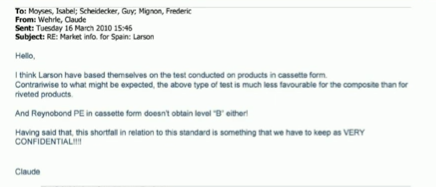
The most interesting point of this morning's evidence came right at the end of the session when Claude Schmidt was grilled about an email his colleague Claude Wehrle sent regarding the serious failure of polyethylene-cored ACM panels when bent into a cassette form in March 2010
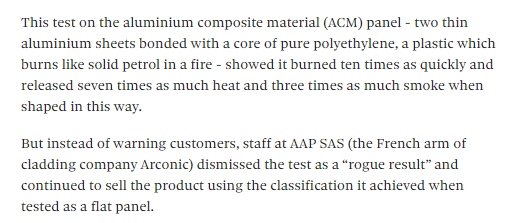
Remember: Arconic in 2004/5 tested its ACM PE panel when bent into cassette and when bolted to a wall with rivets. The cassette version failed spectacularly, burning 10 times as fast. But Arconic dismissed this as a 'rogue result' and drew no distinction in its marketing...
President of French company which sold cladding for Grenfell accepts company told a "misleading half truth" by concealing serious fire test failure from certifiers
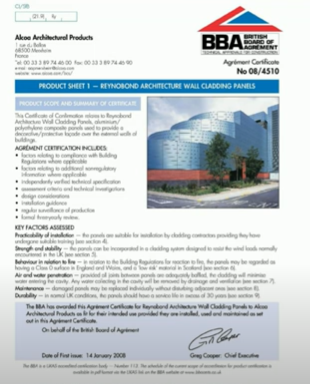
Claude Schmidt has been grilled this morning mostly about the means by which Arconic obtained a certificate from the British Board of Agrèment regarding the fire performance of the panels used on Grenfell Tower:
(A note: BBA certs are widely used and very well respected in the construction sector as the authoritative statement on how products perform. Most building professionals + inspectors will simply take them on their word)
President of the firm which sold the highly combustible used on Grenfell denies that a 2005 test in which it failed “spectacularly” was the firm’s “deadly secret”
There is a lot in today's evidence which is crucial in understanding why Grenfell happened. Essentially, we heard the details of a test in 2005 which showed the cladding was exceptionally combustible when bent into a 'cassette' shape
This is the configuration used on Grenfell Tower. Arconic did not warn the market about this risk and instead sold the cladding with a certificate suggesting it met a much higher standard.
This is pretty extraordinary. Test reports shows Grenfell cladding burned 10 times more quickly, released seven times as much heat and three times as much smoke when bent into cassette shapes as opposed to a flat panel.
Arconic's certificate drew no distinction between them.
Worth emphasising here that while the refurbishment team did not know this, the only reason cassette shaped panels was used on Grenfell was aesthetics. They were actually more expensive.
For those interested, riveted panels had a fire growth rate 105.5 watts, cassette had 1009. Riveted had a heat realease of 7.8 megajoules, cassette had 59. Riveted had smoke growth index rating of 5.7, cassette was 16.6.