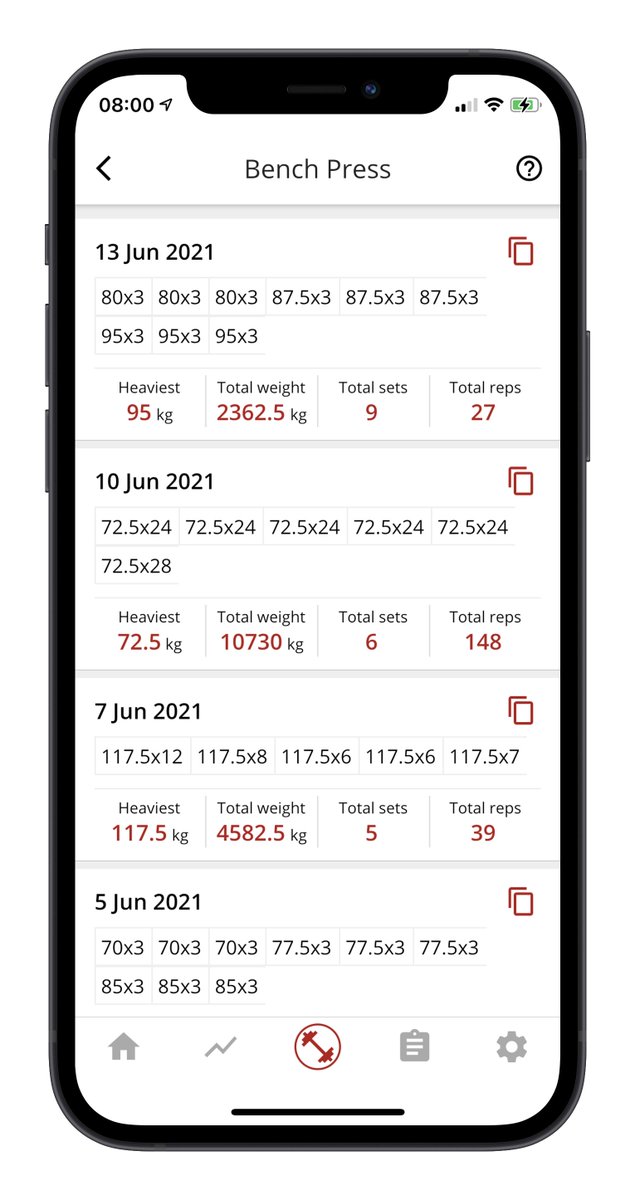
Are you “rep strong” or “max strong”? 🏋️
If you’re leaning towards one or the other, part of the explanation might lie in your muscle fiber type ratio.
A new study tested if the # of reps one could complete at 80% of 1RM in the squat correlated with muscle fiber type ratio.
⬇️
If you’re leaning towards one or the other, part of the explanation might lie in your muscle fiber type ratio.
A new study tested if the # of reps one could complete at 80% of 1RM in the squat correlated with muscle fiber type ratio.
⬇️

Here's what they did:
1. 30 participants warmed up and did a 1RM test in the squat.
2. After 15 minutes of rest, they did a max rep set at 80% of that 1RM.
3. They took muscle biopsies of the participants' quadriceps and analyzed the muscle fiber type ratio.
Results?
1. 30 participants warmed up and did a 1RM test in the squat.
2. After 15 minutes of rest, they did a max rep set at 80% of that 1RM.
3. They took muscle biopsies of the participants' quadriceps and analyzed the muscle fiber type ratio.
Results?
There was a small, inverse correlation (r=-0.38) between the number of reps participants could do and their percentage of fast-twitch fibers.
Mean results, grouped by reps:
• 5–8 reps: 58% fast-twitch
• 9–10 reps: 51% fast-twitch
• 11–15 reps: 44% fast-twitch
Mean results, grouped by reps:
• 5–8 reps: 58% fast-twitch
• 9–10 reps: 51% fast-twitch
• 11–15 reps: 44% fast-twitch
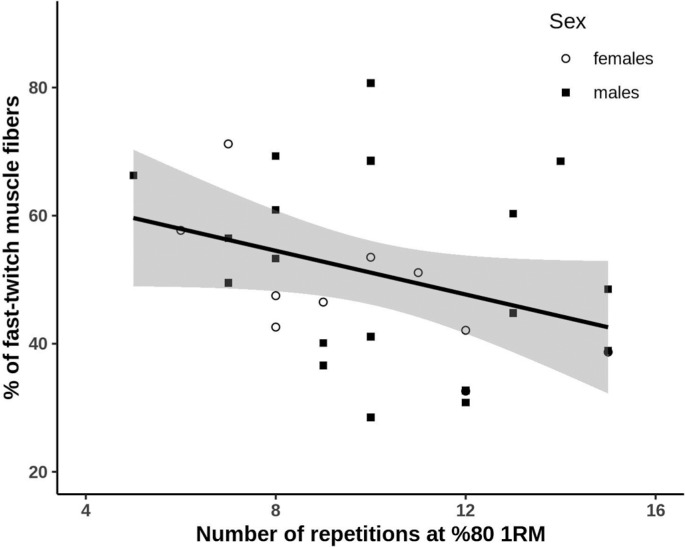
A correlation of r=0.38 can be interpreted that 14% (0.38^2) of the variation in repetition performance is explained by variations in fast-twitch muscle fiber percentage, which is frankly not a lot.
Still, it might give you an inkling.
Still, it might give you an inkling.
The bigger problem is that we still don’t really know how you should change up your training even if you knew your muscle fiber type distribution.
Low or high reps?
Fast or slow?
We don’t know.
Low or high reps?
Fast or slow?
We don’t know.
What I’m taking away from this study, apart from that I found it interesting, is a reminder that our bodies are different in many ways.
I find it plausible that we respond best to different types of training, even if the difference is only that we enjoy one way of training more.
I find it plausible that we respond best to different types of training, even if the difference is only that we enjoy one way of training more.
Want to read more about this study and my interpretation of it?
Check out my newest blog post:
strengthlog.com/reps-at-80-of-…
Check out my newest blog post:
strengthlog.com/reps-at-80-of-…
• • •
Missing some Tweet in this thread? You can try to
force a refresh