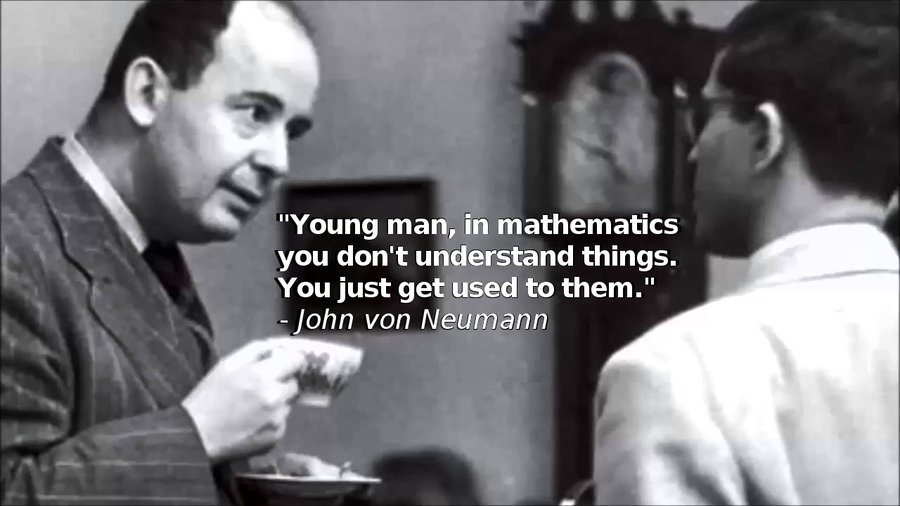
Von Neumann once told a student who was troubled by the counter-intuitiveness of quantum mechanics:
There are many deep learning practitioners who are also lost in mathematics. The difference of course is that DL folks don't actually have to perform the computations, the network does that for them.
In fact, with methods like architecture search, they can just use the machine to discover the optimal neural architecture.
But neural architecture search is only as good as the hard-coded vocabulary that is combined in a search. Furthermore, it doesn't design higher-level modules like say a Transformer or Capsule block. We can of course add these as a library and thus extend the vocabulary.
In quantum mechanics, there are many alternative interpretations. Interpretations are useful for scientists so that they can devise new hypotheses that leads to new experiments.
The hypothesis of science do not arise out of thin air, they are always based on some intuitive understanding of the domain. An intuitive understanding implies an interpretation of the underlying formal models.
One difference between physics and math is that physics has an interpretation of the mathematics. A physicist looks at an equation and derives a handwavy interpretation of what it means. One very visual kind is the formulation of the least action principle.
In deep learning, there are many practitioners who seek a Bayesian interpretation of the formulations. There are countless papers that talk about priors and posteriors to reason as to why they select elements of their architectures.
I've always argued that the Bayesian perspective is not the only way to interpret the design of neural networks. There are alternative ways of interpretation that can also lead to novel architectures.
In fact, many times researchers employ neuroscience, biological, game theory, physics or ecological metaphors in the design of their algorithms. I think it's impoverished that too many papers are written without explanations using alternative metaphors.
In my case, my favored metaphors come from the semiotic space, and hence it is language-inspired.
But the point I would like to drive home is that you cannot just rely on mathematics to make progress in neural network design. You have to be inspired by richer metaphors.

• • •

Missing some Tweet in this thread? You can try to force a refresh

 

Keep Current with Carlos E. Perez

Carlos E. Perez Profile picture

Stay in touch and get notified when new unrolls are available from this author!

Read all threads

This Thread may be Removed Anytime!

PDF

Twitter may remove this content at anytime! Save it as PDF for later use!

Try unrolling a thread yourself!

how to unroll video
  1. Follow @ThreadReaderApp to mention us!

  2. From a Twitter thread mention us with a keyword "unroll"
@threadreaderapp unroll

Practice here first or read more on our help page!

More from @IntuitMachine

7 Aug
Is it not strange that for some, the significant events of history occurred in a virtual world? I actually wasn't aware of this posting, rather, I was aware when Linux was announced by Torvalds (which came 15 days later).
Social networking was primarily on Gopher at that time. Perhaps the only reason I was interested in Linus announcement was that I was taking an OS course at that time and we were playing around with Minix. I never was an OS aficionado though.
I left university shortly after and the corporate world. There I was actually cut off from the goings-on in the internet for about a year. It was only when I joined IBM did I got exposed to the WWW.
Read 27 tweets
6 Aug
Some interesting GPT-3 quotes. 1- Economists have predicted nine out of the last five recessions. 2-The early bird might get the worm, but the second mouse gets the cheese. 3- When in doubt, try using a bigger hammer.
4-Insanity is a perfectly rational adjustment to an insane world. 5-Awe is the sense of wonder you feel when you see something that looks like it’s too big to be true. 6- To be sure of hitting the target, shoot first and call whatever you hit the target.
7- If at first you don’t succeed, destroy all evidence that you tried. 8-The hardness of the butter is proportional to the softness of the bread. 9-The severity of the itch is inversely proportional to the ability to reach it.
Read 8 tweets
6 Aug
More GPT-3 jokes. (1) Why did the Anarchist cross the road? To get to the chicken side of the free-range anarchist commune. (2) Why did the Atheist cross the road? There was no chicken, so he didn't. (3) Why did the Catholic cross the road? To get to the other confession.
(4) Why did the Evangelist cross the road? To witness to the chicken. (5) Why did the Hindu cross the road?
To get around the chicken. (6) Why did the Agnostic cross the road? To see whether the chicken was on the other side.
(7) Why did the Jihadist cross the road? To increase the body count on the other side. (8) Why did the physicist cross the road? To see what would happen. (9) Why did the theoretical physicist cross the road?
Because it was his field.
Read 8 tweets
6 Aug
It is indeed strange that so many people in the US ignore the advice of experts. I suspect is that because they've never encountered experts in real life or they aren't aware that other people can be experts.
It is as if they live a life where everyone else seems as intelligent as they believe themselves to be. The Dunning–Kruger effect.
But this of course cannot be true, because they spend their Sundays listening to a pastor for hours. Surely that pastor is an expert at something.
Read 9 tweets
6 Aug
This is a wonderful talk about design and how to do it right. runemadsen.com/talks/uxcampcp…
I do recommend that you go through the talk before proceeding in this tweet storm.
The conclusion comes out at the very end. It is the same observation that Christopher Alexander employs in this multiple volume series 'The Nature of Order': amazon.com/Nature-Order-P…
Read 10 tweets
6 Aug
In IT you can be employed for life because the technical debt keeps piling up. The garbage collector analogy is an apt analogy. Nobody wants to do it, so they'll pay people to do it.
The most predictable path to profitability is to create a business collecting other people's garbage. The riskiest business model is to do only the cool things that everyone else wants to do.
Too many startups are fixated only on doing the next cool thing. There's a survival bias that big companies are doing all the cool things. Doing the cool thing is profitable only when you are first to pick the low-hanging fruit.
Read 13 tweets

Did Thread Reader help you today?

Support us! We are indie developers!


This site is made by just two indie developers on a laptop doing marketing, support and development! Read more about the story.

Become a Premium Member ($3/month or $30/year) and get exclusive features!

Become Premium

Too expensive? Make a small donation by buying us coffee ($5) or help with server cost ($10)

Donate via Paypal Become our Patreon

Thank you for your support!

Follow Us on Twitter!

:(