A fascinating article on Trump & NATO, and in particular @jensstoltenberg's key role in dissuading Trump from attempting a US withdrawal from the alliance.
The key argument is that Stoltenberg patiently massaged Trump's ego through flattery, reached out to other actors in the US to contain Trump, and manipulated meeting agenda to make it appear like NATO was responding to Trump's concern about insufficient defence spending & China.
But the part I found most interesting was where Schuette talks about how Stoltenberg worked to undermine a possible rapprochement with Russia because it threatened NATO's very raison d'être.
Also here:
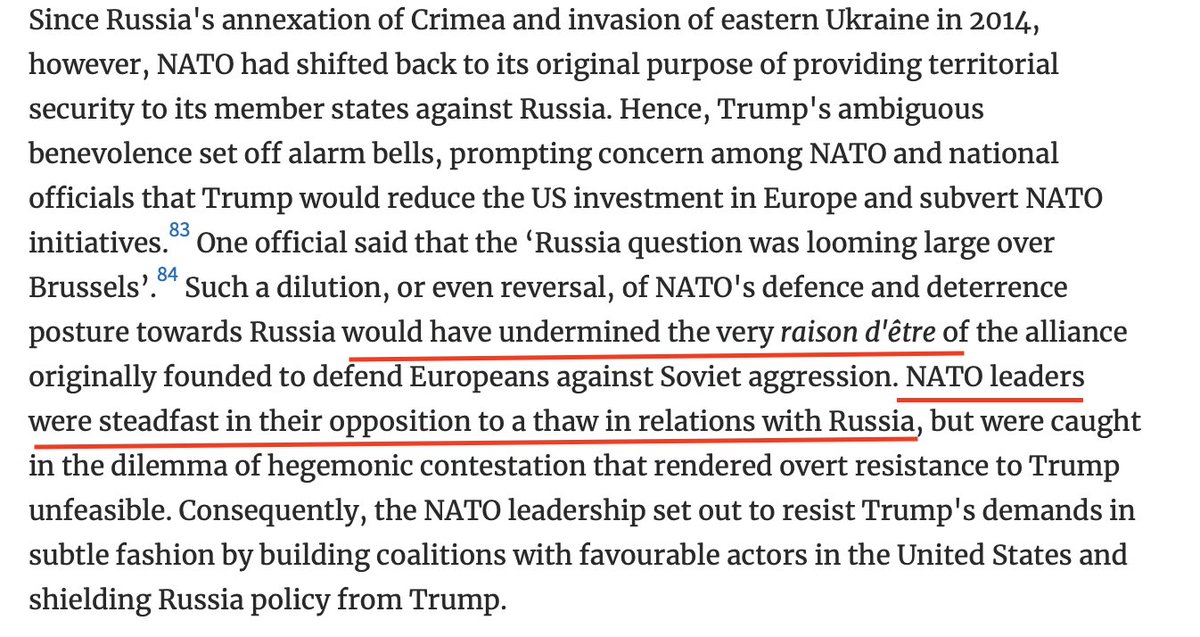
There is nothing surprising here, to be sure. In fact, NATO was never in a deeper crisis than when relations with Russia were at their best. In the early 1990s, it was not even clear that the alliance would survive. But it does raise interesting questions for the future.
One question is to what extent will entrenched bureaucratic interests in NATO resist improvement of relations with Russia when opportunities arise (e.g. after Putin's departure or in view of rapidly deteriorating US-China relations)?
Will, say, NATO's growing irrelevance under such circumstances translate into a bureaucratic strategy aimed at precluding an improvement in Russia's relations with the West? Schuette thinks NATO officials will play a major role here.
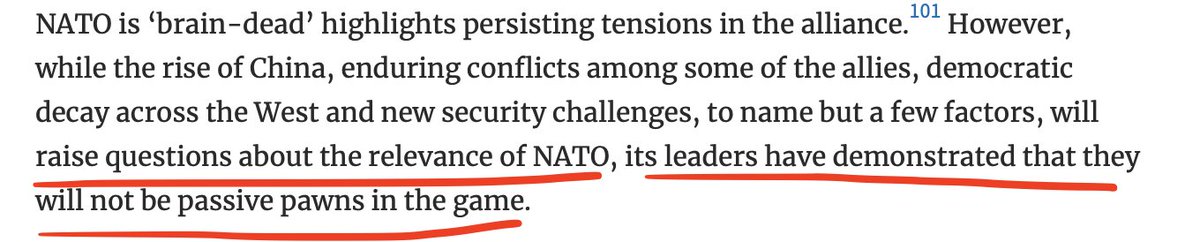
But Schuette's article is another reminder that the Russians are really the makers of their own misfortune. He shows, for instance, that were it not for Russia's aggressive policy, it would have been much more difficult to commit member states to increasing defence spending.

But do not feel sorry for Putin. Much like @jensstoltenberg, he has a direct stake in bad relations between Russia and the West, since his domestic legitimacy discourse is built around the narrative of NATO hostility towards Russia.
In other words, the situation is basically satisfying to both sides, and one only needs to commend Stoltenberg on expertly managing erratic Trump to make sure he did not upset this equilibrium of hostility.
• • •
Missing some Tweet in this thread? You can try to
force a refresh

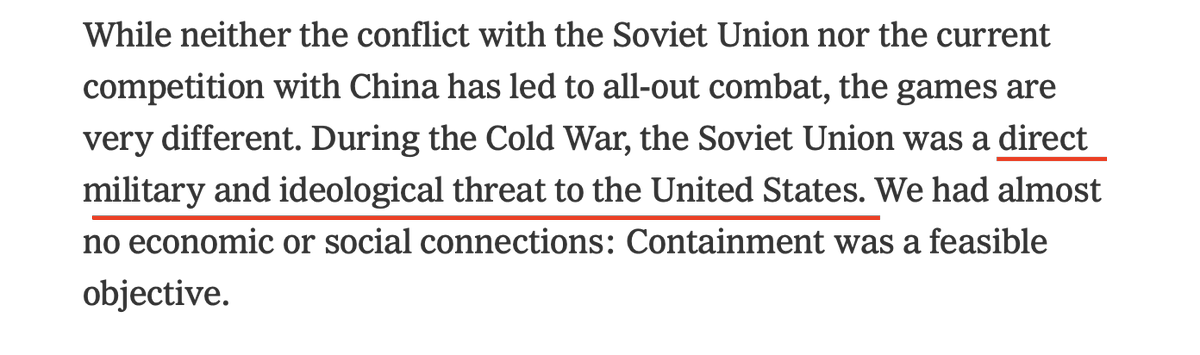
An interesting op-ed by Joseph Nye, where he argues that the parallel between the Cold War and the current state of US-China rivalry is misplaced. The analogy is "lazy and dangerous", says the title. nytimes.com/2021/11/02/opi…. Here's why Nye is wrong 👇🏿...
According to Nye, the key difference was that during the Cold War the Soviet Union was a direct ideological and military threat to the United States, so containment was a feasible objective. Let's unpack this.
At no point during the Cold War was the Soviet Union a direct ideological threat to the United States. To argue that it was a direct ideological threat would be to imply that the Communists could come power in the U.S. or, broadly speaking, in the West, through the ballot.
I keep wondering about the term "empire" and how we apply it to the Soviet Union but not, for example, to today's Russia and China, which are both instead called "multiethnic states". Is there an actual reason why we do this apart from convention?
My sense is that there is no conceptual difference between, say, the Soviet incorporation of the Baltics in 1940, and China's incorporation of Tibet in the 1950s.
Nor is there a great conceptual difference between, say, Moscow's relationship with Dagestan and Tuva today and Moscow's relationship with Moldavia and Turkmenistan in the 1960s or the 1970s.
This is a rather strange article. You'd think that, at one level, Russian policy-makers should be quite pleased with it because Kupchan here endorses a strategy (that the Biden administration has in any case been following) of easing off on Russia to focus on China. But...
But the evidence is unconvincing, many of the historical examples furnished get the facts wrong, and the whole premise of the article - that Washington can somehow convince Russia of what its national interests should be - infantilises Russia to a degree.
Kupchan argues that the relationship between China & Russia is asymmetrical; thus, Russia should presumably see that it is not in its interest to align with Beijing. Yet he also claims that the relationship allows Russia to push above its weight on the international stage.
A pretty interesting article about Lavrov's recent adventures in Central Asia. kommersant.ru/doc/4907714?fb…. Highlights: 1) Lavrov criticises the US for quitting Afghanistan. 🤯 2) However, he doesn't want the US to have any bases / training centres in Central Asia.
3) But Putin apparently proposed that the US make use of Russian bases to track the situation in Afghanistan. 🤯 4) US refusal is construed to mean that the real purpose of US interest in Central Asia is to contain Russia, China and Iran.
5) Meanwhile, Lavrov spoke up against the US plan of allowing tens of thousands of pro-government Afghan refugees to settle in Central Asia, which, he indicated, could radicalise these countries.
Reading Archie Brown's The Human Factor, which, though it is highly complimentary towards Gorbachev (to the point of sometimes being uncritically so), contains fierce criticism of Yeltsin. amazon.co.uk/Human-Factor-G…. 👇🏿
"His [Yeltsin's] prime aim," writes Brown, "was to remove Gorbachev from power and to take his place in the Kremlin. If that could have been done while preserving Soviet statehood, Yeltsin would have been more than happy to preside over the larger state."
"If his surest path to power involved the break-up of the union, it was one he was ready to follow." Brown quotes from the unpublished diary of former UK Ambassador Rodric Braithwaite, who wrote of Yeltsin in Sept 1990 that Yeltsin had "very little interest in policy matters."
Archie Brown here discussing the reasons for the Soviet withdrawal from Afghanistan in his new book. As my comments here indicate, I don't agree with this take.
First of all, the Soviets realised almost as soon as they invaded that it was a huge mistake. It was not like they thought it was going great and then suddenly discovered in 1985 that it was a blunder.
In fact, as Brezhnev's conversations with Karmal make clear, he hoped (much as Gorby would with Karmal and then Najibullah) that the Afghans would fight the war on their own, and not rely on Soviet support.