This here is not a very intelligent idea. Under international law, one either recognises a country or one does not. When you recognise a country, you recognise its government, whoever happens to run it. Democrats, dictators, kings, anyone.
So, it won't fly in strictly legal terms but will of course annoy the Russians for little gain. I doubt, in fact, that this resolution will ever pass but it's already making rounds in the Russian media. The Kremlin will milk it dry for the purposes of domestic legitimacy.
You'll ask: how can Putin be legitimised by "non-recognition"? This is because "non-recognition" is a form of recognition - Putin is recognised as the "other", the "enemy". One can, in fact, derive domestic legitimacy from being seen as America's adversary.
Psychologically fascinating. Legally meaningless. Will annoy the Russians for sure. But, hey, the Kremlin scores points from such annoyance, so everyone should be happy.
• • •
Missing some Tweet in this thread? You can try to
force a refresh

A thought-provoking article by @scharap, where he argues the US should arm-twist Ukraine to meet Russia's demands on Donbas: politico.com/news/magazine/…. I see it has triggered an interesting debate among experts. My take is as follows: 👇🏿
For a start, we need to agree on what Putin's aims in Ukraine are. That's a 64,000 question but let's just say there are two possibilities. 1) He is intent on annexing Ukraine. Why? Well, say has set his mind on 'gathering the lands', etc, which he would see as his legacy.
If this is the case (and in my view this is extremely unlikely) - but for the argument's sake we'll say it's a possibility - then making concessions to Russia on Donbas will hardly satisfy Putin - it'll just feed his appetite. If he is going for broke, he is going for broke.
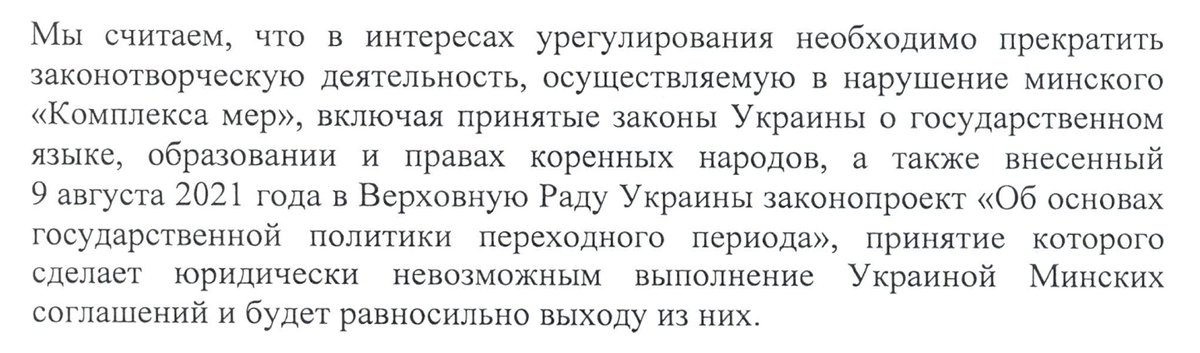
A rather nasty move by the Russian Foreign Minister Sergey Lavrov. He ordered the publication of his exchange of letters with his German and French counterparts @HeikoMaas and @JY_LeDrian. mid.ru/documents/1018….
Letters concern the prospect of having a Normandy meeting on the conflict in Ukraine. Lavrov refused to participate after Germany and France refused to endorse his proposed final document, which Ukraine would have to sign, and which contains questionable propositions.
For example, Ukraine would have to cancel some of its laws (on the national language, education, and rights of minorities). Ukraine would also be required to deal directly with the de facto authorities in Donbas and Luhansk (which is a long-standing Russian goal).
A very interesting interview with Bertrand Russell (recorded in 1961 at his house in North Wales), where he talks about his life, and sets out his views on issues ranging from sex life to education to nuclear war. .
Many of the things he says appear unduly pessimistic in retrospect. For example, he predicts that there would not be one person left alive by the end of the century. He repeatedly calls for Britain's withdrawal from NATO, which he sees as just an extension of US imperialism.
Other points seem right on the money (knowing what we know of the Cold War today). For example, he sees ideology as playing a decidedly secondary role to the struggle for power and claims things would have been much the same if the Russian tsars were still around.
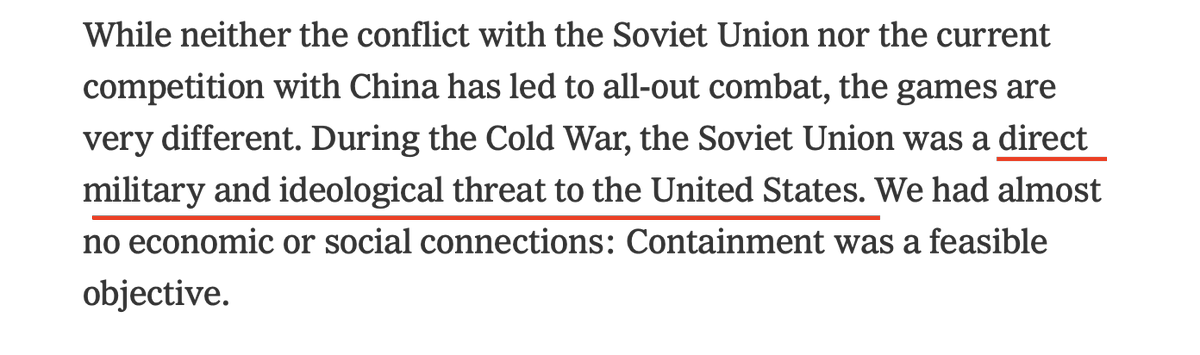
An interesting op-ed by Joseph Nye, where he argues that the parallel between the Cold War and the current state of US-China rivalry is misplaced. The analogy is "lazy and dangerous", says the title. nytimes.com/2021/11/02/opi…. Here's why Nye is wrong 👇🏿...
According to Nye, the key difference was that during the Cold War the Soviet Union was a direct ideological and military threat to the United States, so containment was a feasible objective. Let's unpack this.
At no point during the Cold War was the Soviet Union a direct ideological threat to the United States. To argue that it was a direct ideological threat would be to imply that the Communists could come power in the U.S. or, broadly speaking, in the West, through the ballot.
A fascinating article on Trump & NATO, and in particular @jensstoltenberg's key role in dissuading Trump from attempting a US withdrawal from the alliance.
The key argument is that Stoltenberg patiently massaged Trump's ego through flattery, reached out to other actors in the US to contain Trump, and manipulated meeting agenda to make it appear like NATO was responding to Trump's concern about insufficient defence spending & China.
But the part I found most interesting was where Schuette talks about how Stoltenberg worked to undermine a possible rapprochement with Russia because it threatened NATO's very raison d'être.
I keep wondering about the term "empire" and how we apply it to the Soviet Union but not, for example, to today's Russia and China, which are both instead called "multiethnic states". Is there an actual reason why we do this apart from convention?
My sense is that there is no conceptual difference between, say, the Soviet incorporation of the Baltics in 1940, and China's incorporation of Tibet in the 1950s.
Nor is there a great conceptual difference between, say, Moscow's relationship with Dagestan and Tuva today and Moscow's relationship with Moldavia and Turkmenistan in the 1960s or the 1970s.