"No time to exercise? What about three seconds a day?" Once Pandora's Box was opened and researchers discovered that, if you have a ton of dependent variables and you don't adjust for multiplicity, you can make headlines around the world, it was over.
Dear researchers, we have a beautiful science that can do some good in the world. Approach it with respect, with diligence, with a sense of responsibility. Understand the impact of your press releases on public perception. Please, consider the larger implications of your actions.
In particular, if you don't understand how statistics work, if you don't know what it means to conduct a gazillion tests of probability on samples of 10 to 13, please ask for statistical help. Have someone explain things to you. It's not a shame to ask for help when you need it.
To our good friends at the Scandinavian Journal of Medicine & Science in Sports, you can do better. You cannot expect people on the editorial board to have statistical expertise. So, when you see that the number of dependent variables is getting "up there," consult a statistician
To the @EdithCowanUni press office, you are a university press office. You primarily disseminate news about scientific research. Therefore, your writers should have some scientific training, to be able to perform at least a basic evaluation of the research they promote.
Finally, let's be clear: there is no evidence that (a) the reason why most people are inactive is lack of discretionary time, and (b) that offering shorter exercise options, especially those that involve maximal physical effort, will increase exercise participation and adherence.
• • •
Missing some Tweet in this thread? You can try to
force a refresh

So, @NICEComms released the latest draft of its updated guidelines for the treatment of adult #depression. Although the timeline can be unpredictable, we're probably getting close to the final version. Let's do a thread!
If there was ever any doubt that "evidence-based medicine" should NOT be taken to imply sole reliance on the evidence and nothing else, depression guidelines are a prime example. The problem is so large and the treatment options so poor that this is, to a great extent, political.
To remind everyone, in the distant 2004, with Clinical Guideline 23 (CG23), NICE pioneered the "stepped care model" for the treatment of depression and the idea of using exercise for cases of mild depression.
There is no official announcement from Stanford yet but there is enough chatter to suggest that the legendary Albert Bandura has passed away. We know this day was coming (Bandura was born in December, 1925) but it is still a very sad day in the history of psychology. A tribute...
I think it's fair to say that few people have been able to read (and understand) Bandura from the original. Most know Social Learning Theory and Social Cognitive Theory from simplified and abbreviated secondary sources. His language seems wordy but is densely packed with meaning.
I first tried to read his 1977 classic as an undergrad in the late 1980s. I probably made it to page 2 before giving up, exhausted. It would be years before I managed to return to it, with more experience, and was able to finish it.
Of all the diseases, the ONE that is most often thought as something that can be treated with #exercise is, of course, #obesity. But, instead, obesity is commonly treated with #drugs. Who would like to know more about the history of FDA-approved obesity drugs in the US? A thread!
For economy, let's skip the part about the 1st wave of obesity drugs being based on amphetamine & methamphetamine (to speed up metabolic rate), either alone or in combination with a "downer," to balance the stimulatory effect of the meth/amphetamine on the central nervous system.
In 1959, phentermine (an amphetamine analogue, with less addictive potential) was introduced. It stimulates the release of norepinephrine (primarily), and dopamine and serotonin (secondarily) in the brain. Acts as an appetite suppressant.
Something remarkable, from several angles, happened yesterday. The @US_FDA approved aducanumab for the treatment of Alzheimer’s disease, the first such approval in almost 20 years! This decision is a major blow to Evidence-Based Medicine and introduces new standards. A thread...
As many of you know, besides brain atrophy, there are two microscopic biomarkers of Alzheimer's disease: (a) plaques made up of β amyloid and (b) tangles make up of another protein called τ. These can be detected in cerebral spinal fluid through a spinal tap or via PET imaging.
It is now recognized that initially β and subsequently τ accumulate in the brain several years before the first appearance of behavioral symptoms (e.g., memory loss).
The paradigm shift in exercise prescription cannot / will not come from the propagators of the paradigm. Kuhn told us that "almost always" those who achieve "fundamental inventions of a new paradigm have been either very young or very new to the field whose paradigm they change."
Kuhn predicted that paradigm change will come from iconoclasts and "mavericks": "being little committed by prior practice to the traditional rules of normal science, [they] are particularly likely to [...] conceive another set that can replace them."
So, we are now beginning to see multiple (geographically detached and politically emancipated) organizations issue exercise prescription guidelines that depart from the ACSM-dictated paradigm in important ways.
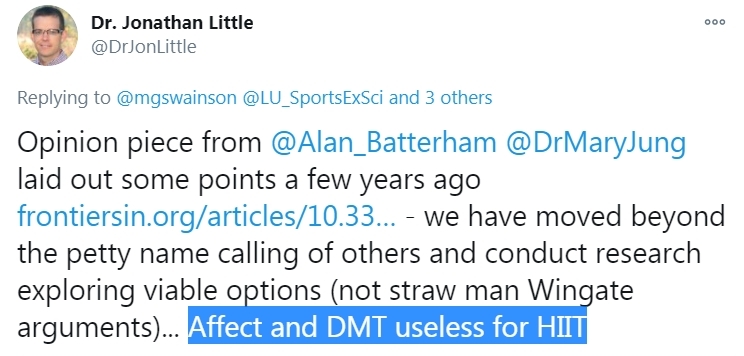
"Affect and DMT useless for HIIT." Inspired by this thoughtful and incisive assessment of Dual-Mode Theory (DMT) by Dr Little (who has clearly "moved beyond petty name calling"), let me again offer some thoughts that may help colleagues better understand what the issues are here.
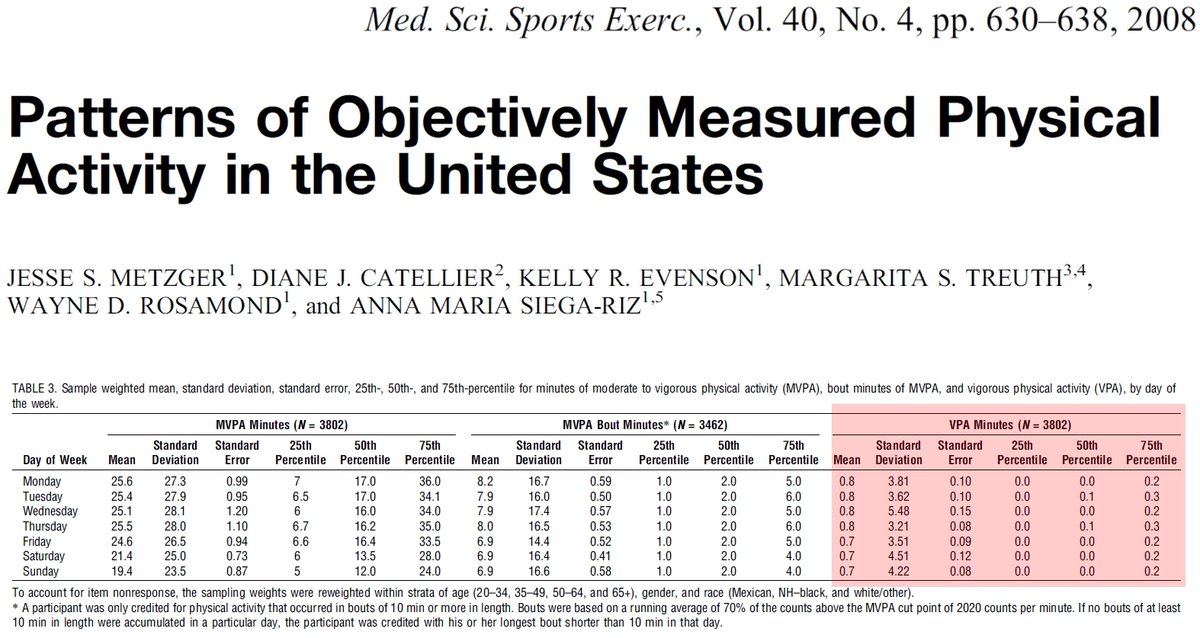
Let's start from some basic points. First, the "debate" over HIIT is not really about "options" or about public health in general. As explained in a recent thread (see link), nearly all people avoid vigorous-intensity (let alone "high-intensity") activity.
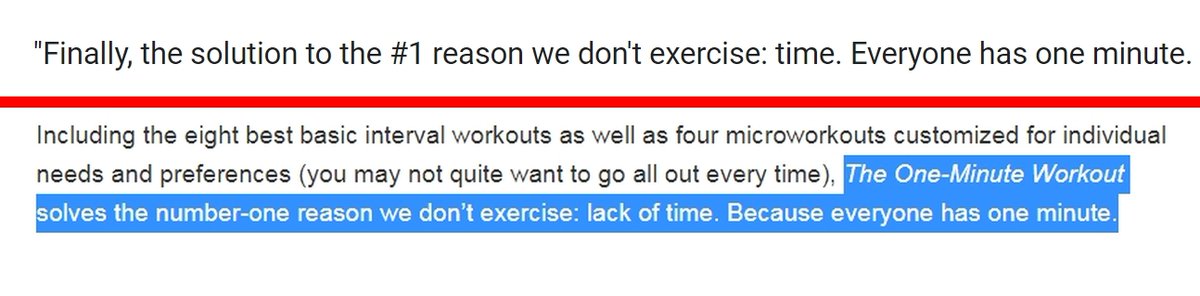
Instead, one of the main engines propelling the HIIT phenomenon is that it presents an argument that seems believable to non-experts, including non-specialists who review grant applications: "look, we discovered a silver bullet for the #1 reason for inactivity: lack of time!"