The date from which the British state appears to have known everything it needed to know to stop the Grenfell Tower fire from ever happening.
This has emerged steadily from the inquiry (and some leaked documents) over the last few months, but the nutshell is as follows.
In 1991 and 1997 there were large fires which spread up the outside of council blocks (Knowsley Heights and Garnock Court).
This resulted in a Parliamentary Select Committee recommending changes to building regulations guidance to remove reliance on a fire standard called 'Class 0' and require cladding systems to be either non-combustible or justified by a large-scale test
- Legal commitment that no leaseholder in buildings above 11m pays to remove cladding
- Developers who own buildings and other building owners 'that can afford to do so' legally obliged to pay non-cladding costs
- Where building owner does not have resources to pay, there will be a Florrie's Law cap of £10k (£15k in London) on what can be billed to leaseholders. This is to be backdated and includes waking watch (so if you've already paid £7k, further costs capped at £3k)
- Govt will give itself power to apply levies to more new builds and increase rates if industry does not comply. Says it "hopes not to use these powers".
- Courts to be given powers to prevent use of shell companies by developers to avoid liability
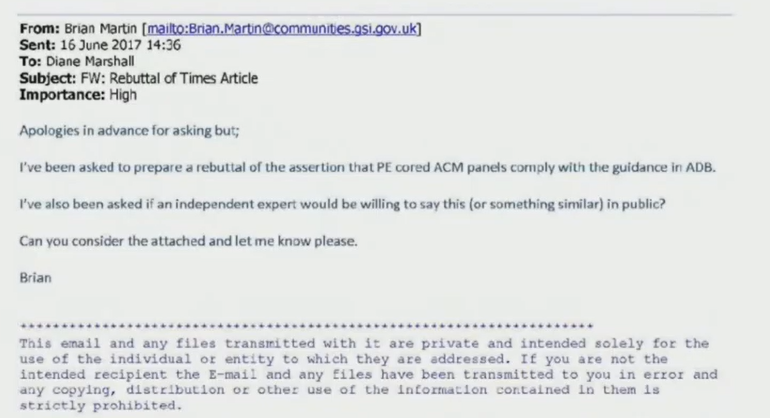
A new email from the Grenfell Tower Inquiry shows government officials tapping up industry figures to act as 'independent experts' who would follow a 'pre-prepared script' to help rebut a critical news story in The Times. Two days after the fire.
Here's the email. To spell it out: this is the UK government attempting to feed its defensive line to figures the media would treat as 'independent experts' in the immediate aftermath of a shocking public tragedy in which the state is deeply implicated.
This happened on the same day that Gavin Barwell (then chief of staff at No 10) was chased down the street by reporters asking why he hadn't reviewed building guidance before the fire. They were under intense scrutiny.
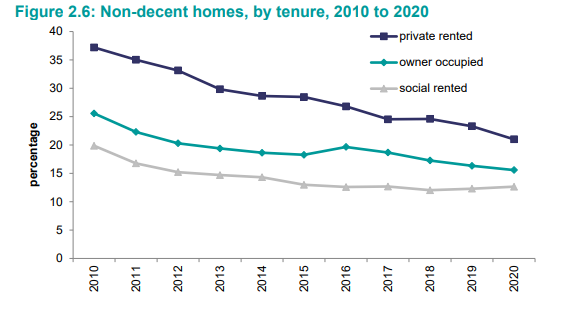
First the private rented sector bits. I think the most interesting announcement is that all PRS homes will have to meet the decent homes standard. According to the most recent data, that's where the highest number of non-decent homes are
The estimate is around 20%, which is some 880,000 homes. Given the unregulated nature of the PRS, it's a safe bet that the true number is higher.
The big question (unanswered) is how the govt plans to enforce this. Cash strapped councils will struggle, to say the least
A senior fire engineer at the UK's largest building inspector suspected Kingspan was 'concealing' failed fire tests before the Grenfell fire. It continued to accept the product for high rise buildings
The inquiry saw emails from NHBC fire engineer John Lewis where he described the use of combustible materials as "an accident waiting to happen" and a certificate claiming the product met the standard of 'limited combustibility' as "garbage"
He also said he had been told of a test on a system where Kingspan's insulation had burnt so fiercely flames had gone over the top of a 9m test rig. He said the company which had helped arrange the test had been threatened with legal action by Kingspan if they spoke about it
At around this time Kingspan K15 (a combustible plastic insulation) was the market leading brand for high rise buildings. But people in the industry were starting to ask questions about its fire safety. Was the one test which supported its use really adequate?
As a result, an organisation called the National House Building Council (NHBC) told Kingspan it needed to see more testing proving its suitability. The NHBC is a private firm which signs off new builds as compliant with regulations and also provides warranties for them