September 2002.
The date from which the British state appears to have known everything it needed to know to stop the Grenfell Tower fire from ever happening.
The date from which the British state appears to have known everything it needed to know to stop the Grenfell Tower fire from ever happening.
This has emerged steadily from the inquiry (and some leaked documents) over the last few months, but the nutshell is as follows.
In 1991 and 1997 there were large fires which spread up the outside of council blocks (Knowsley Heights and Garnock Court).
In 1991 and 1997 there were large fires which spread up the outside of council blocks (Knowsley Heights and Garnock Court).
This resulted in a Parliamentary Select Committee recommending changes to building regulations guidance to remove reliance on a fire standard called 'Class 0' and require cladding systems to be either non-combustible or justified by a large-scale test
As part of the plan to introduce this large-scale test, the Building Research Establishment (BRE, former national laboratory, privatised in 1997) was commissioned to research the types of cladding in use in the UK
The survey was pretty rubbish (only 13 full responses) but the data was nonetheless used to set up a testing programme to see how the popular systems responded to fire
One of these tests involved a cladding panel called aluminium composite material (ACM) - two thin aluminium sheets bonded together with a plastic called polyethylene.
This system was tested by the BRE on 18 July 2001.
This system was tested by the BRE on 18 July 2001.
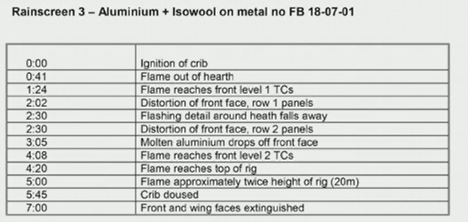
It was an utterly disastrous failure. The timeline below shows that molten aluminium was falling down from three minutes and flames reached 20m high after five. It was supposed to last 30 minutes but was extinguished after less than six for safety reasons 
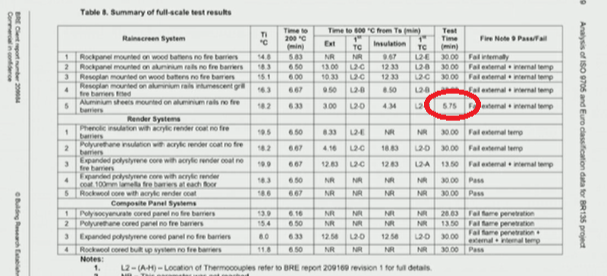
This failure was substantially worse than any of the other systems tested, many of which failed but none as seriously as the ACM polyethylene. The test times for all the tests exemplify this (ACM ringed in red)
To make matters even more serious, the panel used in this test (we don't know the particular brand) had a Class 0 rating.
This meant that under guidance in force at the time, it could be used on tall buildings.
This meant that under guidance in force at the time, it could be used on tall buildings.
The reports of these tests were delivered to govt in September 2002. So from this day forward they should have known:
1. ACM was in use on high rises in the UK
2. It could achieve the standard required by guidance
3. It would perform catastrophically in a fire
1. ACM was in use on high rises in the UK
2. It could achieve the standard required by guidance
3. It would perform catastrophically in a fire
But in the 15 years from then until June 2017, they never issued any warning to industry not to use it and never amended guidance to completely remove the Class 0 standard. Instead, there was some fiddling with the wording of the standard for insulation...
... which government witnesses claim should have outlawed the use of ACM but many industry figures and experts reject (ACM is not insulation, so it was not unreasonable to think this passage did not apply to it)
This failure was despite the coroner investigating the 2009 Lakanal House fire (not ACM, but major external spread via another combustible material) to review building guidance with particular regard to the issue of external fire spread
It was also despite a series of massive ACM fires in the 2010s in the Middle East, France, Australia and elsewhere.
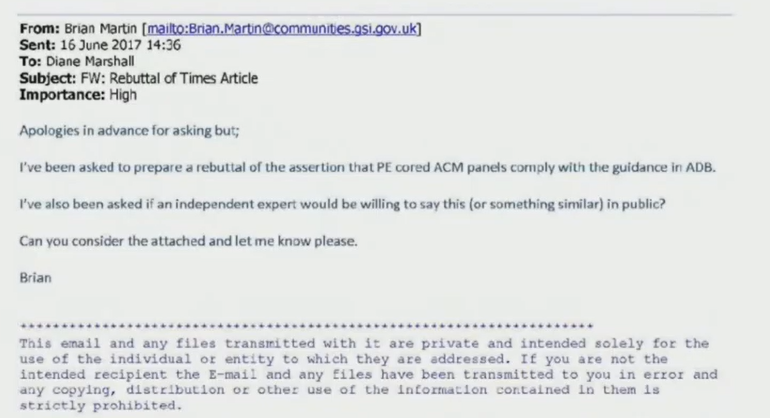
And despite specific warnings from industry that this was a risk to buildings in the UK.
And despite specific warnings from industry that this was a risk to buildings in the UK.
They also said nothing about this testing until the results were leaked to the BBC *four and a half years* after Grenfell. Even then, they did not confirm that the cladding panel used had been ACM PE (it wasn't clear from the documents the BBC obtained)
This matters, because it would have immediately added to our understanding of why Grenfell happened and increased the urgency to remove the material from other towers. More than 450 high rises in England alone have been found with it after the fire.
This is despite key figures within the BRE and government staying in important roles from the time of this testing to the time of the fire and beyond.
Debbie Smith, who signed off the 2002 report and is giving evidence today, only retired in April last year
Debbie Smith, who signed off the 2002 report and is giving evidence today, only retired in April last year
Today she was asked:
"Can we be clear... that your evidence to the inquiry is, that from the middle of September 2002... the government was in no doubt at all that ACM panels with a PE core should never ever be used above 18 metres?"
"Can we be clear... that your evidence to the inquiry is, that from the middle of September 2002... the government was in no doubt at all that ACM panels with a PE core should never ever be used above 18 metres?"
After having the question put to her a few times, she said that was her evidence - albeit within the context of the development of a large-scale test for cladding systems.
She says the BRE did not issue a warning because that was govt's role.
She says the BRE did not issue a warning because that was govt's role.
Later this week, we'll hear from Anthony Burd - the civil servant to whom the report was delivered. He stayed in the department until January 2014.
I'll have a report about today later, but we reported on the same issue last week here: insidehousing.co.uk/news/governmen…
I'll have a report about today later, but we reported on the same issue last week here: insidehousing.co.uk/news/governmen…
We've reported on the other warnings issued to government here: insidehousing.co.uk/news/senior-go…
And here: insidehousing.co.uk/news/senior-go…
And now a report of today's proceedings here: insidehousing.co.uk/home/catastrop…
• • •
Missing some Tweet in this thread? You can try to
force a refresh