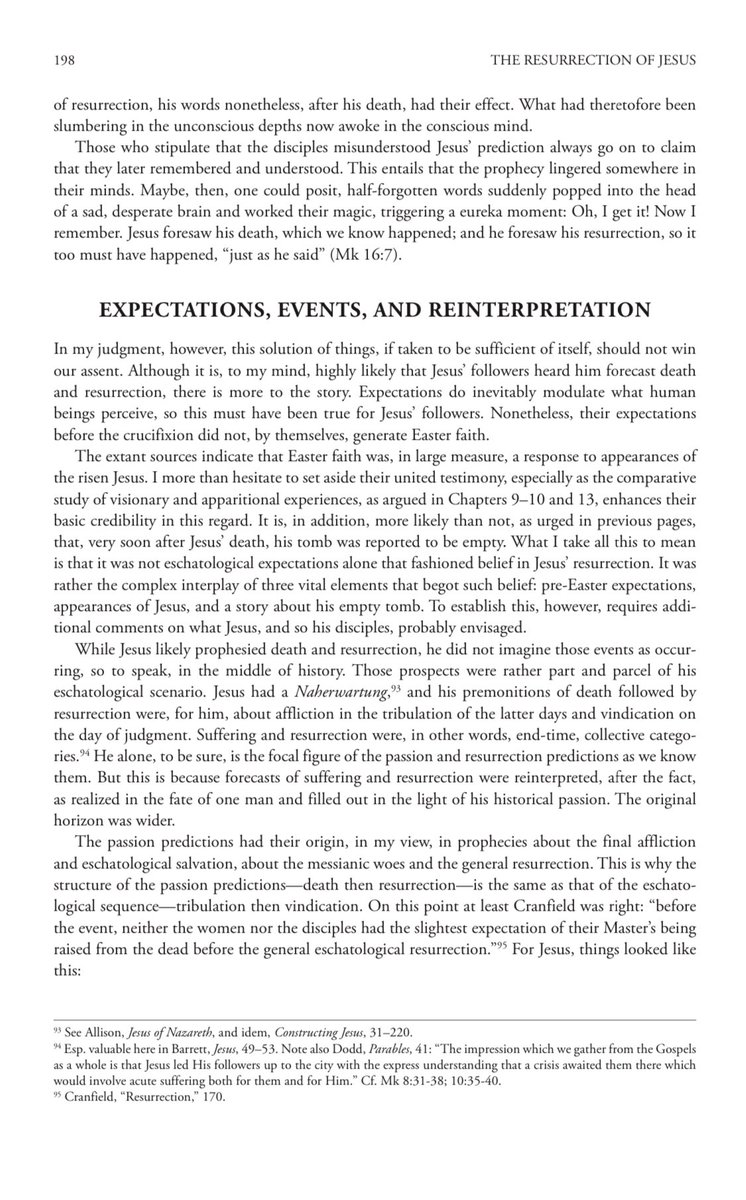
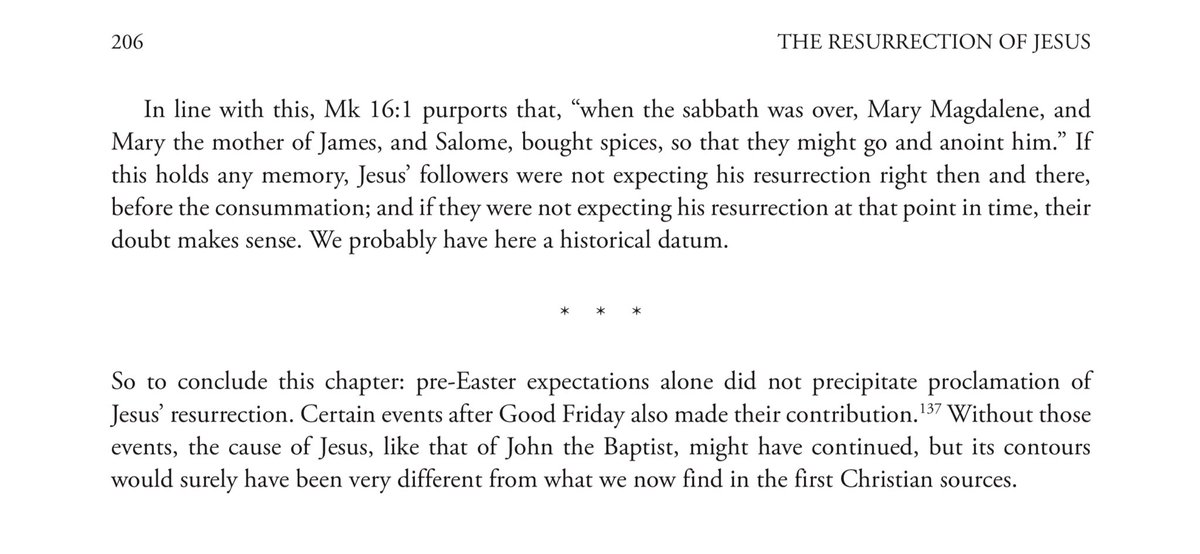
The matter, Carmona, R.N., is that if you know anything about 1st C Judaism, you’ll know that the term “resurrection” was almost always understood to mean the general resurrection of the dead at the end of the world.
Jesus’ followers would have understood his statements about his resurrection to refer to this communal, eschatological, event…not his own “special” resurrection dropped into the middle of history.
Here’s Dale Allison (The Resurrection of Jesus, 198 & 206). ⬇️
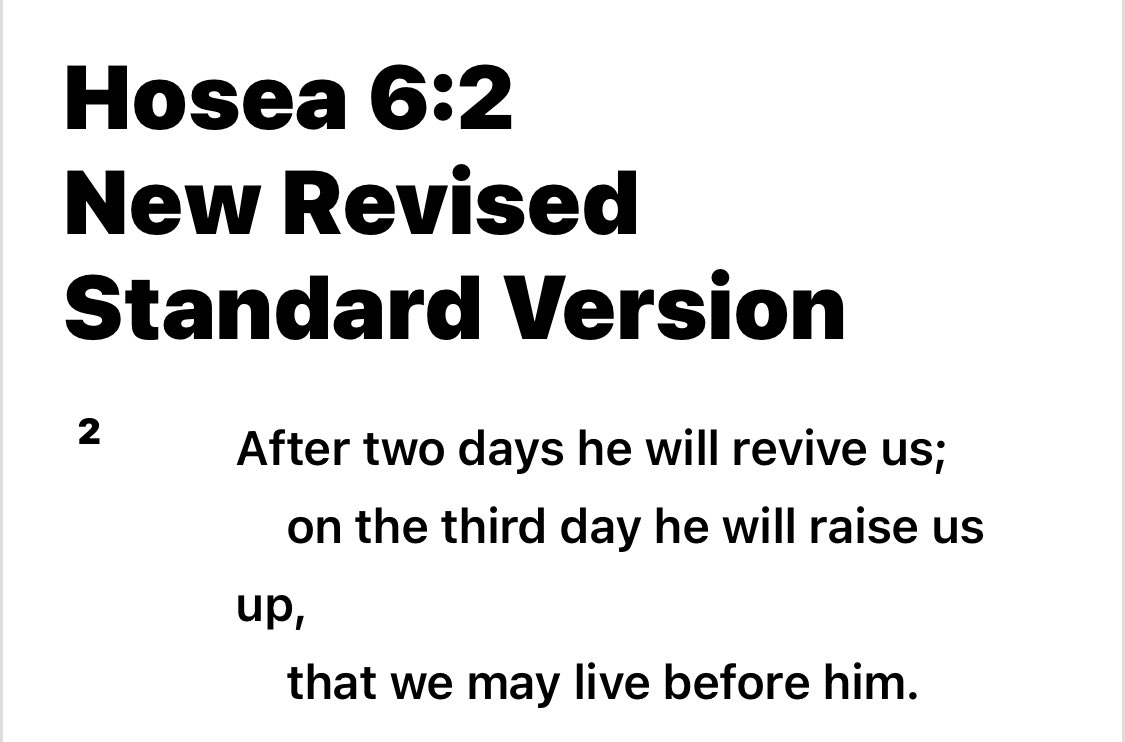
The verse you referenced, Mark 9:30-32, says, “they will kill him, and three days after being killed, he will rise again.” The term, “in three days” or “three days after” likely harkens back to Hosea 6:2. ⬇️ The “third day” was the day of the Lord’s salvation.
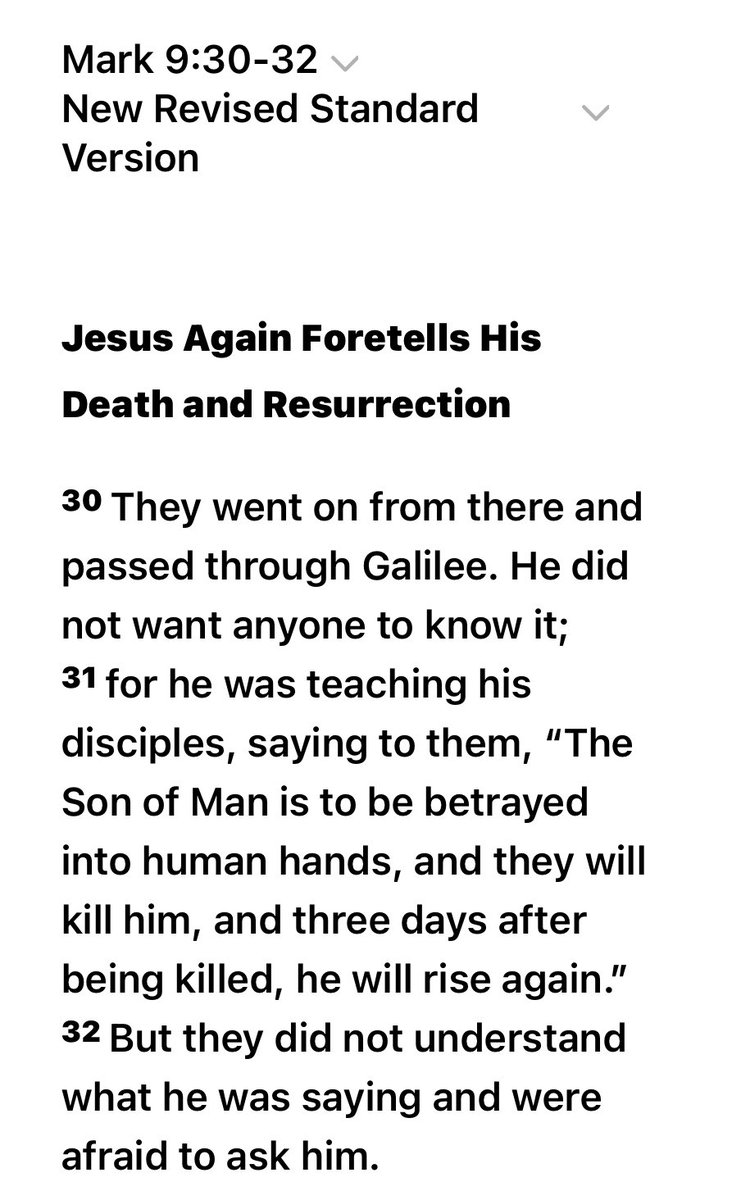
This supports the notion that they would be vindicated at the Eschaton at the end of time. This hope in times of tribulation is consistent with Jewish martyrdom literature of the period.
• • •
Missing some Tweet in this thread? You can try to
force a refresh

#Thread Several naturalistic explanations have long been proposed for the resurrection of Jesus. One in particular that has been frequently discussed, especially on social media, is cognitive dissonance.
Essentially, the cognitive dissonance explanation states that Jesus’ followers had totally committed themselves to the belief that when he arrived in Jerusalem he would establish himself as messiah and usher in the eschatological Kingdom of God.
When Jesus was instead arrested and brutally crucified, the cold reality of his death powerfully disconfirmed their strongly held beliefs. The crucifixion, in other words, plunged Jesus’ followers into a state of cognitive dissonance.
Recently, I’ve read some tweets about early Christians/New Testament authors and their positions on slavery. The point being made is that there doesn’t seem to have been a widespread condemnation of slavery by early Christians.
Ok…let’s be honest. We all know intent of these tweets isn’t to engage in an objective sociocultural examination of the attitudes/practices of a particular religious sect within the Roman Empire.
The message being conveyed is that if Christianity is this supposed “force for good” in the world, then we should expect to see a widespread opposition to slavery in the early Jesus movement. We don’t. So…gotcha!
“According to Jesus, to understand God and his kingdom, Torah as it stands does not have the final word. It needs to be reshaped. “Fulfilling Torah,” ironically, means going beyond the words on the page and to another level, which is where you find the heart of God…
For Jesus, that meant intensifying the requirements of Torah in places. At times, it meant going in another direction… God told Moses that Israelites were to make solemn oaths to one another in God’s name, an ancient version of a binding contract…
Jesus said that true followers of God no longer make any oaths at all, in God’s name or any other way. They just do what they say they are going to do. Their word is their bond… God told Moses that the Israelites were to love their neighbor…
@MatthewHartke often promotes cognitive dissonance theory as an explanation for the rise of early Christianity. So I read a piece he recommended entitled “The Process of Jesus’ Deification and Cognitive Dissonance Theory” by F. Bermejo-Rubio. See my thoughts below.
A little background... The grandfather of cognitive dissonance theory was Leon Festinger. Unfortunately, his “groundbreaking” study of cognitive dissonance in a flying saucer cult turned out to be an extreme example of the observer effect and a methodological disaster.
The sociologists who infiltrated the group prompted cult members to act in ways that would confirm the hypothesis of the researchers. At one important cult meeting, 1/3 of the attendees were sociologists. A sociologist even led one of the meetings! It was a methodological mess.