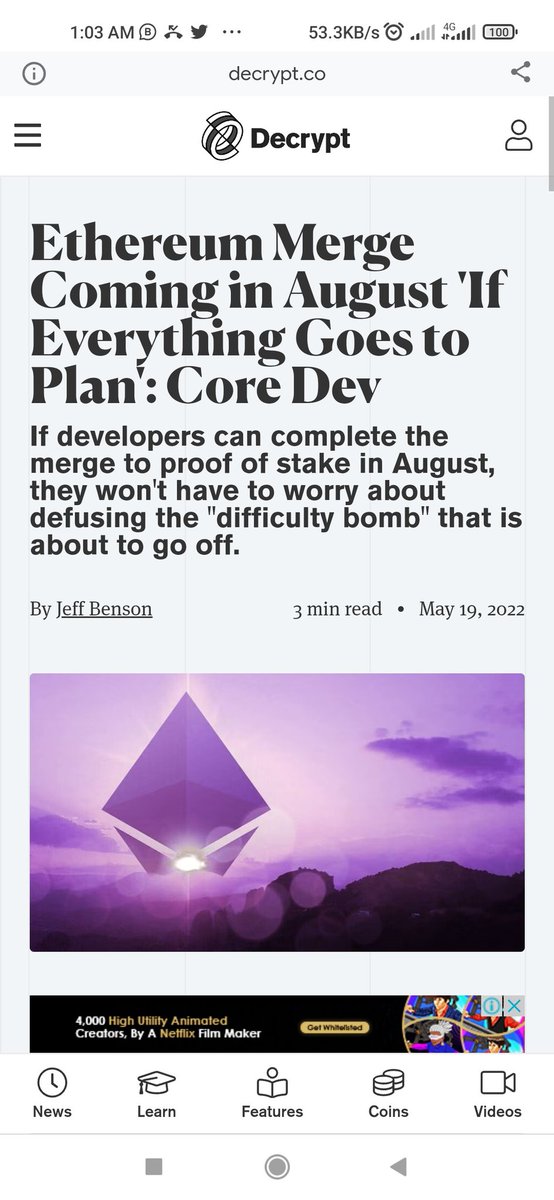
As the Ethereum merge is coming around August, have you thought about how #Layer2 blockchain will aid scalability?
Let's talk about;
•How #Layer2 will aid Ethereum scalability
•Types of #Layer2 scalability solutions
•My bias on the future use case
A Thread 🧵
Let's talk about;
•How #Layer2 will aid Ethereum scalability
•Types of #Layer2 scalability solutions
•My bias on the future use case
A Thread 🧵
Ethereum as a blockchain has been plagued by scalability issues for a while now until they made a plan to move from POW to POS.
Being the first blockchain that introduced smart contracts into the cryptocurrency space, it lured many developers to develop app for millions of users
Being the first blockchain that introduced smart contracts into the cryptocurrency space, it lured many developers to develop app for millions of users
However, the rise of users led to congestion and increased transaction fees.
This gave rise to the creation of other #layer1 blockchain.
For a newbie reading this now, you might be wondering what scalability is all about.
This gave rise to the creation of other #layer1 blockchain.
For a newbie reading this now, you might be wondering what scalability is all about.
Scalability is the ability of a blockchain to handle large transactions at a time without increasing its transaction fees excessively, being slow and bridging security.
Scalability, decentralization and security are the blockchain dilemma that faces any blockchain developer.
Scalability, decentralization and security are the blockchain dilemma that faces any blockchain developer.
Every blockchain developer intends to achieve these three solutions which seem nearly impossible thus they can sacrifice one for two.
For Ethereum, scalability has been the major issue that has pushed away some developers because people can't afford gas fees to use their apps.
For Ethereum, scalability has been the major issue that has pushed away some developers because people can't afford gas fees to use their apps.
The upgrade of the Ethereum network from ETH 1.0 to ETH 2.0 seems to be a roadmap to the solution for scalability in the Ethereum network
The upgrade that started on December 1st 2020 with the beacon chain and POS framework will continue in August as Eth 1.0 merges with ETH 2.0.
The upgrade that started on December 1st 2020 with the beacon chain and POS framework will continue in August as Eth 1.0 merges with ETH 2.0.
After the merge comes sharding around 2023.
The merge will move the Ethereum blockchain from POW to POS and miners will no longer be needed as staking will serve as the new method for validation.
This whole process is done to improve scalability.
The merge will move the Ethereum blockchain from POW to POS and miners will no longer be needed as staking will serve as the new method for validation.
This whole process is done to improve scalability.
Currently, the transaction per second of the Ethereum blockchain is 15-25 transactions per second which is very low, but, with full scalability, we are likely going to see 2000-4000Tx per second.
Scalability can be done in two ways for the Ethereum network
Scalability can be done in two ways for the Ethereum network
•Base layer scaling solution
•Layer 2 scaling solution
The base layer scaling solution will only allow highly specialized nodes to validate transactions which will lead to centralization and possible security breaches.
Thus the only option present now will be #Layer2 scaling
•Layer 2 scaling solution
The base layer scaling solution will only allow highly specialized nodes to validate transactions which will lead to centralization and possible security breaches.
Thus the only option present now will be #Layer2 scaling
What is this layer 2 scalability solution?
Layer 2 scaling solution will increase scalability by taking transactions off-chain.
This reduces the bulk of the transaction and increases the speed, reducing congestion and scalability is greatly improved.
Layer 2 scaling solution will increase scalability by taking transactions off-chain.
This reduces the bulk of the transaction and increases the speed, reducing congestion and scalability is greatly improved.
There are different scaling solutions available include;
1. Channel
This type of scaling solution allows two parties to create a channel that takes unlimited transactions off-chain and then submits only two transactions to the main layer.
1. Channel
This type of scaling solution allows two parties to create a channel that takes unlimited transactions off-chain and then submits only two transactions to the main layer.
Channels can be found as state channels or payment channels.
•State channels deal with the state of date of a channel, while a payment channel deals with payments only.
Payment channel in Ethereum includes
@raiden_network and orinoco
•State channels deal with the state of date of a channel, while a payment channel deals with payments only.
Payment channel in Ethereum includes
@raiden_network and orinoco
2. Side Chains
Are separate blockchains that are connected to the parent block gain through a two-way peg that processes data from the main blockchain and transfers it back to the main chain.
While other #Layer2 leverages on the security of the main layer, side chain doesn't.
Are separate blockchains that are connected to the parent block gain through a two-way peg that processes data from the main blockchain and transfers it back to the main chain.
While other #Layer2 leverages on the security of the main layer, side chain doesn't.
Instead, they have their security and need their nodes to validate transactions.
The side chains in the Ethereum network are;
•Polygon
•Skale
•POA
•XDai(Gnosis chain)
The side chains in the Ethereum network are;
•Polygon
•Skale
•POA
•XDai(Gnosis chain)
3. Plasma
Plasma is a separate blockchain built into the main chain.
These chains are referred to as "Child chains" and are created using smart contract and Merkle trees.
They help to offload work from the main chain and its security is gotten through fraud proof.
Plasma is a separate blockchain built into the main chain.
These chains are referred to as "Child chains" and are created using smart contract and Merkle trees.
They help to offload work from the main chain and its security is gotten through fraud proof.
Fraud proof is a security model for some layer 2 that checks a transaction for fraud whenever a transaction is challenged.
If the transaction is valid, the challenger losses and vice versa.
Example of plasma on the Ethereum network;
If the transaction is valid, the challenger losses and vice versa.
Example of plasma on the Ethereum network;
•LeapDao
•Polygon
•OMG network
•Gluon
•Polygon
•OMG network
•Gluon
4. Rollups
Rollups performs transactions off-chain, bundles it up and posts it back on the main chain three consensus is reached.
Rollups is the best approach for L2 scalability, and there are two types of roll-ups.
•Optimistic Rollups
•Zero Knowledge Rollups
Rollups performs transactions off-chain, bundles it up and posts it back on the main chain three consensus is reached.
Rollups is the best approach for L2 scalability, and there are two types of roll-ups.
•Optimistic Rollups
•Zero Knowledge Rollups
Optimistic rollups assume that the transaction is valid until its validity is challenged, then it runs a computation.
It also uses the fraudproof security model.
Examples
•Arbitrum
•Optimism
•Boba Network
It also uses the fraudproof security model.
Examples
•Arbitrum
•Optimism
•Boba Network
Transaction confirmations using optimistic roll-ups are very slow but scalability is faster.
Zero-Knowledge Rollups bundle transactions of chain and generate a cryptographic proof in form of SNARKS or STARKS.
These proofs are known as validity proofs which get posted to the main layer.
ZK rollups aids the fast movement of funds from layer one to layer.
These proofs are known as validity proofs which get posted to the main layer.
ZK rollups aids the fast movement of funds from layer one to layer.
Examples include
• dydx
•Loopring
•zkSync
•ZKSpace
• dydx
•Loopring
•zkSync
•ZKSpace
•My bias
After Sharding, I am expecting the scalability of Ethereum to move higher.
Combined with layer 2 solutions makes it is more scalable.
More scalability with these #Layer2 happens with a low gas fee.
After Sharding, I am expecting the scalability of Ethereum to move higher.
Combined with layer 2 solutions makes it is more scalable.
More scalability with these #Layer2 happens with a low gas fee.
Also, @VitalikButerin said something about hackathons for developers to come and build, I will be expecting inflows of funds by VCs.
Meanwhile, I am diving dip into the available #Layer2 solutions in my future threads.
Meanwhile, I am diving dip into the available #Layer2 solutions in my future threads.
Don't forget to retweet and let me know if your questions in the comment section.
#Ethereum #blockchain #Layer2
#Ethereum #blockchain #Layer2
• • •
Missing some Tweet in this thread? You can try to
force a refresh