The #Ukrainian counter-offensive in #Kharkiv and northern Donetsk Oblasts continued to make gains near #Lyman on September 25 and September 26.
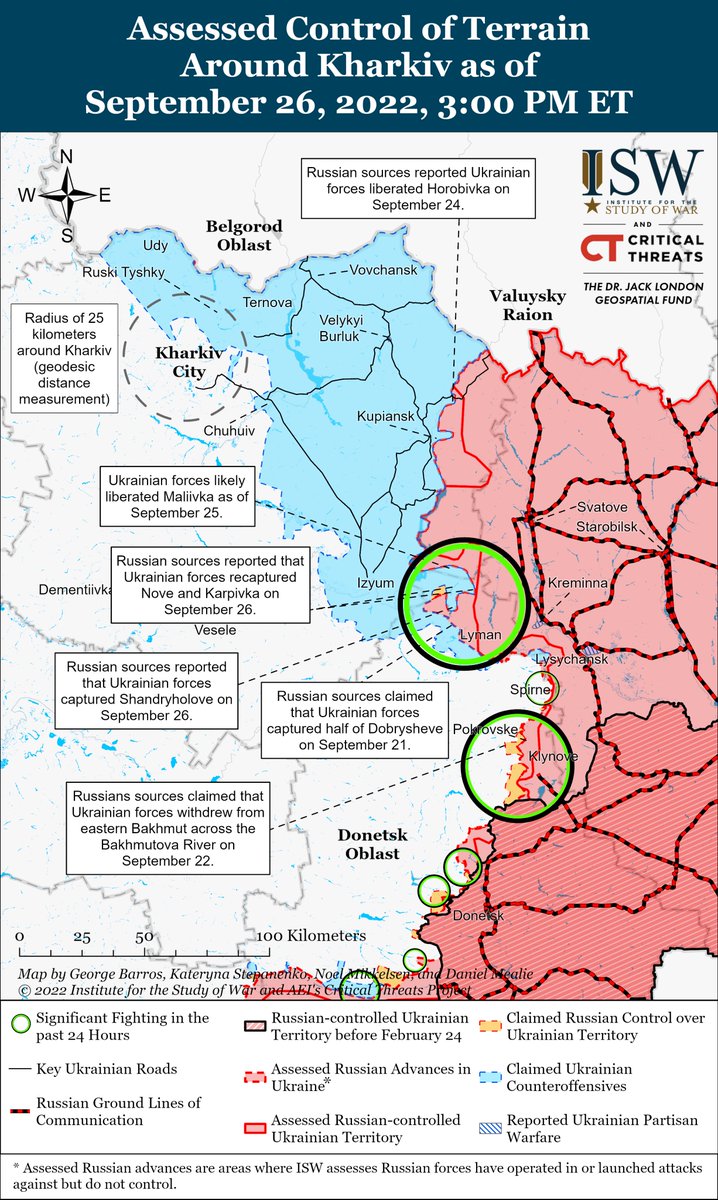
#Russian forces continued conducting offensive operations around #Bakhmut and west of #Donetsk City.
#Ukrainian military officials maintained operational silence about the progress of #Ukraine’s southern counter-offensive on September 25 and September 26.
The Kremlin faces a daunting task in trying to calm the #Russian people while still mobilizing enough men to keep fighting.
• • •
Missing some Tweet in this thread? You can try to
force a refresh

NEW: The Iranian political officials who will reportedly negotiate with the United States in Islamabad, Pakistan, on April 21 neither have the authority to independently determine Iran’s negotiating positions nor are driving decision-making in Tehran.
US Special Envoy to the Middle East Steve Witkoff and Jared Kushner will attend the talks. Iran’s negotiating delegation is expected to include Foreign Minister Abbas Araghchi and Parliament Speaker Mohammad Bagher Ghalibaf.
The upcoming talks appear focused on extending the ceasefire, which is set to expire on April 22. Iranian sources familiar with the negotiations stated that Iran expects that the ceasefire will be extended and that additional talks will occur if the negotiations on April 21 go well.
NEW: The IRGC appears to be controlling Iranian decision-making instead of Iranian political officials who are engaging with the United States in negotiations, particularly Foreign Affairs Minister Abbas Araghchi. (1/7)
Araghchi previously announced on April 17 that the strait was “completely open” to commercial traffic. The IRGC, however, harshly criticized Araghchi’s statement and outlined specific conditions for vessels to transit the strait that amount to Iran retaining control over maritime traffic through the strait. (2/7)
The Khatam ol Anbia Central Headquarters, which is functionally controlled by the IRGC, announced that Iranian forces have reinstated strict management and “control” over the Strait of Hormuz. The headquarters cited the US naval blockade on Iranian ports as the reason for the reimposition of Iranian "control" over the strait. IRGC-affiliated Fars News previously warned on April 17 that Iran would “close” the strait if the United States continued its blockade. (3/7)
NEW | US Central Command (CENTCOM) announced that no vessels have breached the US blockade on Iranian ports since CENTCOM implemented its blockade on April 13. The US blockade on Iranian ports does not have a defined geographic boundary and the United States can interdict vessels almost anywhere in international waters until they arrive at their final port. It is unclear whether any of the vessels that left Iranian ports on April 14 were authorized to do so under CENTCOM’s “limited grade period.” (1/6)
The United States’ decision not to renew a 30-day sanctions waiver for Iranian oil exports, which is set to expire on April 19, will further constrain Iran’s ability to export oil in addition to the US blockade on Iranian ports. Two US officials told Reuters on April 14 that the US Treasury Department will enforce sanctions on Iranian oil after April 19. (2/6)
Iran is reportedly considering temporarily pausing shipments to avoid testing the US blockade on Iranian ports and raising tensions ahead of possible talks, according to a person familiar with Iranian decision-making on the Strait of Hormuz speaking to Bloomberg on April 14. Iran would only be able to pause shipments for a limited period of time before it would start to run out of room to store oil. Iran could also pursue several other courses of action in response to the US blockade, including agreeing to a deal acceptable to the United States, attempting to run the blockade, or resuming the war. (3/6)
NEW | Ukraine’s expanding long-range strike campaign against Russian oil infrastructure is exploiting overstretched Russian air defenses and significantly damaging Russian oil export capabilities.
Russian milbloggers continued to criticize the ineffectiveness of Russian air defense systems and highlight the impact of Ukrainian strikes. (1/4)
2/ The Russian military is experiencing manpower challenges and is unable to recruit enough contract soldiers to replace its frontline losses.
The Russian MoD is attempting to generate additional manpower through other sources, regardless of the financial and societal costs.
Russia is facing increasing recruitment challenges as the pool of Russians willing to sign contracts declines, despite Kremlin efforts to increase signing bonuses and tap additional sources of manpower.
3/ Ukraine’s Western partners continue to provide air defense aid to Ukraine.
Ukrainian forces recently advanced in northern Kharkiv Oblast and the Velykyi Burluk direction.
Russian forces launched 141 drones against Ukraine.
NEW | The combined US-Israeli force has struck over 2,000 targets in Iran and achieved air superiority over Tehran.
The combined force has continued to target Iranian internal security institutions responsible for maintaining stability and suppressing protests, including security forces along Iran’s northwestern borders with Turkey and Iraqi Kurdistan.
The IDF announced that it has started “systematically dismantling” Iran’s nuclear infrastructure.
2/ The combined force conducted several strikes targeting Iranian drone launch facilities in southeastern Iran that Iran likely used to launch drones at its Arab Gulf neighbors.
The combined force seeks to disrupt the Iranian navies’ ability to attack international shipping and US Navy vessels.
3/ Iran appeared to fire significantly less munitions at Israel on March 1 than on February 28, which suggests that US-Israeli efforts to degrade Iran's retaliatory capabilities are succeeding.
Iran also appears to be relying more heavily on its drones compared to its ballistic missiles in its strike packages targeting Gulf states.
The inconsistency of Iran’s retaliatory attacks on March 1 suggests that Iranian units may be struggling to coordinate large-scale attacks.
NEW | Russian forces are reportedly preparing to conduct long-range strikes against substations powering Ukraine’s nuclear power plants. (1/5)
This warning comes as Russia continues its long-range strike campaign against Ukrainian energy infrastructure, resulting in widespread blackouts. (2/5)
Russian state media amplified a Kremlin-affiliated former Ukrainian politician’s statements to prepare the Russian domestic populace for the Kremlin's rejection of peace in the near-team amid ongoing US, Ukrainian, and European negotiations. (3/5)