One of the Global South's leading voices, 🇧🇷 Lula, is in #China.
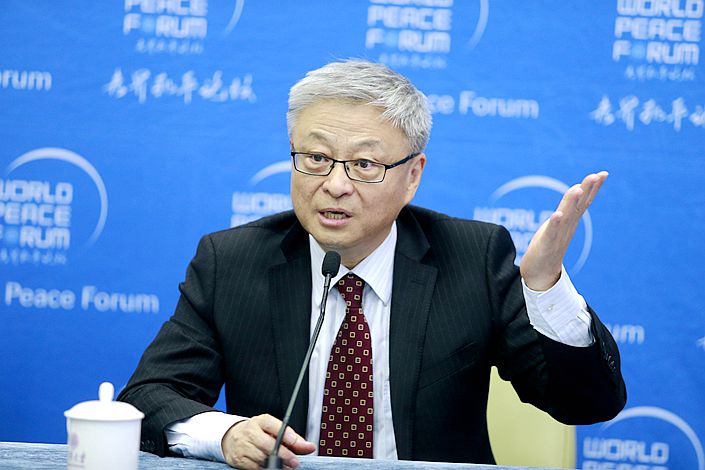
Prof. Cheng Yawen argues that "🇨🇳 and develop. countries need to break the current core-periphery world order" and build a new international system free from Western interference.
THREAD
sinification.com/p/three-rings-…
Prof. Cheng Yawen argues that "🇨🇳 and develop. countries need to break the current core-periphery world order" and build a new international system free from Western interference.
THREAD
sinification.com/p/three-rings-…
🔹The Author: Cheng Yawen (程亚文) – Researcher at the School of International Relations and Public Affairs, Shanghai International Studies University. 

🔹 Summary of Cheng's views:
1⃣ US-led globalisation and capitalism drove #NATO's eastward expansion. This, in turn, has been the “main reason” behind #Russia’s offensive in #Ukraine.
2⃣ Western-style globalisation is coming to an end.
1⃣ US-led globalisation and capitalism drove #NATO's eastward expansion. This, in turn, has been the “main reason” behind #Russia’s offensive in #Ukraine.
2⃣ Western-style globalisation is coming to an end.

3⃣ #China’s rise is threatening the current US-led international order whose rules have been designed to benefit the West.

4⃣ The #UkraineRussiaWar️ has laid bare the West's intent to unite in order to suppress non-Western countries – China and Russia in particular. The #UnitedStates has made clear that “it will not rest until China is defeated”.

5⃣ The West’s decoupling from China is set to accelerate and will continue “for a long time to come”. China’s being hit in its turn by Russia-like sanctions remains a possibility.

6⃣ 🇨🇳 should thus “create a new internat. environment conducive to safeguarding 🇨🇳 nat. security and long-term develop.” It should do so by reassessing “🇨🇳 past tradition of multilateralism” and by shifting its diplomatic focus away from the West towards the Global South (+🇷🇺).
7⃣ This, however, does not mean completely shunning the West. Engaging and even developing cooperative relations with western countries should continue whenever possible.

8⃣ China should categorise its diplomatic relations with the world into “3 rings” and prioritise these as follows: 1. East Asia, Central Asia + the Middle East; 2. Other developing countries in Asia, Africa, and Latin America; 3. Europe, the US and other industrialised countries.

9⃣ To foster this change, China should:
a) Encourage the emergence of a new international payment system, promote the internationalisation of the RMB and provide support for currencies other than the USD (such as the euro).
a) Encourage the emergence of a new international payment system, promote the internationalisation of the RMB and provide support for currencies other than the USD (such as the euro).

b) Upgrade the New Development Bank and Asian Infrastructure Investment Bank.
c) Establish a common energy market and payment network with other Asian countries (incl. the Middle East)
c) Establish a common energy market and payment network with other Asian countries (incl. the Middle East)
d) Strengthen both financial and security cooperation with other Shanghai Cooperation Organisation (SCO) members and Iran.
e) Deepen East Asia’s (as understood in its broadest sense) economic integration.
e) Deepen East Asia’s (as understood in its broadest sense) economic integration.
f) De-emphasise growth-driven strategies in favour of political and security-related ones. This will help reduce Western interference in the region.
g) Use the BRICS as a catalyst for South-South cooperation.
g) Use the BRICS as a catalyst for South-South cooperation.
🔟 Quote: “The emergence of a new world-system and the deepening of South-South cooperation will allow China to enter the forefront of the world economy and politics.”

📣 To receive weekly insights from Chinese think-tank and academic circles on a range of international topics, you can subscribe here at no cost:
sinification.com/p/three-rings-…
sinification.com/p/three-rings-…
• • •
Missing some Tweet in this thread? You can try to
force a refresh