Common sentiment is that "audience-first" is the correct approach:
Create content, gain attention, build something for your new audience, sell it, and celebrate your new found success.
But if you're starting from scratch today, is that your only path? 🧵👇
Create content, gain attention, build something for your new audience, sell it, and celebrate your new found success.
But if you're starting from scratch today, is that your only path? 🧵👇

Audience-first: Build an audience before building a product.
Product-first: Build a product before building an audience.
Product-first: Build a product before building an audience.
But there's another option that can give you even better results:
Build both at the same time.
Build both at the same time.
Here's the playbook:
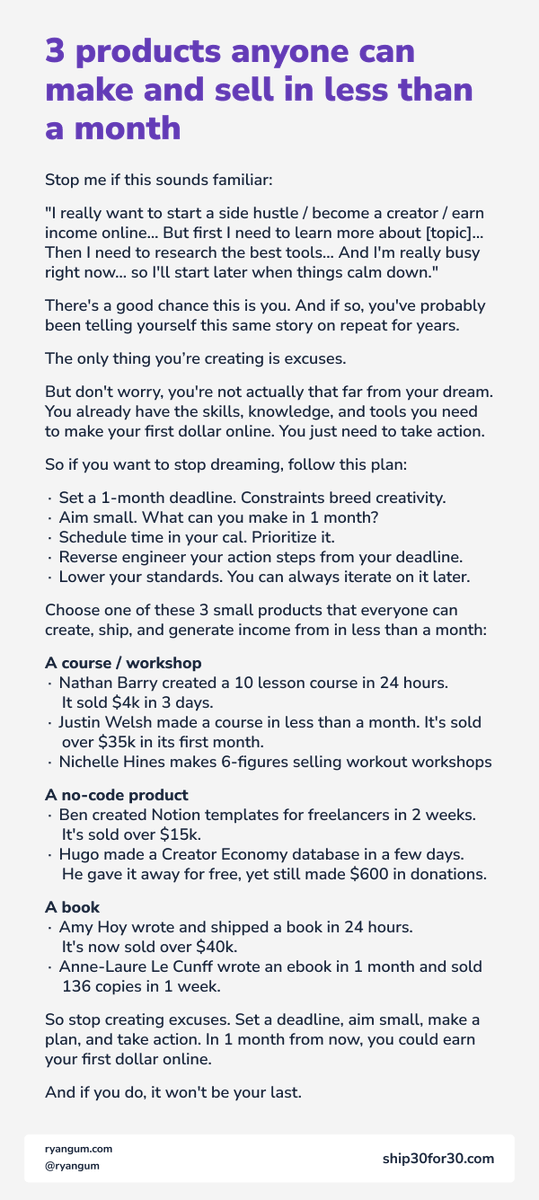
1. Plan your first product.
2. Announce that you're building that product.
3. Build an audience around the idea of your product.
4. Work with your audience to refine your product.
5. Launch your product to a much more targeted audience.
1. Plan your first product.
2. Announce that you're building that product.
3. Build an audience around the idea of your product.
4. Work with your audience to refine your product.
5. Launch your product to a much more targeted audience.
I'm not suggesting to build your product in a cave. That is the only wrong approach. Im suggesting that you can build a better audience with more intent if both you and your audience know where you're heading.
The difference is subtle.
The difference is subtle.
There are 3 unique advantages to building at the same time that you don't get with a pure audience-first approach:
🏅 Establish credibility earlier.
🎯 Create focused content.
🔥 Build a primed audience.
🏅 Establish credibility earlier.
🎯 Create focused content.
🔥 Build a primed audience.
🏅 Establish credibility earlier.
"I tweet about X" vs "I'm writing a book on X" establishes different levels of authority. Anyone can tweet about a topic, but fewer people create books or courses on it. Set yourself apart from the crowd.
"I tweet about X" vs "I'm writing a book on X" establishes different levels of authority. Anyone can tweet about a topic, but fewer people create books or courses on it. Set yourself apart from the crowd.
🎯 Create focused content.
When you know where you're heading, you can create content with purpose from the start. Deciding what content to create simply becomes a matter of asking, "Will this appeal to the same person who will also want to buy my product later?" If not, pass.
When you know where you're heading, you can create content with purpose from the start. Deciding what content to create simply becomes a matter of asking, "Will this appeal to the same person who will also want to buy my product later?" If not, pass.
🔥 Build a primed audience.
Anyone who subscribes or follows you now does so with the intent of learning more about your product. In the audience first product second approach, your audience might be larger, but it won't anywhere near as targeted.
Anyone who subscribes or follows you now does so with the intent of learning more about your product. In the audience first product second approach, your audience might be larger, but it won't anywhere near as targeted.
Audience-first can work. Audience and product at the same time can also work. Product first is the only true wrong path.
• • •
Missing some Tweet in this thread? You can try to
force a refresh