Should vaccinated people stop wearing masks?
Happy to contribute to article @B_resnick w @MonicaGandhi9@AbraarKaran@DocJeffD@DrJeanneM
Short thread w/ my perspective on how to navigate CDC guidance on masks post-vaccination.
1st: Protection from vaccination is NOT 100% (no surprise to anyone that follows me to hear this)
So, despite being vaccinated, I'm still going to wear a mask in what I consider high(er) risk situations - indoors w/ dozens of households, unless community transmission is VERY low.
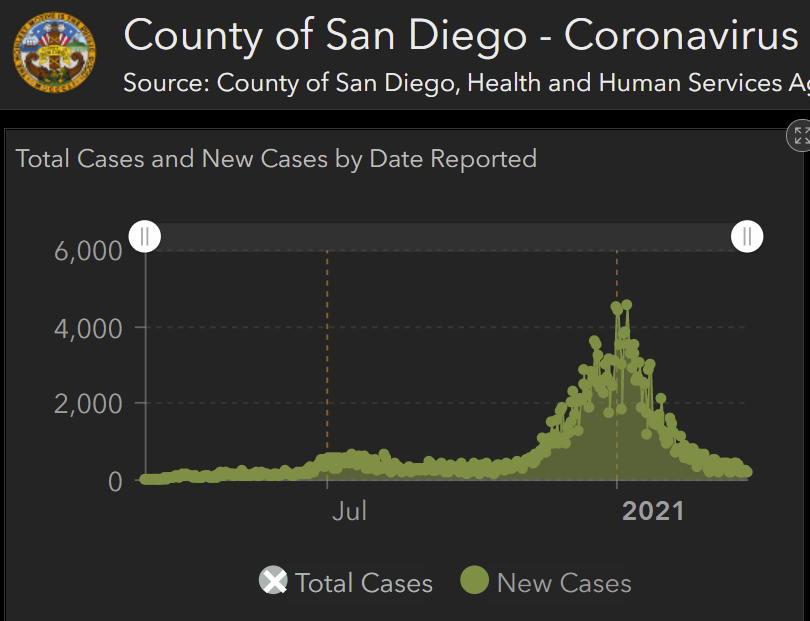
What is very low? My perspective: CA (where I live) has tiers based on daily cases/100K. Lowest tier is <2/100K. If we assume there are 5 infections/case & people are infectious for 10d, this translates to 1/1K. Pretty low. If everyone is vaccinated, risk ~10x+ lower so <1/10K.
So if everyone at indoor event was vaccinated in a county w/ <2 cases/day/100K, then if there were 100 people at event, prob of 1+ infected person would be <1%. I'd prefer prob to be <0.1%. So I'd unmask at 10 person dinner but not 100+ person dance party. @joshuasweitz
I am ~50 yr old, no major pre-existing conditions. If I were older or at-risk, my risk tolerance would go down. If younger, or more risk-tolerant (ride motorcycles @ 100+mph, into base-jumping), then maybe 100+ person vaccinated dance party is ok.
No hard rule, but an idea of how to think about it. @Bob_Wachter has a similar approach (
), but uses % of asymptomatic people testing positive in SF to assess risk. If only all of US had data like this (like UK does!). There is this: nytimes.com/interactive/20…
2nd, I live w/ another person so I also have to think of them. Full mRNA vaccination reduces risk of infection + transmission by ~85-95% (
). Again, not 100%. So, in addition to protecting myself, I'll mask in high(er) risk situations (see above).
As above, adjust your risk tolerance to include chance that your household member might get sick if exposed to virus from you. If they are unvaccinated, older, or at-risk for severe disease, adjust accordingly.
Thus, I'd have preferred CDC guidance on masks post-vaccination to be more honest & include nuance (right @zeynep?): "Post-vaccination, you don't need a mask outdoors, or indoors in lower risk settings: (small gatherings in low-medium risk areas: nytimes.com/interactive/20…). (cont)
In higher risk indoor settings (e.g. large gatherings in moderate or higher risk areas nytimes.com/interactive/20…), please continue to wear a mask, especially if you or your household members are older or at risk for severe disease."
Finally, if incentivizing vaccination was one of they key reasons for loosening mask requirements, then why not make the explicit link b/w vaccination & masks: "The more people are vaccinated, the faster cases will fall, making everyone safer, and eliminating the need for masks."
• • •
Missing some Tweet in this thread? You can try to
force a refresh

What is the trajectory of viral load dynamics & test sensitivity post-INFECTION?
We're 17 month into the pandemic &, shockingly, this Q is still only partly answered.
Recent paper using a study design I proposed 12 months ago provides detailed look & raises many questions.
Background
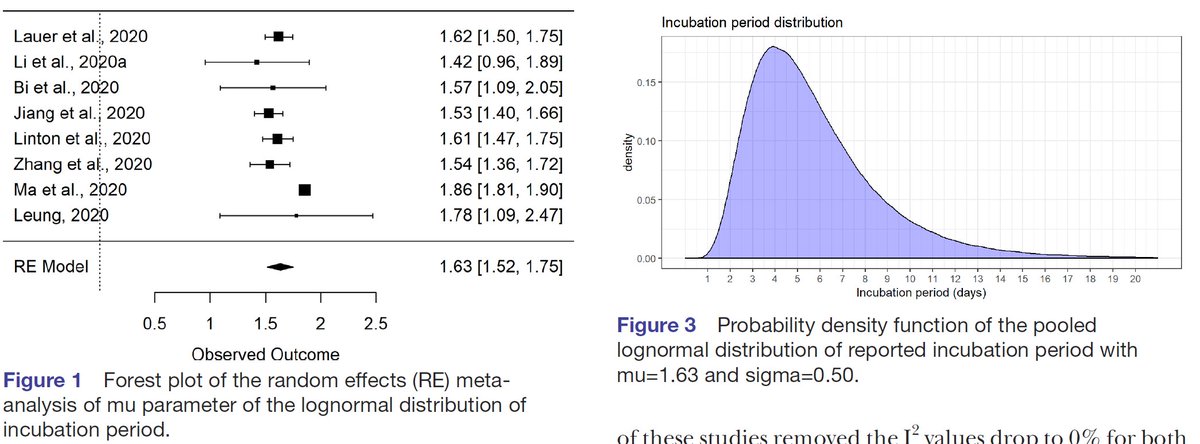
We know that ~3-6d following infection COVID-19 symptoms start (the incubation period). doi:10.1136/
bmjopen-2020-039652
We also know that people are infectious before symptom onset - this has been one of the greatest challenges in controlling SARS-CoV-2.
How effective are vaccines vs severe & all disease, death, infection, & transmission?
Very nice collection of studies assessing different aspects of vaccine protection by Julia Shapiro (on twitter?) @nataliexdean@betzhallo@ilongini & 2 others.
Thread medrxiv.org/content/10.110…
Study has data on many different measures of protection:
all infection (symp + asymp), all symptomatic (mild+severe), severe, hospitalization, death, & transmission,
for 8 vaccines: Moderna, Pfizer, Novavax, Astrazeneca, Sinopharm, Sinovac, Sputnik, J&J,
3 variants&
1&2 doses
Interesting thread @trvrb on growth of B.1.1.7, P.1, B.1.351 in US
I worry about key assumptions underlying these analyses:
-sequences are random sample of state/US infections (definitely not)
-trends in sequences represent local transmission rather than changes in imported cases
Many of the P.1, B.1.351 numbers are very low & introduced cases can make a substantial contribution to total count. Increased transmission elsewhere (e.g. Europe, S America) & constant introductions can lead to apparent increase in US for foreign variants.
In addition, increased detection of introduced cases can also bias results towards observing a local increase of an introduced variant.
Are cases (not frequencies) of P.1 really increasing in many states as @trvrb suggests? Possibly.
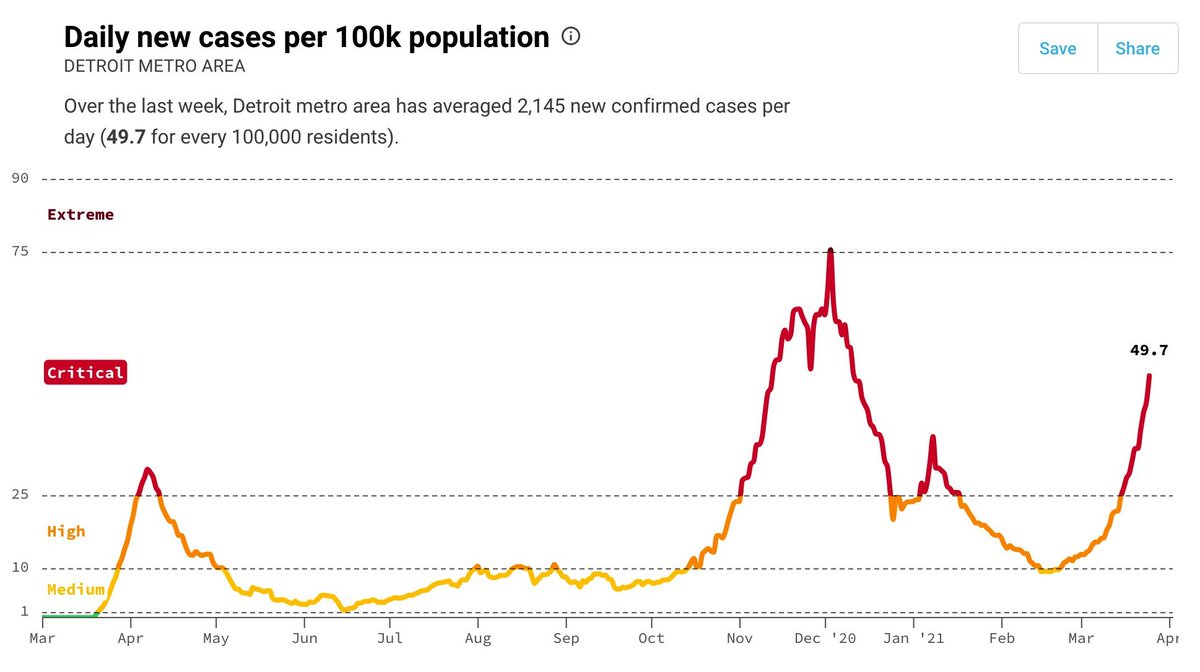
Vaccination can have rapid impacts on transmission & disease & surging vaccines to MI could save many lives.
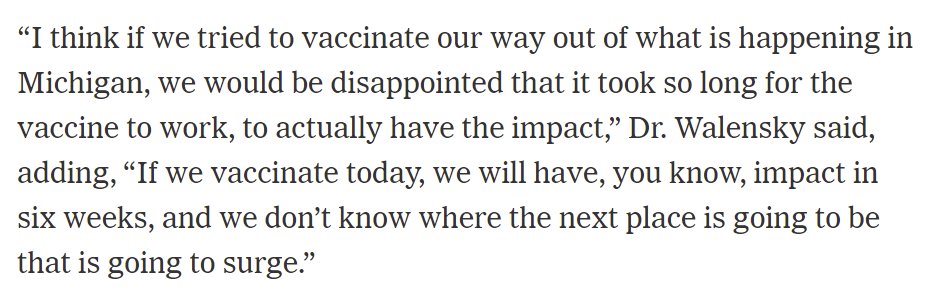
Comments in NYT article from multiple health officials including @CDCDirector@celinegounder are surprisingly at odds w/ data. 1-2 wks not 6. nytimes.com/2021/04/12/us/…
@CDCDirector argues increasing vaccine supply to MI would take 6 weeks to take effect.
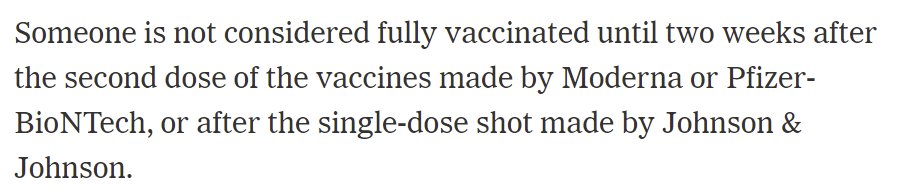
Article by @noahweiland@MitchKSmith tries to explain this by stating that time for full protection w/ mRNA vaccines. But we know 1 dose offers substantial protection vs disease AND infection.
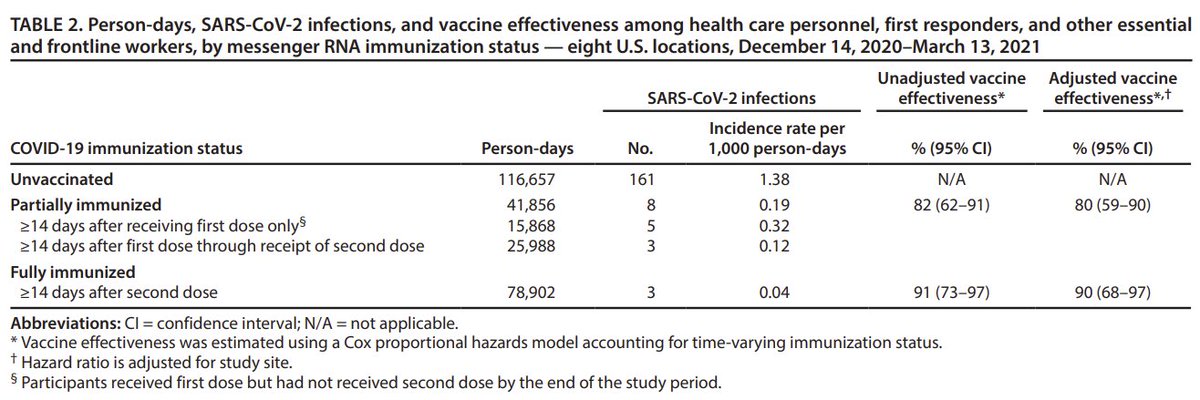
Paper published in CDC's own journal MMWR showed protection against INFECTION (not symptoms) is 80% 2 wks after 1st dose. Thus, vaccinating people could reduce transmission much more quickly than 6 wks. cdc.gov/mmwr/volumes/7…
Why have we given up on targeted vaccination & dose sparing?
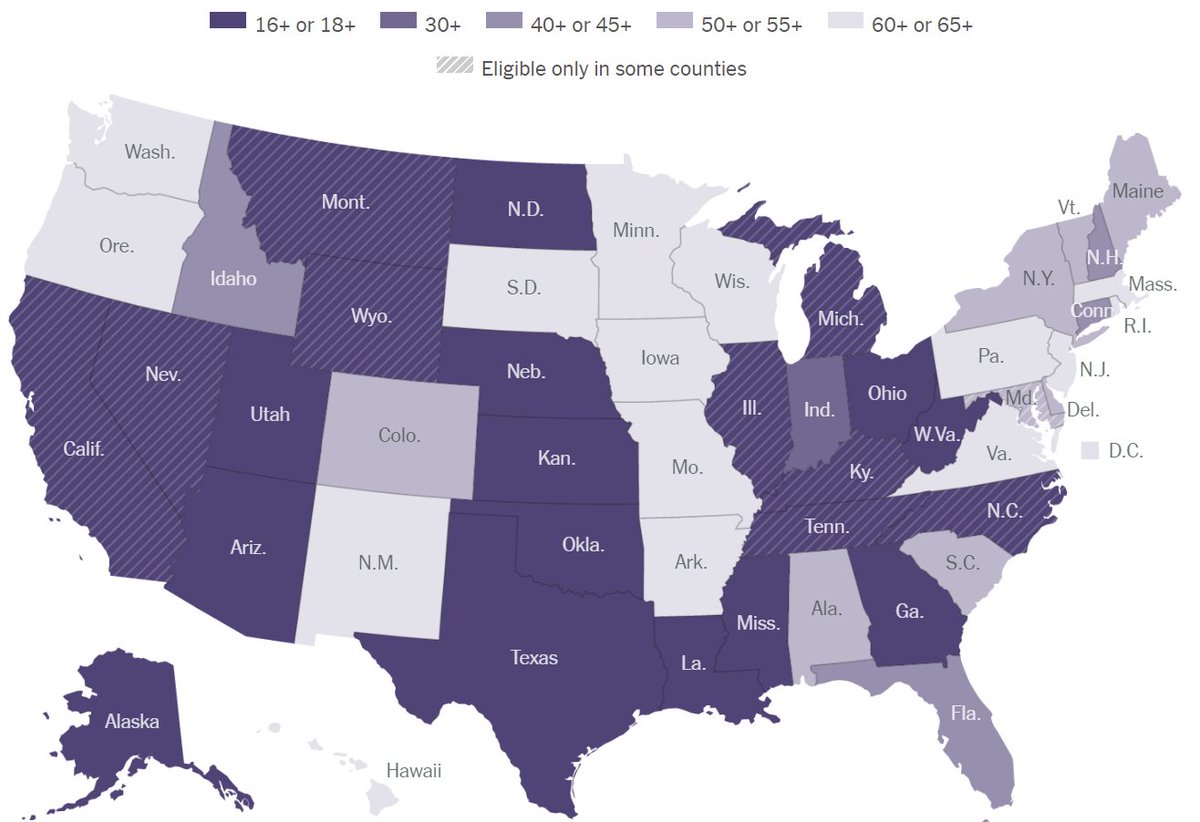
Many announcements like below. Seems great except most 50y+ aren't vaccinated in most states, nor are those w/ pre-existing conditions. Given surging cases & still limited vaccines this will lead to avoidable deaths.
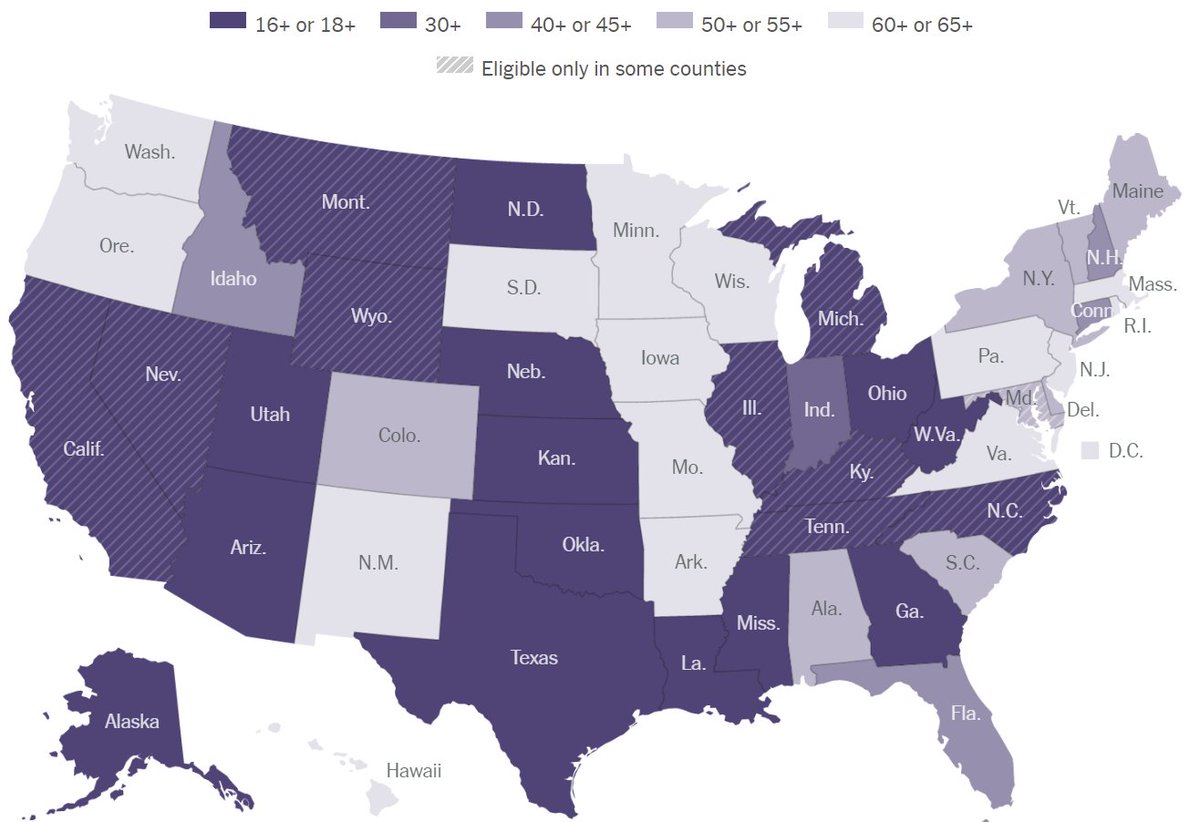
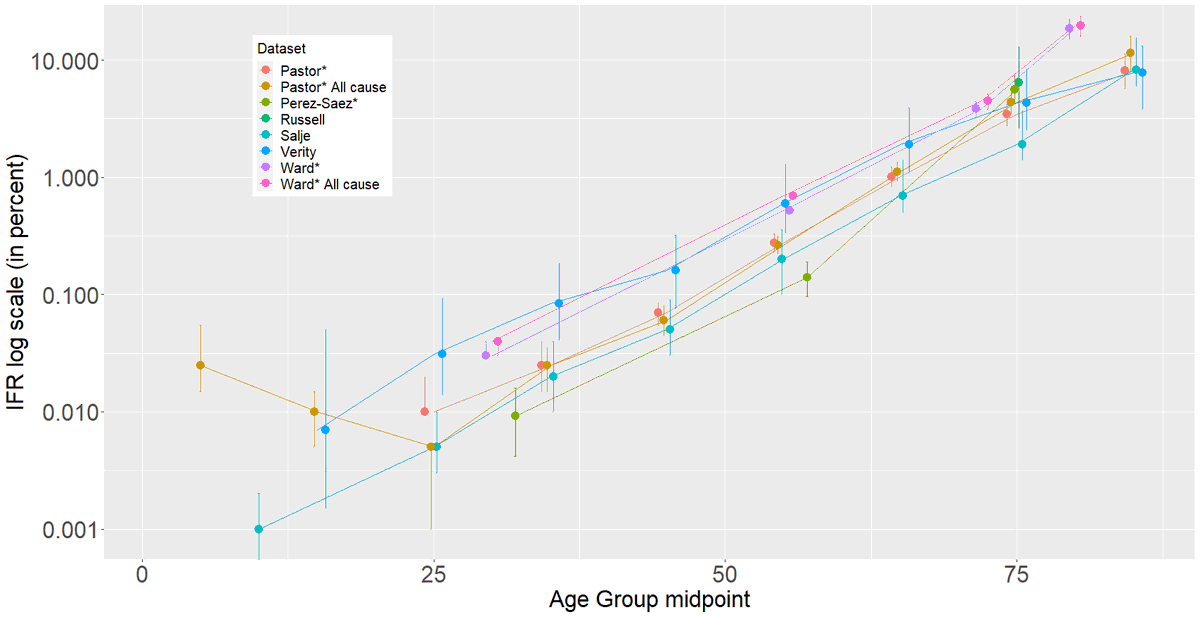
). It's ~10x higher for every 20 yrs of age. Same for hospitalizations. And yet most states are open to 16/18+ (nytimes.com/interactive/20…).
Remember all the discussions about ways to vaccinate faster? Half-doses? Large gap b/w doses? 0/1 doses initially for already infected? Now clear strong evidence for all these strategies, & yet...
silence.
Differential growth trajectories of B.1.1.7 (UK variant) in US states.
The rate of increase in frequency of B.1.1.7 varies between different locations that also differ in case trajectories. What is driving this?
Thread
We know have clear evidence of variant B.1.1.7 being more 50-100% infectious & ~67% more deadly. It is likely playing an important role in the current surge in cases in Europe. nature.com/articles/s4158… doi.org/10.2807/1560-7…
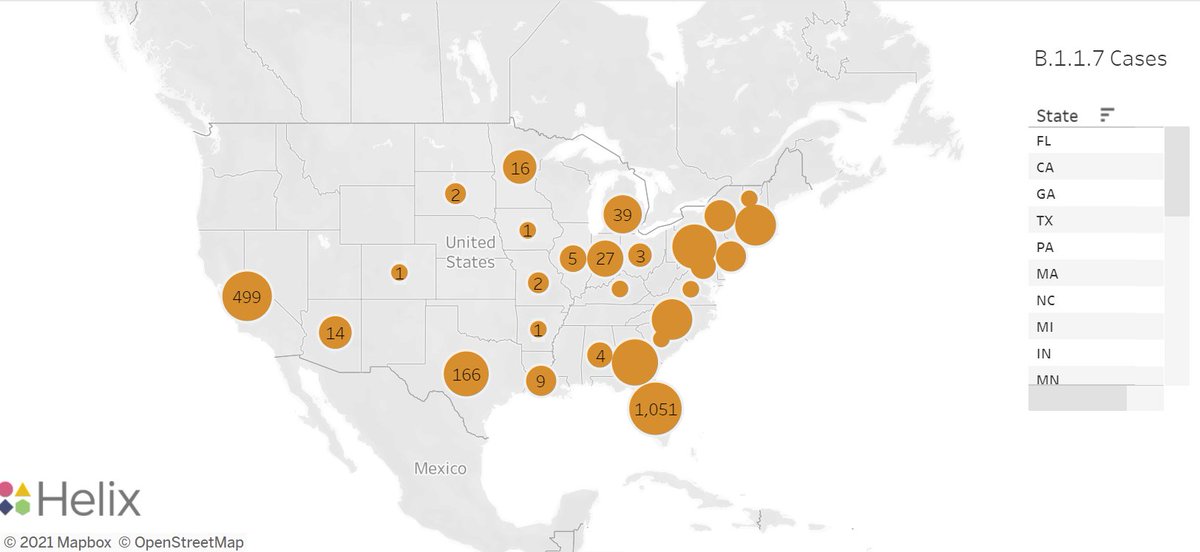
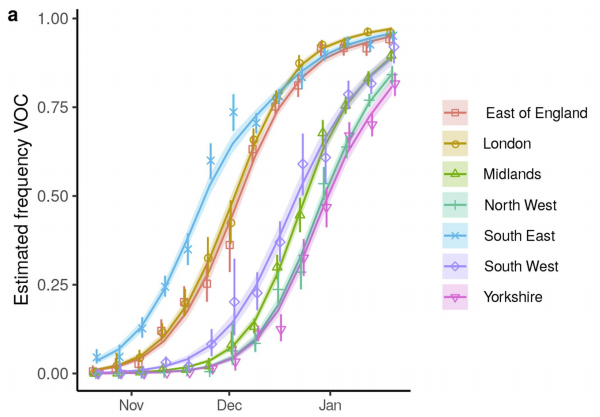
B.1.1.7 has also been detected in many US states(helix.com/pages/helix-co…) & is probably present in most states now. In Jan-Feb most expected it to spread rapidly in US to become the dominant variant like it did in UK Nov-Jan, & other EU countries later (nature.com/articles/s4158…)