1/
I see people are still tweeting (which of course means "arguing" in the Twittersphere) about the "chemical imbalance theory" of psychiatry, so I thought I'd put in my 2 cents.
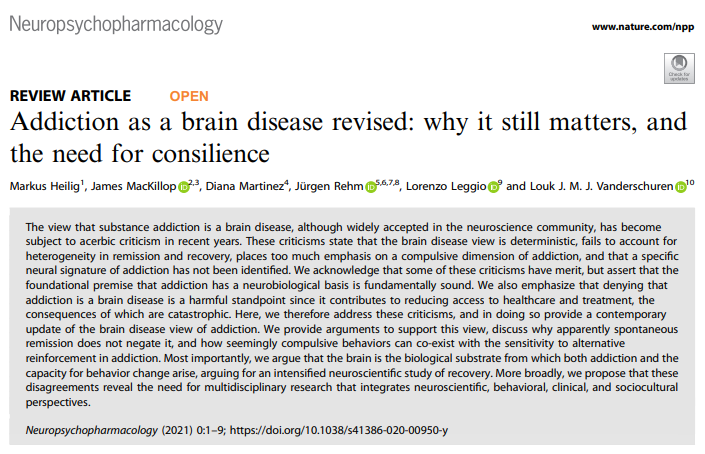
Let's start with something that I wrote with @jonathanstea and @tylerblack32:
I see people are still tweeting (which of course means "arguing" in the Twittersphere) about the "chemical imbalance theory" of psychiatry, so I thought I'd put in my 2 cents.
Let's start with something that I wrote with @jonathanstea and @tylerblack32:
2/
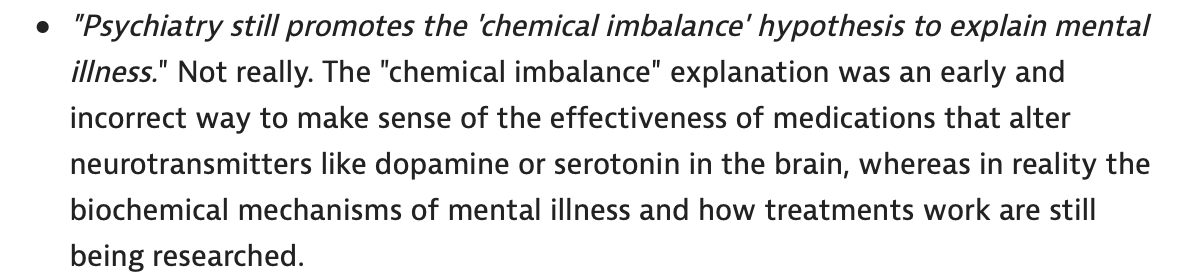
Here's something else I wrote about it:
Here's something else I wrote about it:

3/
Now, by way of further explanation, I remember using the phrase "chemical imbalance" exactly once in my career. It was when I was a resident answering my mother, who was asking me why people get depressed.
Now, by way of further explanation, I remember using the phrase "chemical imbalance" exactly once in my career. It was when I was a resident answering my mother, who was asking me why people get depressed.
4/
I explained that people can get depressed in response to stressors, but can also happen due to genetic factors and a chemical imbalance.
Everyone seems to accept the "trauma" claim, but not the "chemical" one, so why did the "chemical imbalance" account arise?
I explained that people can get depressed in response to stressors, but can also happen due to genetic factors and a chemical imbalance.
Everyone seems to accept the "trauma" claim, but not the "chemical" one, so why did the "chemical imbalance" account arise?
5/
It arose because 1) some people appear to get depressed "out of the blue" without a clear stressor... this observation was acknowledged decades ago in psychiatry and led to modeling depression as either "reactive" (stressor induced) or "endogenous" (coming from within).
It arose because 1) some people appear to get depressed "out of the blue" without a clear stressor... this observation was acknowledged decades ago in psychiatry and led to modeling depression as either "reactive" (stressor induced) or "endogenous" (coming from within).
6/
and 2) because some people's depression gets better with antidepressant treatment and without psychotherapy, which was in part the lesson of "listening to prozac" in the 1980s and 1990s.
and 2) because some people's depression gets better with antidepressant treatment and without psychotherapy, which was in part the lesson of "listening to prozac" in the 1980s and 1990s.
7/
We don't really know what causes depression, or more properly major depression, but with the observation that it can come out of the blue and go away with medication, the chemical imbalance hypothesis was born.
We don't really know what causes depression, or more properly major depression, but with the observation that it can come out of the blue and go away with medication, the chemical imbalance hypothesis was born.
8/
I don't ever recall being taught the "chemical imbalance" phrase in residency during the "decade of the brain," but I do recall learning about the "dopamine hypothesis of schizophrenia" as well as the "serotonin hypothesis of depression" that was borne from such observations.
I don't ever recall being taught the "chemical imbalance" phrase in residency during the "decade of the brain," but I do recall learning about the "dopamine hypothesis of schizophrenia" as well as the "serotonin hypothesis of depression" that was borne from such observations.
9/
I also recall learning the limits of those hypotheses and that it's probably much more complicated than that. Personally, I have never been a big fan of pathophysiologic explanations of psychiatric disorders, because the reality is that we understand very little of it.
I also recall learning the limits of those hypotheses and that it's probably much more complicated than that. Personally, I have never been a big fan of pathophysiologic explanations of psychiatric disorders, because the reality is that we understand very little of it.
10/
It seems as if there are some that view "chemical imbalance" as if it's like George Bush and Dick Cheney claiming Sadam Hussein had WMD, trying to sell a trusting public on an illusory biological lesion in depression that justifies pharmacotherapy. I get that.
It seems as if there are some that view "chemical imbalance" as if it's like George Bush and Dick Cheney claiming Sadam Hussein had WMD, trying to sell a trusting public on an illusory biological lesion in depression that justifies pharmacotherapy. I get that.
11/
My take is that the chemical imbalance theory was more handwaving trope than hard explanation, more a way to provide a simple account of the observations in 5/ and 6/ above, than a way to sell people on something that didn't exist or claim "what's wrong" with them.
My take is that the chemical imbalance theory was more handwaving trope than hard explanation, more a way to provide a simple account of the observations in 5/ and 6/ above, than a way to sell people on something that didn't exist or claim "what's wrong" with them.
12/
So, going back to 1/ and 2/ above, was "chemical imbalance" an early and incorrect (or incomplete and oversimplistic) way to account for 5/ and 6/ and provide an explanation for why antidepressants might work?
Absolutely.
So, going back to 1/ and 2/ above, was "chemical imbalance" an early and incorrect (or incomplete and oversimplistic) way to account for 5/ and 6/ and provide an explanation for why antidepressants might work?
Absolutely.
13/
Is it a "straw man"--did or does "psychiatry" officially endorse this phrase? That might depend on one's definition of when we're talking about and what we mean by "psychiatry."
Is it a "straw man"--did or does "psychiatry" officially endorse this phrase? That might depend on one's definition of when we're talking about and what we mean by "psychiatry."
14/
I would say that today, based on 5/ and 6/, many psychiatrists including myself do believe that "chemicals" (e.g. neurotransmitters) are relevant to "depression" and antidepressant response.
I would say that today, based on 5/ and 6/, many psychiatrists including myself do believe that "chemicals" (e.g. neurotransmitters) are relevant to "depression" and antidepressant response.
15/
But this isn't a claim that stressors/trauma are irrelevant or noncontributory, only that the reactive/endogeneous models--a distinction that's no longer made--are complementary or unified in ways that we don't fully understand.
But this isn't a claim that stressors/trauma are irrelevant or noncontributory, only that the reactive/endogeneous models--a distinction that's no longer made--are complementary or unified in ways that we don't fully understand.
16/
It's also not a claim that antidepressants always help people who suffer from major depression or "depression," which is clearly not the case.
Some respond to psychotherapy, some to meds, some to both, some to neither and some don't respond at all.
Welcome to psychiatry.
It's also not a claim that antidepressants always help people who suffer from major depression or "depression," which is clearly not the case.
Some respond to psychotherapy, some to meds, some to both, some to neither and some don't respond at all.
Welcome to psychiatry.
@AllenFrancesMD @awaisaftab @jonathanstea @dawso007 @DrWinarick @amybarnhorst @ProfRobHoward @SameiHuda @PeterDKramer @sanilrege @Ema_SB @DebiecJacek @KazJNelson @DrHowardLiu @pash22 @PsychSIGN @JRBneuropsiq
@threadreaderapp unroll please
• • •
Missing some Tweet in this thread? You can try to
force a refresh