Why in the world should #Putin send us gas if we open #NordStream2? Some people still haven't understood: He wants an energy crisis in EU, because our #sanctions are crippling his economy and our weapons are defeating his army. He will not send any gas through any pipeline! 1/3
#NordStream2 is last year's quarrel. The stakes are much higher now. There will be no gas for the EU while Russia's economy is nosediving and Western arms flow to #Ukraine. It is a nice fairytale that Putin would come to the rescue if we just did this one more little thing. 2/3
One more time: We will NOT get more gas if we open #NordStream2. You say: But Putin is promising it! Well, you are being fooled again! Nord Stream 2 is peanuts, compared to our other #sanctions. The only way #Gazprom sends gas is if we completely give up supporting Ukraine. 3/3
• • •
Missing some Tweet in this thread? You can try to
force a refresh

1/ Is #Russia flaring gas on a massive scale? Here is another approach to solving that question: Natural gas and gas condensate production should normally go hand in hand. Here is a dot plot of Russian monthly production of gas and gas condensate (unstabilized) until April 22.
2/ The correlation is strong, as expected (r=0.85). My assumption is that gas condensate doesn't have to be flared, because it is easier to store than natural gas. Thus, if #Gazprom is reducing its production by flaring the correlation should break down.
3/ If #Gazprom is reducing its production by shutting down wells, the correlation should rather remain intact (less condensate production). Gazprom's natural gas production started falling dramatically in April.
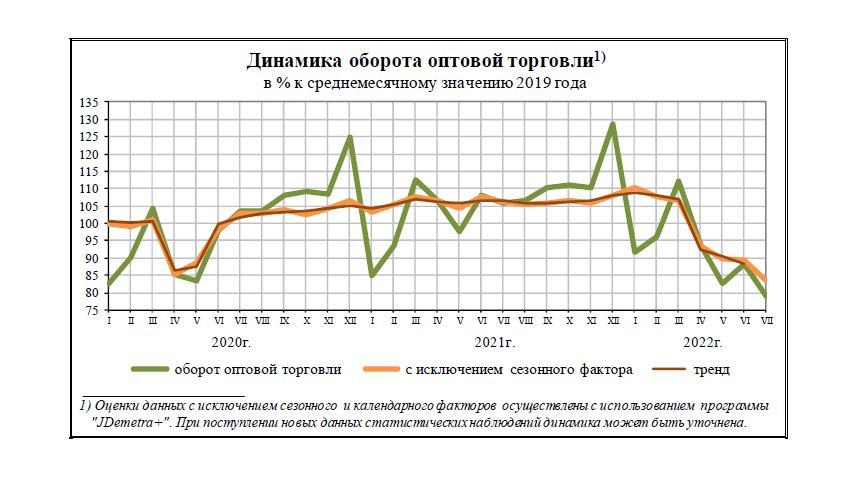
1/ Most economic indicators in #Russia's monthly statistics have stabilized. One exception: The crash in wholesale turnover seems to be continuing unabated. Wholesale turnover has fallen by 25.4% year over year! What's happening? Spoiler: It's Putin's gas blackmail backfiring. 1/
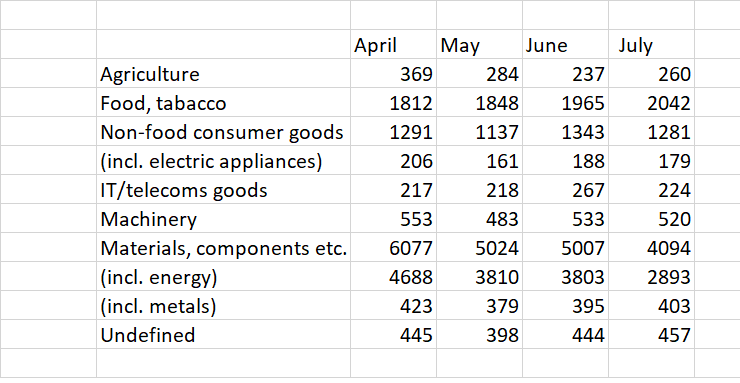
2/ Rosstat hasn't published the individual components of wholesale turnover in absolute terms (at least I couldn't find it), but it is possible to calculate them based on the relative weight of different sectors, which Rosstat publishes.
3/ Here is the resulting wholesale turnover (in current prices). There are some seasonal changes (not important here). Important is the general role that different sectors play. Wholesale turnover is dominated by raw materials, more precisely: energy trade.
1/ Explainer: Why the timing of a crisis has a critical impact on annual GDP figures. Annual GDP depends very much on one thing: In which quarter did the crisis start? These are 4 _identical_ economic crises with subsequent recovery. They start 3 months apart.
2/ Now let's look at the result change in annual GDP in the first 3 calendar years of these hypothetical crises: The difference that a 3-month delay makes! #Russia's current crisis started in Q2 (~red). If Russia had started its war 3 months earlier, we would be looking at ~blue.
3/ The drop in Russian GDP during the Global Financial Crisis fit neatly into the year 2009, resulting in a 7.8% contraction, with growth in 2008 and 2010. It is just this _coincidence_ that makes 2009 look so harsh, and 2022 look rather benign.
1/ Is #Gazprom flaring on a massive scale? I am reopening the case! The flare near #Finland is huge, but it can only burn ~1% of the missing delivieres. BUT: What if there are more? Quite possibly, Gazprom's declining production numbers are actually a _result_ of flaring.
2/ In recent weeks, NASA FIRMS was sometimes used to assess the intensity of artillery in Ukraine. It can also be used to detect flaring. The big flame near Finland appeared for the first time on June 17th. Since then the satellite shows it clearly. firms.modaps.eosdis.nasa.gov/map/#t:adv;d:2…
3/ I checked some places near Novy Urengoy, famous for its gas production. And the first installation I looked at was an immediate hit: It was this flare stack in the East of Novy Urengoy. I went through the last years, and there was only a little activity in late '20/early '21.
There is one key contradiction in the Kremlin's propaganda about the war that could eventually become a problem. On the one hand, Putin wants the population to ignore what's happening, live their lives undisturbed, and be cynical or ignorant. 1/
On the other hand, the justification for the war and the costs associated with it is highly normative: It is supposedly about saving the people in Donbas, protecting them, fighting against Nazis etc. The justification tries to allure to values. /2
You could call this propaganda differentiation - Russians can pick the reality they like. Either its just a military operation, nothing to worry about... or it is essentially the continuation of the Great Patriotic War, and a moral or even existential duty for Russia to fight. /3
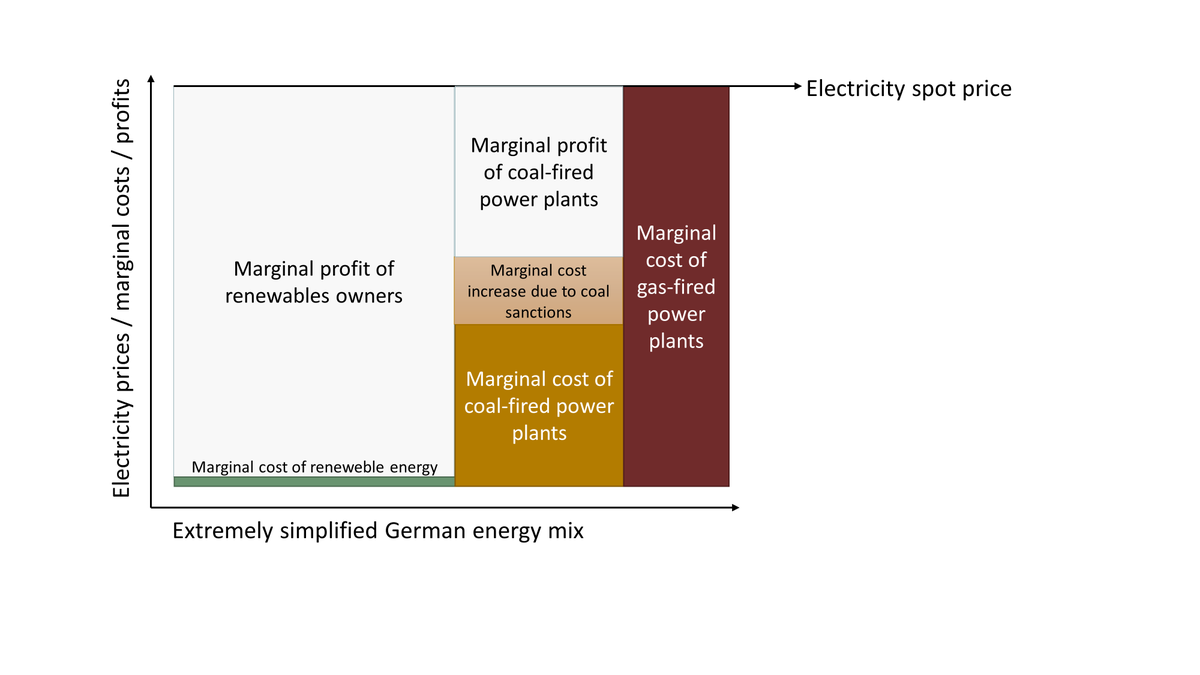
1/ Der einzige relevante, aktuell (seit einigen Tagen) sanktionierte Energieträger aus Russland ist Kohle. Diese Sanktion erhöht den Kohlepreis. Das ist allerdings eher für die Profite der Energiekonzerne ein Problem als für die Verbraucher. Hier eine sehr vereinfachte Grafik:
2/ Der Strompreis ist ein Marktpreis, d.h. er wird von dem Anbieter mit dem höchsten Grenzkosten bestimmt. Aktuell sind das Gaskraftwerke. Die Betreiber von Erneuerbaren/Kohle/Atom etc. können sich freuen, weil es ihre Margen erhöht.
3/ Solange Gas aus Strom notwendig ist, spielt der Kohlepreis für den Strompreis keine Rolle. Die Kohle könnte kostenlos sein, es würde den Strom nicht billiger machen. D.h. in dieser Situation haben die Sanktionen keinen negativen Effekt für die meisten Stromkäufer.