pikuma.com Profile picture
Aug 5, 2023 9 tweets 3 min read Read on X
Why do we call it the "Square Root"?

√‾‾‾

We have been using the popular square root symbol since childhood, yet most of us don't stop to think where it came from.

Let's fix that... 🧵 https://t.co/DkMqpcRSrztwitter.com/i/web/status/1…
square root symbol
The Italians (around 1100~1200 A.D.) started to trade with the north of Africa. And back then, the north of Africa which was strongly touched by the Islamic empire.

The vast Islamic empire came from the Middle East and expanded to Asia, India, and also Europe. Islamic Empire (1000 a.d)
One famous Italian tradesman was Leonardo Bonacci (Fibonacci).

Fibonacci used to trade between Pisa and what we know today as Algeria.

As he traded with the Islamic people, he acquired a large understanding of their math.

In 1202 he wrote "Liber Abaci." Fibonacci
Fibonacci thought it was important to demonstrate this Islamic math to the Europeans.

Liber Abaci was one of the first Western books to describe the Hindu–Arabic numeral system and to use symbols resembling modern "Arabic numerals". Liber Abaci
By addressing applications of both commercial tradesmen and mathematicians, it promoted the superiority of the system & these glyphs.

In this book, we can find one of the first mentions of something called "Radix Quadratum."
Some early notations used acronyms like "Rad" or just "R".

For example, to express that the square root of 9 is 3, we found manuscripts stating that:

"Rad9a3"
In 1525, Christoph Rudolff used the symbol "√" to represent the square root.

The symbol √ was *probably* inspired by the letter "r" from previous manuscripts.

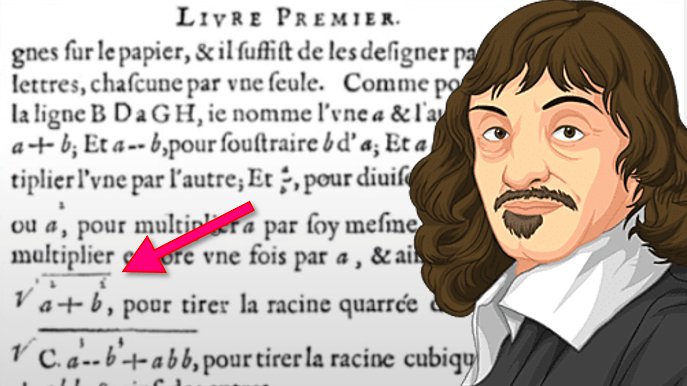
The complete symbol - with the upper part (√‾‾) to enclose the entire radicand - would only appear in 1637. Christoph Rudolff
And in 1637, René Descartes wrote "La Géométrie", which was the first to propose the idea of uniting algebra & geometry into a single subject (inventing an algebraic/analytic geometry).

It was the first time we saw the symbol that most of us recognize today as "Square Root". René Descartes
And just to conclude out thread...

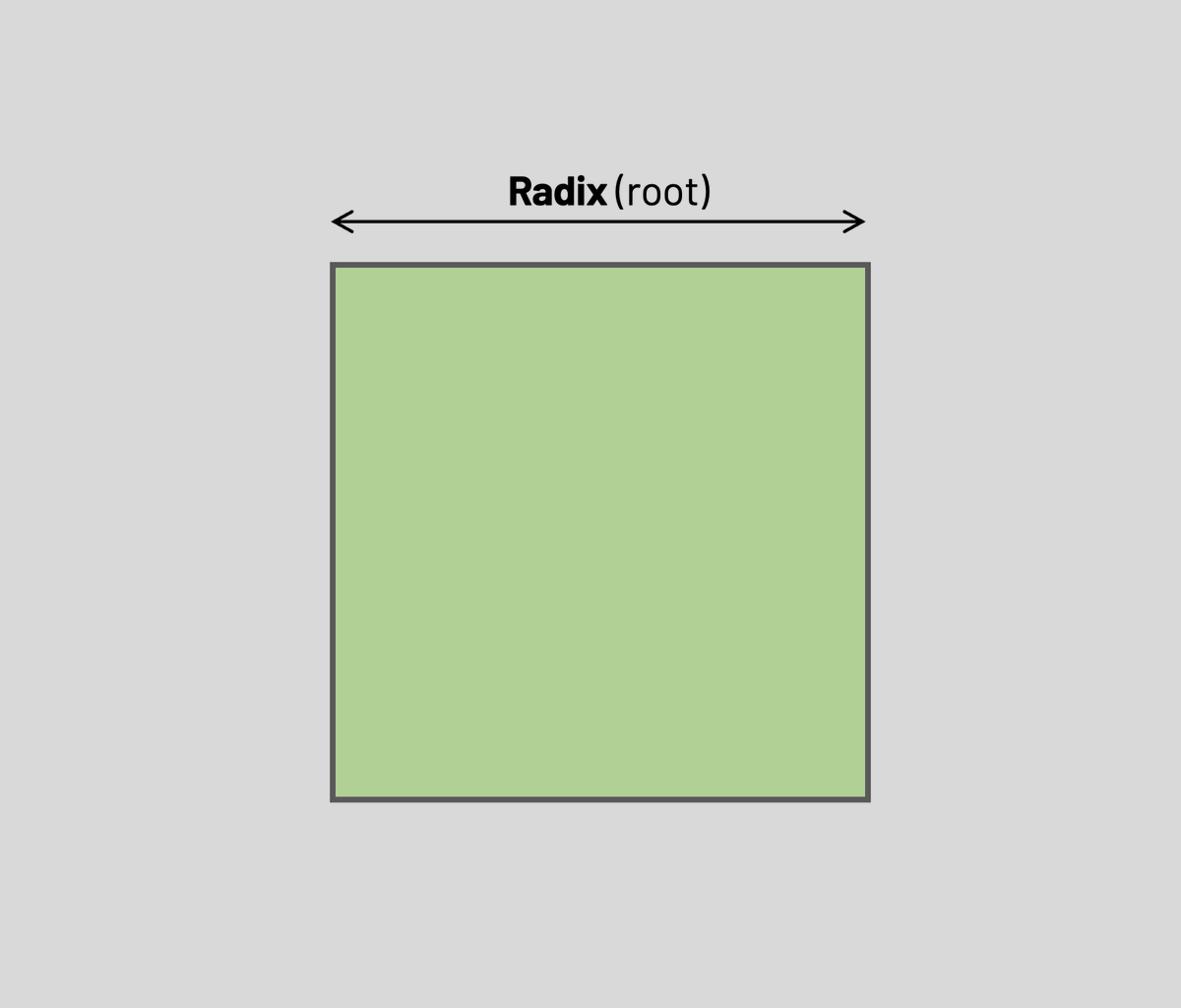
The Radix (the root) is what the Islamic called the sides of a square.

If you think about it, with a single side, one knows how to generate the entire square.

That's why the side is, indeed, the root of the shape. 🙂

Boom! ❤️ Radix / root of a square
• • •

Missing some Tweet in this thread? You can try to force a refresh

 

Keep Current with pikuma.com

pikuma.com Profile picture

Stay in touch and get notified when new unrolls are available from this author!

Read all threads

This Thread may be Removed Anytime!

PDF

Twitter may remove this content at anytime! Save it as PDF for later use!

Try unrolling a thread yourself!

how to unroll video
  1. Follow @ThreadReaderApp to mention us!

  2. From a Twitter thread mention us with a keyword "unroll"
@threadreaderapp unroll

Practice here first or read more on our help page!

More from @pikuma

Sep 14, 2023
If you're programming a game where a boat moves through water, you might be tempted (as I would) to change the V-shape angle of the waves behind the boat based on how fast the boat was moving!

What if I told you that that V-shaped angle is always 19.47°, regardless of how fast the boat is travelling? 😱

This pattern even holds true for a duck traversing a pond. 🦆

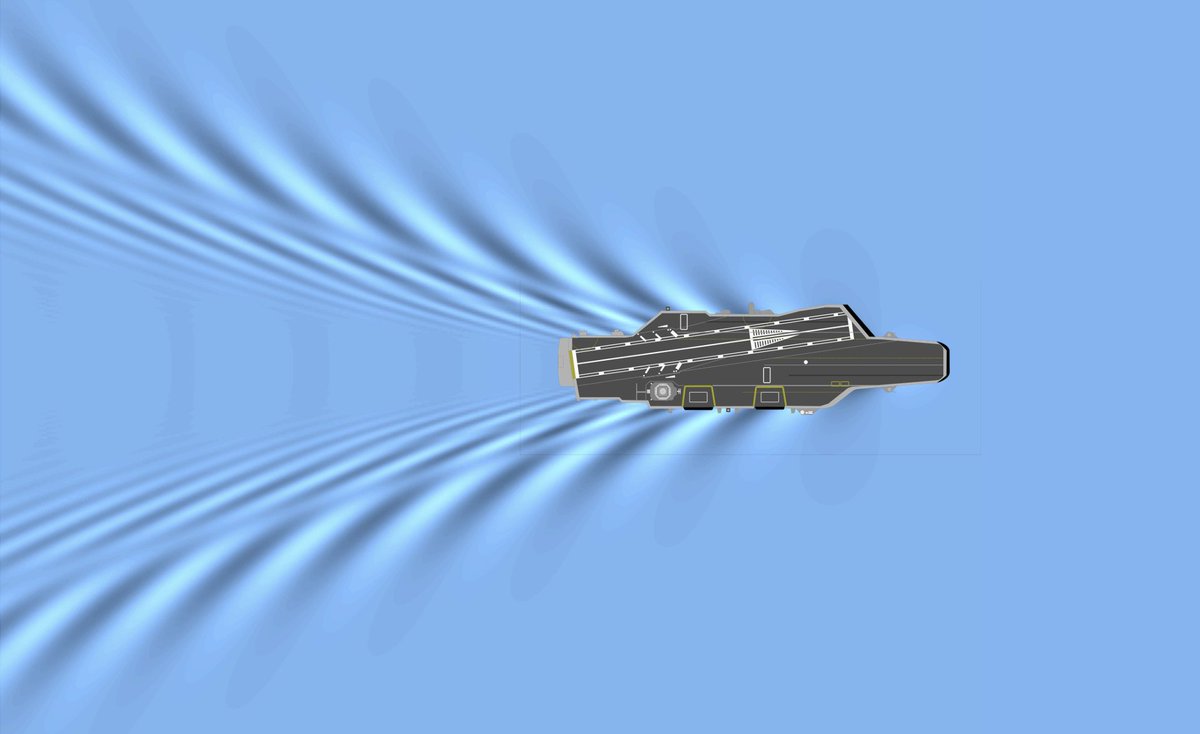
The envelope of these waves stands at a fixed angle, and the wake has a characteristic feathered pattern.

This wake pattern was first explained mathematically by Lord Kelvin (William Thompson) and are known today as the Kelvin wake pattern.
Kelvin angle wake wave pattern
Lord Kelvin described this pattern based on his observations and a rough interpretation of the physics involved. But nowadays we are studying other elements that come into play and can cause small differences based on the object's speed.

Physicists have used satellite images and mathematical modelling to study narrower wakes associated with fast-moving boats. You can read about this discussion here:
Also, here's a quick derivation of how we find the 19.47 degree angle:

.personal.math.ubc.ca/~cass/courses/…
Read 8 tweets
May 9, 2023
Lately, I've been studying the early days of 3D polygons on home consoles for a new course.

We often think 3D on the #PS1 or #Saturn, but there was a bracket of time where special chips were added to both #SNES & #Genesis to help them render fast polygons.

Here's a review...🧵
It's probably not news to anyone here that retro consoles added special power to games by adding special chips *inside* the game cartridges!

Therefore, newer and fancier games were more expensive because manufacturing the cartridge with extra chips cost more for the developers. The Nintendo SA-1 chip
If you took our course on #NES programming, you know that this was also true for 3rd gen. consoles.

For example, the NES console is always the same (CPU speed, RAM size, etc.), but NES games got better with time by adding these special chips *per* cartridge! Different chips added insid...
Read 27 tweets
Apr 14, 2023
I remember reading about determinants in high school. The name was scary and not much context was given. 😦

For a long time, a determinant was just a value I had to blindly compute using a formula.

Here's what I would like to know about determinants when I first started... 🧵 twitter.com/i/web/status/1…
The word "determinant" appears when we are learning about matrices.

And since we want to build some *intuition*, let's look at a simple 2x2 matrix first.

We learn that the determinant of a 2x2 matrix is:

| a b |
| c d | = a*d - b*c

But where does that come from? Determinant of a 2x2 matrix
Alright, let's go back in time!

Seki Kōwa was a Japanese mathematician from the Edo period. He had Samurai origins but was adopted into the noble Seki family, subject of the shōgun.

As a kid, he had great potential with numbers. He was often called "Japan's Newton". Seki Kōwa Japanese mathemat...
Read 25 tweets
May 12, 2022
You know I always add some #math spice into my #gamedev courses, and that usually means touching some cool linear algebra.

But something most students still struggle with is the *intuition* behind the #Determinant of a matrix.

Let's quickly look at it together...🙂

[1/18] 🧵
Since we are really interested in building some *intuition*, let's look at the determinant of a 2x2 matrix first.

When we were in high school, we learned that the determinant of a 2x2 matrix is given by:

| a b |
| c d | = a*d - b-c

But, where does that come from?

[2/18]
Seki Kōwa was a Japanese mathematician from the Edo period, and he was sometimes described as "Japan's Newton."

He had Samurai origins but was adopted into the noble Seki family, subject of the shōgun.

As a kid, it was visible that he had great potential with numbers.

[3/18] Seki Kowa
Read 20 tweets
Feb 25, 2022
Since we discussed isometric games in a previous post, let's briefly mention one of the big #devs of this style: Chis Sawyer.

Most retro gamers think Chris' first isometric game was Transport Tycoon, but his journey started 10 years before.

So, let's dive in!

[1/15] 🧵...
In 1984, Chris programmed QOGO.

QOGO was a clone of the popular arcade game #QBert that ran on the Memotech computer.

QBert is one of the most popular arcade games to carry the isometric look. If you are a retro gamer, you probably played (or at least heard of) QBert.

[2/15]
Now, we mortals usually coded for these machines using some sort of BASIC. But we have to remember that BASIC is an interpreted language, meaning every high-level BASIC command needs to be translated to low-level machine code.

And for 8-bit machines, that means *slow*!

[3/15] Memotech MTX computer
Read 15 tweets
Dec 27, 2021
This is one of my favorite folklore stories about computer #bugs!

...

In the 1980s, Jake Poznanski had a programming mentor, Sergei, who was writing software for an SM-1800, a Soviet clone of the PDP-11.

[1/10] 🧵
The computer was just installed at a railroad station near Sverdlovsk, a major USSR shipping center at the time. The new system was designed to route trains and cargo to their intended destinations, but there was a nasty bug that was causing random failures and crashes.

[2/10]
The crashes would always occur once everyone had gone home for the night, but despite extensive investigation, the computer always performed flawlessly during manual and automatic testing procedures the next day.

[3/10]
Read 11 tweets

Did Thread Reader help you today?

Support us! We are indie developers!


This site is made by just two indie developers on a laptop doing marketing, support and development! Read more about the story.

Become a Premium Member ($3/month or $30/year) and get exclusive features!

Become Premium

Don't want to be a Premium member but still want to support us?

Make a small donation by buying us coffee ($5) or help with server cost ($10)

Donate via Paypal

Or Donate anonymously using crypto!

Ethereum

0xfe58350B80634f60Fa6Dc149a72b4DFbc17D341E copy

Bitcoin

3ATGMxNzCUFzxpMCHL5sWSt4DVtS8UqXpi copy

Thank you for your support!

Follow Us!

:(