The 100% Renewable Energy Strategy Group makes no sense to me. Net-zero electricity by 2030 is a target many would argue is near-impossible for even the USA, yet the signatories set exactly the same target for, say, Mongolia. Oh, and no nuclear allowed. (THREAD) 
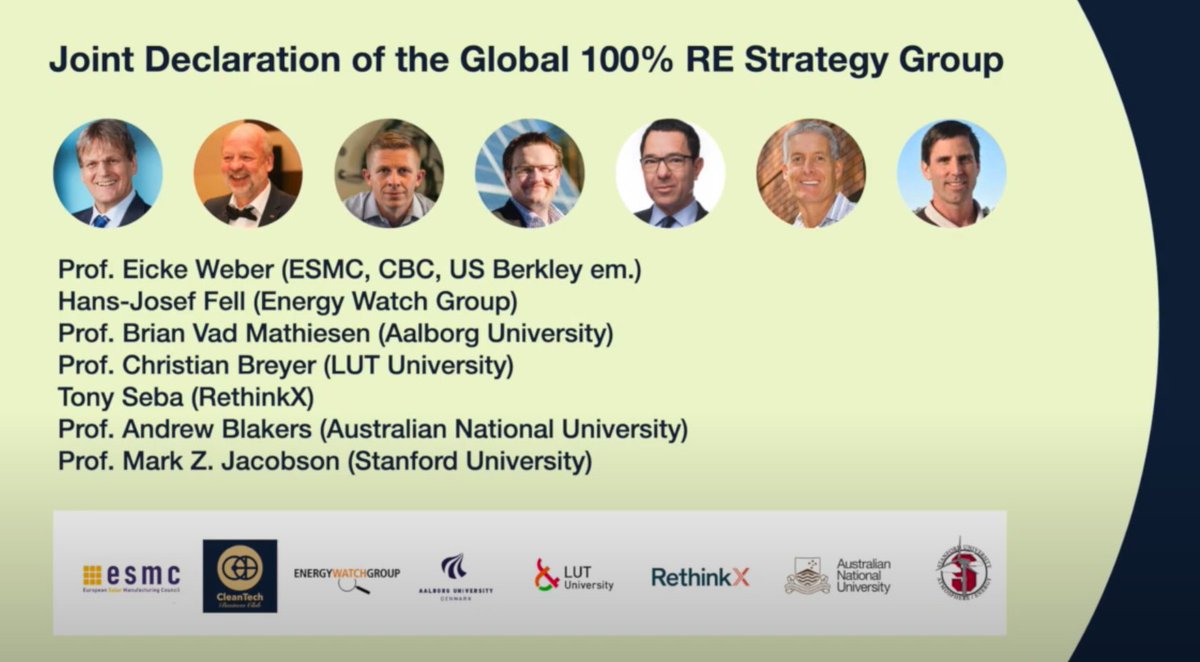
Global 2030 net-zero electricity is a target exponentially, ludicrously beyond many current commitments globally. Still using Mongolia as example, renewables generate <10% of total electricity (rest is coal). Mongolia’s 2030 renewables target is 30%. (1)
montsame.mn/en/read/227933
montsame.mn/en/read/227933
Japan’s targets (which may increase later this yr), are to generate just under 1/4 of power from renewables and just under 1/4 from nuclear by 2030.
China may be considering a 40% renewable power generation target for 2030 (see below from @YanQinyq). (2)
China may be considering a 40% renewable power generation target for 2030 (see below from @YanQinyq). (2)
https://twitter.com/YanQinyq/status/1359195558674632711?s=20
So the 100% RE Group is de facto arguing most costs, land use, political/economic factors should go right out the window, as this is necessarily required to even contemplate a 2030 net-zero global power target.
Renewables become top national priority everywhere for a decade.(3)
Renewables become top national priority everywhere for a decade.(3)
That’s an absurdly ambitious goal, but climate change is a serious, urgent global issue so maybe ambition is hardly a bad thing…
But then, why are the Group members making the challenge even harder by explicitly excluding nuclear? (4)
But then, why are the Group members making the challenge even harder by explicitly excluding nuclear? (4)
The Group claims nuclear is costly, but is it really inconceivable to imagine specific local, regional, or national circumstances where nuclear heat and power would be less costly than potentially messy overbuilding of wind, solar, and batteries? (5)
In Ulaanbaatar, Mongolia where winter heating is a life-or-death matter, is it really totally unfathomable that co-generation of district heat and power via nuclear could be an attractive benefit? (6)
nationalgeographic.com/environment/20…
nationalgeographic.com/environment/20…
Disasters: “Climate change costs $$$$$. We should be willing to pay for more climate action.”
Battery storage: “Batteries are still a bit expensive, don’t scale well. We should massively invest to fix this.”
Nuclear: “Ach nein, too expensive. We should move away from it.” (7)
Battery storage: “Batteries are still a bit expensive, don’t scale well. We should massively invest to fix this.”
Nuclear: “Ach nein, too expensive. We should move away from it.” (7)
If climate change is critical, and if objections to nuclear are cost, time to build, then why a lack of interest in fixing these issues? It’s not as if all research/economics are worked out for utility-scale battery storage yet, so why do batteries get a pass but not nuclear? (8)
I’m not aware of any serious nuclear power advocates who think that we should exclude future solar or wind farms from consideration, so why is it that renewables advocates often fight so hard to exclude nuclear entirely and completely? (9)

In 2019, nuclear power produced 10% of all global electricity generation. US nuclear generated almost as much power as was consumed in all of Africa.
Why is the idea that nuclear is a useful part of the pantheon of climate solutions so unacceptable? (10)
iea.org/reports/world-…
Why is the idea that nuclear is a useful part of the pantheon of climate solutions so unacceptable? (10)
iea.org/reports/world-…
Why is nuclear getting called out by name by the Global 100% RE Group and not biomass thermal energy, which has questionable low-carbon credentials yet somehow continues to be counted as “renewable” energy, especially in Europe?
latimes.com/opinion/story/… (11)
latimes.com/opinion/story/… (11)
Why is there no interest in discussing how nuclear power could help *support* a power grid with high amounts of renewable energy, by facilitating challenges from manufacturing huge quantities of batteries, smart pricing, juggling EV-to-grid, to long-distance transmission… (12)
Is it not incongruous that there's more of a consensus of support in enviro advocacy/research for seaweed feed for cows, biomass energy, vehicle-to-grid, and mangrove forest preservation (in a world of rising seas) as climate solutions than there is for nuclear power? (13)
There’s something fishy about declaring climate change a critical emergency, calling for net-zero global 2030 power, while entirely dismissing nuclear.
@TedNordhaus’s piece on anti-nuclear bullshit today really couldn’t be more timely. (14)
thebreakthrough.org/issues/energy/…
@TedNordhaus’s piece on anti-nuclear bullshit today really couldn’t be more timely. (14)
thebreakthrough.org/issues/energy/…
Can we be frank and admit that part of what rubs people the wrong way about nuclear is that it presents a climate solution without requiring a fundamental virtuous global reinvention of the human soul or a radical reorganization of society along picturesque pastoral lines? (16)
Obligatory “nuclear is absurdly safe” post to preempt accident-anxious commenters.
If you live in Europe, you likely should honestly be much more worried for your life because of biomass energy. (17)
ourworldindata.org/safest-sources…
If you live in Europe, you likely should honestly be much more worried for your life because of biomass energy. (17)
ourworldindata.org/safest-sources…
TL;DR - A 2030 net-zero global power target is insanely hard.
Also, *something* is up with how nuclear power is treated in energy and climate discussions, and the Global 100% Renewable Energy Strategy Group is a prime example of this.
(18 - END)
Also, *something* is up with how nuclear power is treated in energy and climate discussions, and the Global 100% Renewable Energy Strategy Group is a prime example of this.
(18 - END)
• • •
Missing some Tweet in this thread? You can try to
force a refresh