Update from this morning at the Grenfell Tower Inquiry:
- Former resident Lee Chapman describes efforts to complain about gas pipe installation in tower's communal staircase
So this morning we've heard from the first resident witness from this part of the inquiry, Lee Chapman - former secretary of the Grenfell Tower Leaseholders Association. He lived on the 22nd floor with his partner Naomi Li.
Primarily, his evidence focused on GTLA's complaints about work from 2016 onwards to install new gas pipes through the tower's staircase. This work was carried out by the National Grid and was separate to the refurbishment of the tower by Rydon et al
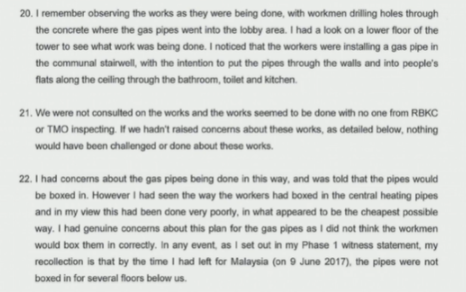
He learned about the works when he saw workers drilling holes through concrete to fit the pipes - and he was immediately worried about 'boxing in' to protect the pipes, something he felt had been done poorly for the recently installed communal hot water pipes.
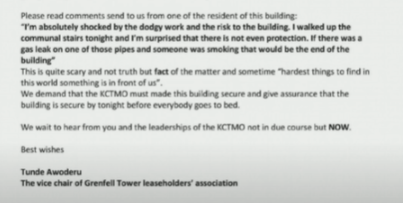
GTLA picked this up in March 2017, calling for an independent inspector to check that the works being carried out were safe. Vice chair Tunde Awoderu's email contained a warning that "if there was a gas leak and someone was smoking... that would be the end of the building"
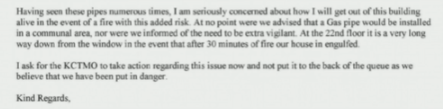
Mr Chapman followed this with emails to Millicent Williams, estate manager, writing to tell her: "I am seriously concerned about how I will get out of this building alive in the event of a fire with this added risk". Further emails sent to other TMO/RBKC managers through March.
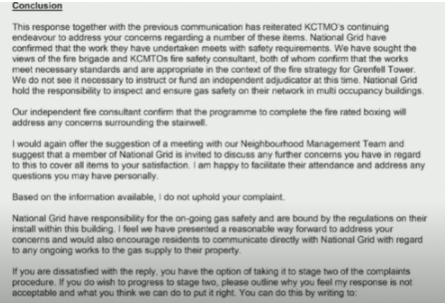
The complaint is dealt with by TMO's Anthony Cheyne at stage one, and a response sent on 5 May 2017. Declines to put independent adjudicator in place, saying TMO has liased with fire brigade and its independent fire consultant (Carl Stokes) on the matter
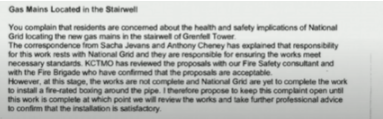
GTLA follow up, escalating complaint to stage two and asking for copies of reports. They did not receive them. On 6 June, Peter Maddison of KCTMO responds. Says works are responsibility of National Grid, but as works are not complete will seek professional assurance when they are
Conclusion of Phase 1 was impact of gas in fire "appears to have been minimal", although flames did not stop until supply was shut off. Moore-Bick did say "works associated with the installation of the new gas riser were incomplete and may have contributed to the spread of smoke"
Mr Chapman also gives evidence about the replacement of his flat door, which the couple did themselves in 2016. Says they were told by TMO it needed to have 30 minutes fire resistance which he ensured it did but not that it needed a self-closer. Also says...
... no one from the TMO came to check it following installation. After lunch we will hear from David Collins, who was chair of the residents group (known as 'the compact') during the main refurbishment.
• • •
Missing some Tweet in this thread? You can try to
force a refresh

- Residents describe how vital self-closing devices were removed from flat doors by KCTMO staff
- Disabled woman forced to 'bump' her way down stairs to escape fire after no escape plan made
This morning we've heard from two residents: Betty Kasote and Youseff Khalloud, as well as hearing some statements read in.
For the resident witnesses so far, the oral evidence appears to be about picking up specific thematic things and clarifying issues in the witness statement. Makes these documents a bit more important for following the narrative than was the case for the corporates.
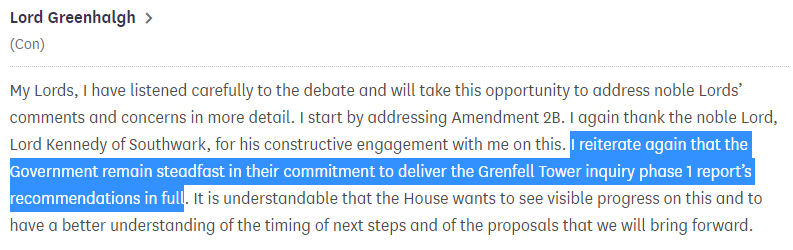
I see the government was back in the House of Lords today claiming to be implementing the Grenfell Tower Inquiry recommendations in full. Something which remains... not true
1. Manual fire alarms
The inquiry said all high rise buildings should be "equipped with facilities for use by the fire and rescue services enabling them to send an evacuation signal to the whole or a selected part of the building by means of sounders or similar devices"
That is quite conclusively not something the government is signed up to. Leaked minutes I've seen show an industry response group warning the government this recommendation is a case of “cost against benefit (it’s not cheap)”.
BBA published 'materially wrong' certificate for cladding later used on Grenfell after Arconic 'stonewalled' their request for up to date information for 16 months
Background: In 2007, the British Board of Agrement published a certificate which confirmed th cladding panels later used on Grenfell "may be regarded" as Class 0 - the standard in English regs at the time for high rises. You can read more about that here: insidehousing.co.uk/news/grenfell-…
This morning we've been hearing from Valentina Amoroso from the BBA, who reviewed the certificate in 2014/15.
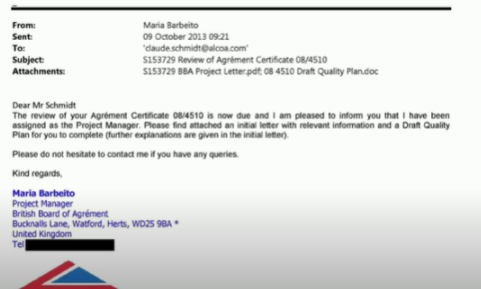
This review was originally due to be done by January 2014 and the BBA began seeking the info necessary in October 2013:
Senior manager at Arconic wrote an internal document in in 2007 pondering what its responsibility would be if a fire involving its product killed “60 or 70” people in a high rise
On this specific document, the marketing manager at Arconic (which later sold the cladding used on Grenfell Tower) went to Norway in 2007 for an industry get-together hosted by a Norwegian products distributor
While there, attendees were invited to give presentations and a consultant from OTEFAL (a German metatls company) did a seminar on the dangers of using ACM as compared to solid aluminium.
Window panel supplier offered 'Class E' fire rated panels with highly combustible polystyrene core as default option, inquiry hears
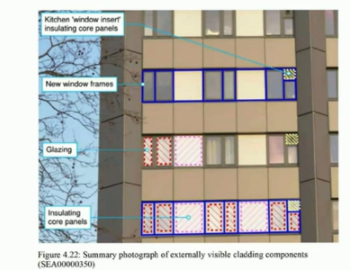
A brief stint in the virtual witness box this morning for Chris Ibbotson, MD of Panel Systems, which sold window panels for the new window systems on Grenfell Tower. These are the panels which go in between windows and in the top corner with an extractor fan (below)
The majority of these panels were comprised of a thin aluminium skin covering 'styrofoam' polystyrene insulation. That's the same stuff as you find in your every day plastic cup and is very combustible (Class E rated, which is close to the bottom ranking possible)
Cavity barrier manufacturer says installation of barriers on Grenfell was "some of the worst I have ever seen"
Chris Mort carried out an examination of the way his product had been installed after the fire in 2018. Says he believes there were areas where the products either weren't fitted at all or stuck on with sillicone instead of fixed with a bracket
There were instances where gaps of 140mm were left, instead of the required 25mm - meaning the barrier would not have been able to close the gap. Brackets designed for horizontal barriers were used for the vertical, meaning they were pierced