How will #NATO's posture change in response to Russia's invastion of #Ukraine (and statements threatening NATO members)? What is clear already: Putin has forced NATO to massively invest in its infrastructure and strengthen its posture on the eastern flank. 1/7
With his actions, Putin will eventually bring substantial NATO forces to Russia's borders - something that he has warned of for many years (remember his complaints about NATO infrastructure moving closer to Russia) and that many NATO members also tried to avoid. 2/7
Today, Allied leaders announced that they "will now accelerate NATO's transformation for a more dangerous strategic reality." nato.int/cps/en/natohq/… 3/7
As Stoltenberg stressed today: "The leaders agreed to task our military commanders to provide options for a long-term reset of our presence, of our military posture in the eastern part of the Alliance and across the whole Alliance." #NATOnato.int/cps/en/natohq/… 4/7
Four additional battlegroups on the eastern flank can only be a first step. As @jensstoltenberg stressed, "President Putin’s invasion of Ukraine has changed our security environment for the long term." 5/7
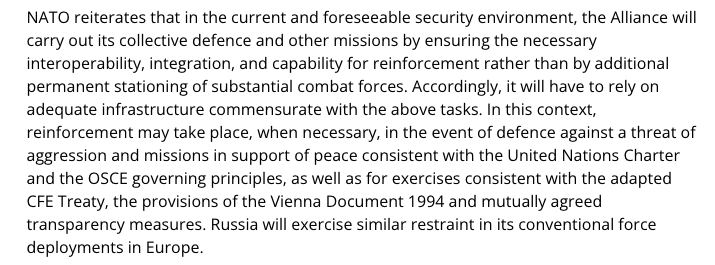
This phrase is a hint at the NATO-Russia Founding Act, which #Russia has violated for years but which #NATO members still complied with because some members hoped for a return to a partnership based on the Founding Act in the long run. 6/7
As Allies in CEE have long stressed, in this political document, signed in 1997, NATO commits to far-reaching (self-)restrictions only "in the current and foreseeable security environment." Today, no one can pretend that this environment still exists. 7/7
• • •
Missing some Tweet in this thread? You can try to
force a refresh

It’s time for my traditional train Twitter thread after @MunSecConf. As our Chairman @ischinger said, we’re all tired now. But the most important thing is that we had a weekend of vivid debates!
I’m glad that the title of our #MSCreport – #Westlessness – triggered some of them. We think of the MSR as a conversation starter for the conference, and it worked well this year – in particular because some thought it accurately described the zeitgeist, and others disagreed.
Are you still wondering – like my my two-year old (“Papa, was soll das heißen?"| "Dad, what does this even mean?”) – what this term is meant to convey? You can re-watch my presentation of the #MSCreport in Berlin. #Westlessnesssecurityconference.org/en/medialibrar…
On my way home from #MSC2019 - and reflecting on the debates, speeches and informal meetings of the past four days in Munich. Let me share my very personal summary - w/ a focus on the transatlantic partnership. Last year, I was quite pessimistic...
So let me start with a bit of good news. In our #MSCreport, we asked who would pick up the pieces of a disintegrating global order. At least rhetorically, the Europeans and representatives of other like-minded liberal democracies have underlined their willingness to step up. 2/
Most attendees agreed that Chancellor #Merkel gave one of the best foreign policy speeches of her career. She really hit a nerve in the audience. Merkel forcefully argued that "all of us" had to pick up the pieces together.
Although I suggest you all download our new #MSCreport (-> securityconference.de/en/publication…) and read it - let me walk you through some of its main arguments and illustrations. Some of you might remember Gramsci's famous description of the inter-war "interregnum": 1/n
"The crisis consists," Gramsci wrote, "precisely in the fact that the old is dying and the new cannot be born; in this #interregnum a great variety of morbid symptons appear." Well, that seems like an apt description of today's world. 2/n
The post-Cold war period - and the optimism associated with it - has come to an end. Many of the certainties, widely shared and taken for granted in Europe since the end of the Cold, are eroding. As German Foreign Minister, @HeikoMaas, put it in June: 3/n
On my way home from #MSC2018 - and even more worried than before. When people who don't spend much time with world politics ask whether it is as bad as the media say I now respond: No, it's actually worse.
First, the world has seen a frightening amount of brinkmanship recently. Whether it's East Asia, the Middle East or even Eastern Europe - there is an increased risk of escalation. Many speeches at #MSC2018 have underscored this - in many cases, they added fuel to the fire.
Second, there was a lack of constructive ideas to solve some of the most pressing conflicts: The participants of the Normandy format didn't even meet to discuss. It's hard to imagine a good solution to the INF issue. And it's even worse when it comes to Syria or North Korea.