KeyBank sponsorship deal will help Cleveland Metroparks celebrate its 100th anniversary
The partnership begins in April with the introduction of "KeyBank ZooKeys," a callback to a program that started in the 1960s. More than two dozen special boxes crainscleveland.com/article/201703…
The partnership begins in April with the introduction of "KeyBank ZooKeys," a callback to a program that started in the 1960s. More than two dozen special boxes crainscleveland.com/article/201703…
will be placed throughout the Cleveland Metroparks Zoo; children can insert a customized key to unlock an educational message specific to each animal.
"As two organizations with decades of a longstanding commitment to Northeast Ohio, we are incredibly excited to work together
"As two organizations with decades of a longstanding commitment to Northeast Ohio, we are incredibly excited to work together
to further connect the community and celebrate the past 100 years," said Metroparks CEO Brian M. Zimmerman in a statement.
Referred to unofficially as the 'Emerald Necklace',[2] the network of parks spans over 23,000 acres (9,300 ha) and includes over 300 miles (480 km) of walking, bicycle, and horse trails as well as numerous picnic areas, nature education centers, golf courses, and countless
fishing spots. In addition, the district includes the zoo in Cleveland. Four of the reservations are adjacent to Cuyahoga Valley National Park.
A self-taught engineer working as a surveyor for the City of Cleveland in 1895, Stinchcomb was appointed chief engineer of the
A self-taught engineer working as a surveyor for the City of Cleveland in 1895, Stinchcomb was appointed chief engineer of the
City Parks Department by Mayor Tom Johnson in 1902, and shortly thereafter began to conceptualize an Emerald Necklace for the city.[
In 1915, Stinchcomb received the break that would finally allow him to pursue his ambitious goal. While serving as Cuyahoga County engineer, he
In 1915, Stinchcomb received the break that would finally allow him to pursue his ambitious goal. While serving as Cuyahoga County engineer, he
was approached by city council and offered an appointment as consulting engineer on what was eventually to become the Cleveland Metropolitan Park District board—the same board he'd lobbied for two years prior. Stinchcomb accepted and, at the urging of city council, immediately
hired the renowned landscape architectural firm, the Olmsted Brothers.
The group immediately went to work drawing up plans for a system of connecting parks as well as the acquisition of land and resources.[4] The proposed Cuyahoga County Park and Boulevard System, which
The group immediately went to work drawing up plans for a system of connecting parks as well as the acquisition of land and resources.[4] The proposed Cuyahoga County Park and Boulevard System, which
included a parkway encircling the Cleveland area, following various creeks and rivers in the area, was the framework for what would become today's Metroparks system.[
Stinchcomb returned to the Statehouse in 1917, this time as an officer of the newly formed Metropolitan Park
Stinchcomb returned to the Statehouse in 1917, this time as an officer of the newly formed Metropolitan Park
District board, and proposed a bill that would authorize the Metropolitan Park District board to levy a one-tenth mill tax to fund the district's operations.
The creation of the Park District's law enforcement agency was made possible on June 14, 1920, when the Board of Park Commissioners passed resolution #315 which called for maintaining "...general peace and good order of the park." The Park District hired its first patrolman on 

May 5, 1921.
The earliest officers patrolled the Park District on foot and horseback, because there were few roads. Officers had no communications equipment. Red illuminated pole lamps were added in key locations throughout the Park District. The lamps were turned on as a
The earliest officers patrolled the Park District on foot and horseback, because there were few roads. Officers had no communications equipment. Red illuminated pole lamps were added in key locations throughout the Park District. The lamps were turned on as a
simple but effective signal that an incident had occurred which required an officer's attention.
The Great Depression had a significant impact on the Park District. Work programs created by President Franklin D. Roosevelt led to many improvements on park land. By 1933, the Park
The Great Depression had a significant impact on the Park District. Work programs created by President Franklin D. Roosevelt led to many improvements on park land. By 1933, the Park
District and its law enforcement agency were growing in tandem. The department had increased to 15 officers. They used a stable of horses, one motorcycle, and three cars to patrol what had grown, by that year, into a 10,000 acre park district. During World War II, many younger
officers were called into service overseas. As a result, older officers were hired to protect the Park District.
In 1945, the Board of Park Commissioners passed resolution #2317, arming its police officers. The .38 caliber Smith & Wesson Police Special was designated as the
In 1945, the Board of Park Commissioners passed resolution #2317, arming its police officers. The .38 caliber Smith & Wesson Police Special was designated as the
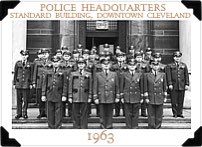
official department firearm. Prior to the passage of the resolution, officers were expected to furnish their own weapons. In the mid 1950s, the patrol fleet was equipped with mobile telephones instead of standard police radios. It was believed that mobile phones permitted
greater flexibility. Chief James K. Hoy reported, "the Park District is adjacent to so many other police districts that no single radio frequency could be assigned satisfactorily."In 1967, the title "police" was officially changed to "ranger." The new name more accurately
represented the department's outdoor law enforcement functions. The revamped department soon moved into a new home, occupying a former Ohio Turnpike tollgate building in Strongsville. At the same time, 10 new cars were purchased for the 45 member department. The new vehicles
were equipped with the department's first radio system, and a central dispatch center became operational.
The Cleveland Metroparks Ranger Training Academy was also established in 1967. The training academy was the first such center for park ranger training in the United States,
The Cleveland Metroparks Ranger Training Academy was also established in 1967. The training academy was the first such center for park ranger training in the United States,
except for the National Park Service Academy in Colorado. Law enforcement officers from other park districts and local police agencies were invited to attend at no cost. During its 19 years of operation, the academy graduated 877 law enforcement officers.
In 1973 and 1981, national acclaim was bestowed on the Ranger Department. The Mounted Unit was invited to ride in the Washington D.C. inaugural parades of presidents Richard M. Nixon and Ronald W. Reagan. On both occasions, Cleveland Metroparks Ranger Department was selected as
the lone Ohio law enforcement representative.
Of particular note is the national award for Best Dressed Law Enforcement Agency, as featured in the September 2004 edition of Law and Order magazine.
Of particular note is the national award for Best Dressed Law Enforcement Agency, as featured in the September 2004 edition of Law and Order magazine.
In 2004, the department moved into a new headquarters in Rocky River Reservation. Police Headquarters houses a state-of-the-art communications center, prisoner holding facilities, a forensic laboratory, and a museum. The museum displays photographs, uniforms, artifacts,
and equipment utilized throughout the years
Through extensive training programs, continuing education efforts, and advancements in technology, the department and its officers remain in a perpetual state of evolution.
Through extensive training programs, continuing education efforts, and advancements in technology, the department and its officers remain in a perpetual state of evolution.
• • •
Missing some Tweet in this thread? You can try to
force a refresh