Plain of Jars - Wikipedia
Incidentally, the megalithic Dravidians of South India used giant burial urns called Mudhumakkal Thazhi ('burial-pots-of-the-old-people') or EemaThazhi. These funerary urns were buried with the bodies of the deceased or soon-to- en.wikipedia.org/wiki/Plain_of_…
Incidentally, the megalithic Dravidians of South India used giant burial urns called Mudhumakkal Thazhi ('burial-pots-of-the-old-people') or EemaThazhi. These funerary urns were buried with the bodies of the deceased or soon-to- en.wikipedia.org/wiki/Plain_of_…
die in a sitting posture, along with their personal goods and ornaments.[3] This practice was in vogue until 200 CE.
Colani connected the location of the jars sites to ancient trade routes, in particular with the salt trade. She assumed that salt was a commodity sought after by
Colani connected the location of the jars sites to ancient trade routes, in particular with the salt trade. She assumed that salt was a commodity sought after by
the Plain of Jars people, which brought traders to the Xiangkhouang Plateau.
The suggestion that the jars, similar to traditional Southeast Asian Royal mortuary practices, functioned as "distilling vessels", was put forward by R. Engelhardt and P. Rogers in 2001.
She assumed that salt was a commodity sought after by the Plain of Jars people, which brought traders to the Xiangkhouang Plateau. The Xiangkhouang area is rich in metallic minerals, mainly due to granite intrusions and associated hydrothermal activit
History has shown that Xiangkhouang, at the northern end of the Annamite Range, provides relative easy passage from the north and east to the south and west.
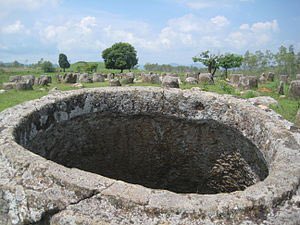
The most investigated and visited Jar site is close to the town of Phonsavan, and is known as Site 1. Seven jar sites have now been cleared of unexploded bombs and are open to visitors. These are currently sites 1, 2 and 3, and Site 16 near the old capital Xieng Khouang; Site 23, 

near the big hot spring in Muang Kham; Site 25 in the largely unvisited Phou Kout District; and Site 52, the largest known jar site to date with 392 jars near a traditional Hmong village only accessible by foot.
The Annamite Range runs parallel to the Vietnamese coast, in a gentle curve which divides the basin of the Mekong River from Vietnam's narrow coastal plain along the South China Sea.
Laos lies mostly within the Mekong basin, west of the divide, although most of Houaphan Province
Laos lies mostly within the Mekong basin, west of the divide, although most of Houaphan Province

and a portion of Xiangkhoang Province (where the famous Plain of Jars is located) lie east of the divide. Most of Vietnam lies east of the divide, although Vietnam's Tây Nguyên (Central Highlands) region lies west of the divide, in the Mekong basin.
Most of the highlands like the Annamite Range and the Central Highlands were populated by ethnic minorities who were not Vietnamese during the 20th century's start. The demographics were drastically transformed with the mass colonization of 6 million settlers from 1976 to the
1990s, which led to ethnic Vietnamese Kinh outnumbering the native ethnic groups in the highlands.
Up until French rule, the Central Highlands was almost never entered by the Vietnamese since they viewed it as a savage (Moi-Montagnard) populated area with fierce animals like tigers, "poisoned water" and "evil malevolent spirits." The Vietnamese expressed interest in the
land after the French transformed it into a profitable plantation area to grow crops on,[4] in addition to the natural resources from the forests, minerals and rich earth and realization of its crucial geographical importance.
In a lapse of judgment with surrounding village children, a child steals a Nestlé Crunch bar from Doyle's backpack; the wrapper, when found, lets the NVA know of the local villagers' cooperation with the Americans.
As punishment, Brigadier Nguyen (Hoang Ly) of the NVA, orders his subordinate, Captain Quang (Vo Trung Anh), to kill the villagers' elephant right before a spiritual festival. To aid the villagers, Cahill promises to replace the slain elephant before their upcoming ceremony while
Doyle (whom the villagers blame for the elephant's death) reluctantly agrees to help.
At Pleiku Air Base, Major Pederson notifies the captains that the mission has been cancelled. The Ho Chi Minh Trail has changed direction, and they no longer need the support of the local village. A CIA airstrip near Dak Nhe has already been destroyed by the NVA, making a landing
by plane impossible.


1866; 155 years ago (as Anglo-Swiss Condensed Milk Company)
1867; 154 years ago (as Farine Lactée Henri Nestlé)
1905; 116 years ago (as Nestlé and Anglo-Swiss Condensed Milk Company)
Founder
1867; 154 years ago (as Farine Lactée Henri Nestlé)
1905; 116 years ago (as Nestlé and Anglo-Swiss Condensed Milk Company)
Founder
Nestlé was formed in 1905 by the merger of the Anglo-Swiss Milk Company, established in 1866 by brothers George and Charles Page, and Farine Lactée Henri Nestlé, founded in 1866 by Henri Nestlé.[13] The company grew significantly during the First World War and again following
the Second World War, expanding its offerings beyond its early condensed milk and infant formula products. The company has made a number of corporate acquisitions, including Crosse & Blackwell in 1950, Findus in 1963, Libby's in 1971, Rowntree Mackintosh in 1988, Klim in 1998,
and Gerber in 2007.
The company has been associated with various controversies, facing criticism and boycotts over its marketing of baby formula as an alternative to breastfeeding in developing countries, its reliance on child labour in cocoa production, and its production
The company has been associated with various controversies, facing criticism and boycotts over its marketing of baby formula as an alternative to breastfeeding in developing countries, its reliance on child labour in cocoa production, and its production
and promotion of bottled water.
In 1866, Charles Page (US consul to Switzerland) and George Page, brothers from Lee County, Illinois, USA, established the Anglo-Swiss Condensed Milk Company in Cham, Switzerland. The company's first British operation was opened at Chippenham,
In 1866, Charles Page (US consul to Switzerland) and George Page, brothers from Lee County, Illinois, USA, established the Anglo-Swiss Condensed Milk Company in Cham, Switzerland. The company's first British operation was opened at Chippenham,

Wiltshire, in 1873.[
The following year, Daniel Peter began seven years of work perfecting the milk chocolate manufacturing process. Nestlé was the solution Peter needed to fix his problem of removing all the water from the milk added to his chocolate, thus preventing the
The following year, Daniel Peter began seven years of work perfecting the milk chocolate manufacturing process. Nestlé was the solution Peter needed to fix his problem of removing all the water from the milk added to his chocolate, thus preventing the
product from developing mildew. Henri Nestlé retired in 1875 but the company, under new ownership, retained his name as Société Farine Lactée Henri Nestlé.[citation needed]
In 1877, Anglo-Swiss added milk-based baby foods to its products; in the following year, the
In 1877, Anglo-Swiss added milk-based baby foods to its products; in the following year, the
Nestlé Company added condensed milk to its portfolio, which made the firms direct rivals.
In 1879, Nestlé merged with milk chocolate inventor Daniel Peter.
In 1879, Nestlé merged with milk chocolate inventor Daniel Peter.
In 1904, François-Louis Cailler, Charles Amédée Kohler, Daniel Peter, and Henri Nestlé participated in the creation and development of Swiss chocolate, marketing the first chocolate – milk Nestlé.[18]
In 1905, the companies merged to become the Nestlé and Anglo-Swiss Condensed
In 1905, the companies merged to become the Nestlé and Anglo-Swiss Condensed
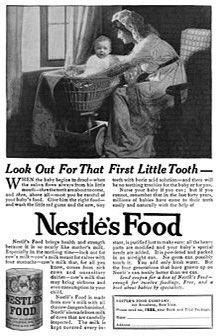
Milk Company, retaining that name until 1947 when the name 'Nestlé Alimentana SA' was taken as a result of the acquisition of Fabrique de Produits Maggi SA (founded 1884) and its holding company, Alimentana SA, of Kempttal, Switzerland.
Nestlé began developing a coffee brand in 1930, at the initiative of the Brazilian government, to help to preserve the substantial surplus of the annual Brazilian coffee harvest. Max Morgenthaler led the development project. Nestlé introduced the new product under the brand

name "Nescafé" on 1 April 1938.[3] Nescafé is a soluble powdered coffee that became an American staple during World War II.[4]
In 1965, Nestlé introduced a freeze-dried coffee brand called "Nescafé Gold" in Europe.[3]
In 1966, Nestlé developed a freeze-dried coffee brand under
In 1965, Nestlé introduced a freeze-dried coffee brand called "Nescafé Gold" in Europe.[3]
In 1966, Nestlé developed a freeze-dried coffee brand under
the name Taster's Choice.
While the Nescafé brand was created for soluble coffee, it has subsequently been used as an umbrella brand on a number of instant coffee products, including, in the UK, Gold Blend and Blend 37 freeze-dried coffees.
While the Nescafé brand was created for soluble coffee, it has subsequently been used as an umbrella brand on a number of instant coffee products, including, in the UK, Gold Blend and Blend 37 freeze-dried coffees.
A significant turning point for freeze drying occurred during World War II. Blood plasma and penicillin were needed to treat the wounded in the field, and because of the lack of refrigerated transport, many serum supplies spoiled before reaching their recipients.[6]
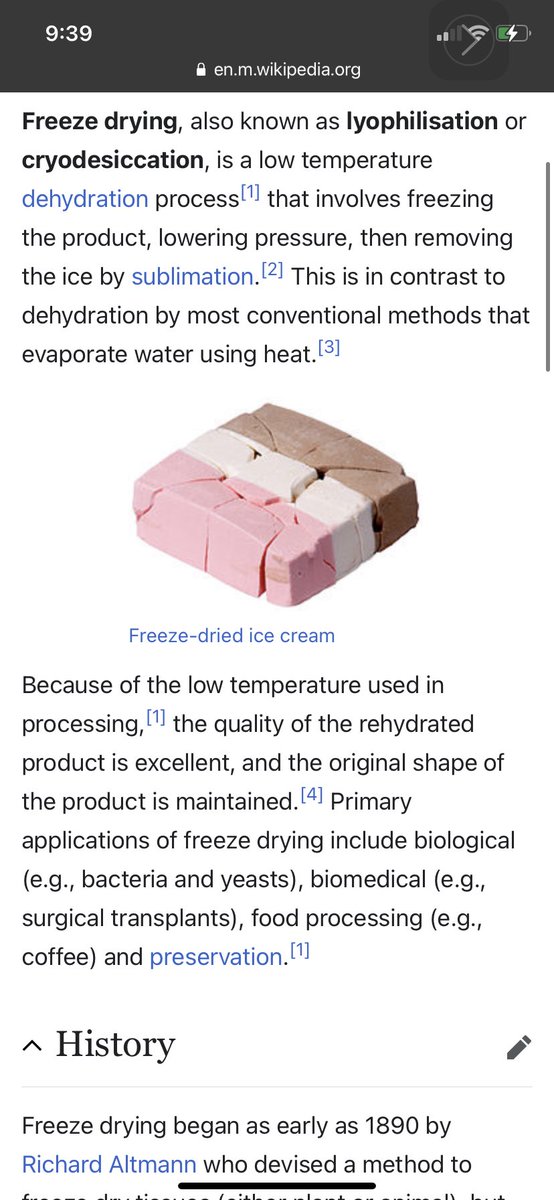
The freeze-drying process was developed as a commercial technique that enabled blood plasma and penicillin to be rendered chemically stable and viable without refrigeration.[6] In the 1950s–1960s, freeze drying began to be viewed as a multi-purpose tool for both pharmaceuticals
and food processing
In nanotechnology, freeze-drying is used for nanotube purification[23] to avoid aggregation due to capillary forces during regular thermal vaporization drying.
In nanotechnology, freeze-drying is used for nanotube purification[23] to avoid aggregation due to capillary forces during regular thermal vaporization drying.
Freeze-drying is among the methods used to preserve animals in the field of taxidermy. When animals are preserved in this manner they are called "freeze-dried taxidermy" or "freeze-dried mounts". Freeze-drying is commonly used to preserve crustaceans, fish, amphibians, reptiles,
insects, and smaller mammals.[24] Freeze-drying is also used as a means to memorialize pets after death. Rather than opting for a traditional skin mount when choosing to preserve their pet via taxidermy, many owners opt for freeze-drying because it is less invasive upon the pet'.
body
• • •
Missing some Tweet in this thread? You can try to
force a refresh