Nathaniel Grant and A.S. Branham to found the Long, Grant & Company which in turn would become the Kansas City Savings Association.
During Long's term the Hannibal Bridge—the first bridge to cross the Missouri River—opened. The bridge would establish Kansas City as the dominant
city in the region. With the bridge came the founding of the Kansas City Stockyards
The First Hannibal Bridge was the first permanent rail crossing of the Missouri River[1] and helped establish Kansas City, Missouri as a major city and rail center. The increased train traffic
resulting from its construction also contributed to the building of Union Depot, the predecessor to the Kansas City Union Station.[
Construction started in 1867, shortly after the end of the American Civil War.[3] Construction on the bridge was completed in 1869. The completion
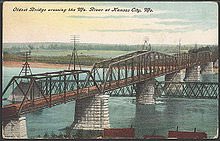
of the bridge came after a short battle between Leavenworth, Kansas, and the town of Kansas City for the Hannibal & St. Joseph Railroad bridge.
After construction was completed, the population of Kansas City began to boom.
The bridge was designed by Octave Chanute, who also
designed the Kansas City Stockyards. It was a swing bridge which could open in under two minutes, and it had an arched truss design. The bridge cost $1 million to build.
The bridge was built for the Hannibal & St. Joseph Railroad by the Keystone Bridge Company. Although the
railroad became part of the BNSF Railway, the name "Hannibal" has stuck.
• • •
Missing some Tweet in this thread? You can try to
force a refresh
While he was best known for his movie palaces, his work wasn't limited to theaters. He also designed Detroit's Olympia Stadium, the former home of the Detroit Red Wings (1927-1987) that sat more than 12,000, as well as the Lafayette historicdetroit.org/architects/c-h…
Building (1925-2010). Crane's tallest building was the Leveque Tower in Columbus, Ohio, which stands at 47 stories.
The Great Depression took its toll on Crane, like it did with many businessmen. He lost everything in the stock market crash, and as a result, he moved to London. His office in Detroit was kept open, and he continued to keep in communication with over the years. While in Britain,
Texas Eastern Pipeline (TETCo) is a major natural gas pipeline which brings gas from the Gulf of Mexico coast in Texas and Louisiana up through Mississippi, Arkansas, Tennessee, Missouri, Kentucky, Illinois, en.wikipedia.org/wiki/Texas_Eas…
Indiana, Ohio, and Pennsylvania to deliver gas in the New York City area. It is one of the largest pipeline systems in the United States. It is owned by Enbridge. Its FERC code is 17.[1]
This pipeline was built as Big Inch by War Emergency Pipelines (WEP), a consortium of
Standard Oil Company of New Jersey, Texas Pipe Line Company, Cities Service, Socony-Vacuum Oil, Gulf Oil, Consolidated Oil, Shell Oil, Atlantic Refining, Tidewater Associated Oil, Sun Oil and Pan American Petroleum and Transport Company.
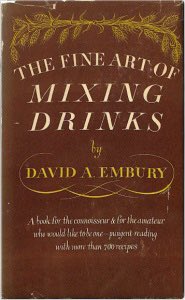
The Fine Art of Mixing Drinks is a book about cocktails by David A. Embury, first published in 1948.[1] The book is noteworthy for its witty, highly opinionated and conversational tone,[2] as en.wikipedia.org/wiki/The_Fine_…
well as its categorization of cocktails into two main types: aromatic and sour; its categorization of ingredients into three categories: the base, modifying agents, and special flavorings and coloring agents; and its 1:2:8 ratio (1 part sweet, 2 parts sour, 8 parts base) for sour
type cocktails.
In terms of IBA Official Cocktails, Embury describes classic Before-Dinner Cocktails, which whet the appetite, not other categories.
Incidentally, the megalithic Dravidians of South India used giant burial urns called Mudhumakkal Thazhi ('burial-pots-of-the-old-people') or EemaThazhi. These funerary urns were buried with the bodies of the deceased or soon-to- en.wikipedia.org/wiki/Plain_of_…
die in a sitting posture, along with their personal goods and ornaments.[3] This practice was in vogue until 200 CE.
Colani connected the location of the jars sites to ancient trade routes, in particular with the salt trade. She assumed that salt was a commodity sought after by
the Plain of Jars people, which brought traders to the Xiangkhouang Plateau.
"Oz" is the nickname for the Oswald State Correctional Facility, formerly Oswald State Penitentiary, a fictional level 4 maximum-security state prison.
The nickname "Oz" is also a reference to the classic film The Wizard of Oz (1939), which popularized the phrase, "There's no
place like home." In contrast, a poster for the series uses the tagline: "It's no place like home".[4] Moreover, most of the series' story arcs are set in "Emerald City", a wing named after a setting from the fictional Land of Oz in L. Frank Baum's Oz books, first described in
The Wonderful Wizard of Oz (1900).
The Emerald City (sometimes called the City of Emeralds) is the capital city of the fictional Land of Oz in L. Frank Baum's Oz books, first described in The Wonderful Wizard of Oz (1900).
KeyBank sponsorship deal will help Cleveland Metroparks celebrate its 100th anniversary
The partnership begins in April with the introduction of "KeyBank ZooKeys," a callback to a program that started in the 1960s. More than two dozen special boxes crainscleveland.com/article/201703…
will be placed throughout the Cleveland Metroparks Zoo; children can insert a customized key to unlock an educational message specific to each animal.
"As two organizations with decades of a longstanding commitment to Northeast Ohio, we are incredibly excited to work together
to further connect the community and celebrate the past 100 years," said Metroparks CEO Brian M. Zimmerman in a statement.