"Oz" is the nickname for the Oswald State Correctional Facility, formerly Oswald State Penitentiary, a fictional level 4 maximum-security state prison.
The nickname "Oz" is also a reference to the classic film The Wizard of Oz (1939), which popularized the phrase, "There's no
The nickname "Oz" is also a reference to the classic film The Wizard of Oz (1939), which popularized the phrase, "There's no
place like home." In contrast, a poster for the series uses the tagline: "It's no place like home".[4] Moreover, most of the series' story arcs are set in "Emerald City", a wing named after a setting from the fictional Land of Oz in L. Frank Baum's Oz books, first described in
The Wonderful Wizard of Oz (1900).
The Emerald City (sometimes called the City of Emeralds) is the capital city of the fictional Land of Oz in L. Frank Baum's Oz books, first described in The Wonderful Wizard of Oz (1900).
The Emerald City (sometimes called the City of Emeralds) is the capital city of the fictional Land of Oz in L. Frank Baum's Oz books, first described in The Wonderful Wizard of Oz (1900).

Munchkin Country or Munchkinland, as it is referred to in the famous MGM musical film version, is the fictional Eastern region of the Land of Oz in L. Frank Baum's Oz books, first described in The Wonderful Wizard of Oz (1900). Munchkin Country is in the East, noted by later
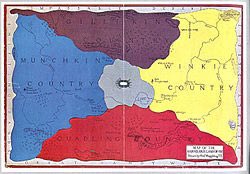
being ruled by the Wicked Witch of the East.
The publishing company Reilly & Britton (later Reilly & Lee) published, in the form of end-papers to the first edition of Tik-Tok of Oz (1914), one of the Oz books, the only authenticated map (reproduced here) that shows the Land of
The publishing company Reilly & Britton (later Reilly & Lee) published, in the form of end-papers to the first edition of Tik-Tok of Oz (1914), one of the Oz books, the only authenticated map (reproduced here) that shows the Land of
Oz in its entirety.
Sinclair, and Nelson Ludington. Ludington later moved his headquarters to Chicago, where he also entered banking. I. Stephenson established a successor lumber company in the area and also became a capitalist.
Before the war, iron ore was being mined from
Sinclair, and Nelson Ludington. Ludington later moved his headquarters to Chicago, where he also entered banking. I. Stephenson established a successor lumber company in the area and also became a capitalist.
Before the war, iron ore was being mined from
the Marquette Range, which shipped out on barges from Escanaba.[10] By the time of the American Civil War, this port was important to the Union as a shipping point for these ores, in addition to lumber.
As shipping increased, a lighthouse was needed to warn of a sand shoals in Little Bay de Noc, which extended from Sand Point, a sandspit located just south of and adjacent to the harbor area.[14] The United States Lighthouse Service approved construction of the
Sand Point Lighthouse at a cost of $11,000.[15] Construction began in the fall of 1867 and was completed in early spring 1868.[
Until 2017, Escanaba continued to serve as an important shipping point for iron ore to other Great Lakes ports, especially south to Chicago and norther
Until 2017, Escanaba continued to serve as an important shipping point for iron ore to other Great Lakes ports, especially south to Chicago and norther
n 1906, William Albrecht founded the soon-to-be successful Western Tablet Company which would produce the Big Chief tablet, used by school children nationwide. In 1933, William Albrecht bought property along Frederick Avenue where he would build his "dream house".[1] In 1965,
the Albrecht mansion was given to the St. Joseph Art League for use as an art gallery in memory of Mr. & Mrs. William Albrecht.
Kemper was born into an influential banking and railroading family in Kansas City, Missouri. His father was R. Crosby Kemper. He attended Southwest
Kemper was born into an influential banking and railroading family in Kansas City, Missouri. His father was R. Crosby Kemper. He attended Southwest
High School in Kansas City, then transferred to Phillips Academy in Andover, Massachusetts where he graduated in 1945. After returning from service in World War II, Mr. Kemper enrolled in the University of Missouri
In 1950, Kemper went to work for the United Missouri Bank,
In 1950, Kemper went to work for the United Missouri Bank,
which later became UMB Financial Corporation was active in the running of the Kemper Museum of Contemporary Art, which was named for him. He retired as chairman of UMB in 2004.
Kemper's college fraternity brother Sam Walton often referred to Mr. Kemper as his "personal banker."[
Kemper's college fraternity brother Sam Walton often referred to Mr. Kemper as his "personal banker."[
• • •
Missing some Tweet in this thread? You can try to
force a refresh