The Fine Art of Mixing Drinks - Wikipedia
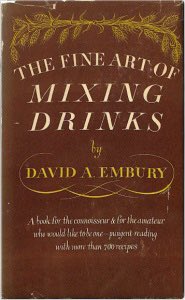
The Fine Art of Mixing Drinks is a book about cocktails by David A. Embury, first published in 1948.[1] The book is noteworthy for its witty, highly opinionated and conversational tone,[2] as en.wikipedia.org/wiki/The_Fine_…
The Fine Art of Mixing Drinks is a book about cocktails by David A. Embury, first published in 1948.[1] The book is noteworthy for its witty, highly opinionated and conversational tone,[2] as en.wikipedia.org/wiki/The_Fine_…
well as its categorization of cocktails into two main types: aromatic and sour; its categorization of ingredients into three categories: the base, modifying agents, and special flavorings and coloring agents; and its 1:2:8 ratio (1 part sweet, 2 parts sour, 8 parts base) for sour
type cocktails.
In terms of IBA Official Cocktails, Embury describes classic Before-Dinner Cocktails, which whet the appetite, not other categories.
In terms of IBA Official Cocktails, Embury describes classic Before-Dinner Cocktails, which whet the appetite, not other categories.
Embury's six basic drinks are the Daiquiri, the Jack Rose, the Manhattan, the Martini, the Old Fashioned, and the Sidecar. Embury's preferred recipe for each is:
He was a senior tax partner with the Manhattan law firm of Curtis, Mallet-Prevost, Colt & Mosle.[5] He became a member of the Acacia fraternity at Columbia Law School on January 17, 1914. He was also a member of Phi Alpha Delta Law Fraternity. He was the first Acacian to become
chairman of the North American Interfraternity Conference. He served as chairman of the National Interfraternity Conference from November 29, 1946, to November 28, 1947. During this time he vocally opposed desegregation, believing it to be the work of communists.[
The law firm was founded in 1830 in New York City by Connecticut natives and brothers, John L. and James L. Graham, who established their legal practice at 143 Fulton Street, Manhattan,[1] today's Financial District.
The Graham and Curtis families had a history of intermarriage in Connecticut[1] and, in 1838, the firm admitted partner William Curtis Noyes, the son of a state Supreme Court justice. The firm merged in 1852 with another legal partnership established by a member of the Curtis
family and moved to new premises on Wall Street. In 1899, Severo Mallet-Prevost joined the firm. In 1925, the firm's current name was adopted, Curtis, Mallet-Prevost, Colt & Mosle. The firm established its Washington, D.C. office in 1963, followed by an office in Paris in the
1970s, and has continued to expand globally, to 14 fourteen international offices[citation needed]. The firm presently maintains its headquarters in the H. J. Kalikow and Co., Inc. building at 101 Park Avenue in Midtown Manhattan.[
Curtis represented now-defunct securities firm Drexel Burnham Lambert in charges under the RICO Act and the Securities Act by the United States government. Key clients include Verizon and Flextronics in the telecommunications sector, Access Industries and the
Century Aluminum Company (a subsidiary of Glencore International AG), in the industrial sector, and Citgo, PDVSA, YPFB and KazMunayGas, in the petrochemical sector. The firm is noted as representing state-owned or parastatal energy companies. Curtis also represented the Air
Transportation Stabilization Board in a number of transactions regarding air carrier consolidation and restructuring following the September 11 attacks. The firm was retained by bankrupt investment bank Lehman Brothers to serve as conflicts counsel in its Chapter 11 proceedings
when its lead counsel, Weil, Gotshal & Manges, cannot act due to conflicts of interest. Noted clients also include Mexican state oil company Pemex and Venezuelan PDVSA.[citation needed]
The firm was founded in New York City in 1931 by Frank Weil, Sylvan Gotshal, and Horace Manges. Since 1968, Weil has been headquartered in the General Motors building, overlooking Central Park, in New York City's Manhattan borough.
After its founding in 1931, the firm grew steadily in the following decades, taking on clients including General Electric and General Motors, and becoming one of the largest law firms in the country. In 1975, the firm opened an office in Washington, D.C., its first outside
New York City, followed in the 1980s by locations in Miami, Houston and Dallas. In 1991, the year that the internet became publicly available, Weil was the first global, non-California law firm to open a Silicon Valley office, in Redwood Shores, California. Later, the firm
further spread its practice, notably in non-contentious finance and private equity practice.
The fall of the Berlin Wall in 1989 an
and the subsequent move by Central and Eastern European countries toward market-based economies prompted the firm to launch its international
The fall of the Berlin Wall in 1989 an
and the subsequent move by Central and Eastern European countries toward market-based economies prompted the firm to launch its international
expansion. It established offices in Budapest, Prague and Warsaw in the early 1990s, followed by the establishment of offices in Frankfurt, London, Munich and Paris. In the 21st century, the firm established offices in Beijing, Dubai, 29/F, Alexandra House, Hong Kong, and
Shanghai. As of 2012 one-quarter of the firm's lawyers practiced outside the U.S.
He became an authority on copyright law and served as a counsel to the American Book Publishers Council from 1953 to 1970.[
He became an authority on copyright law and served as a counsel to the American Book Publishers Council from 1953 to 1970.[

Together with Frank Weil and Horace Manges he founded Weil, Gotshal & Manges in 1931, which as of 2016 is one the largest law firms in the world. He also became very active in civic affairs and was, at one time, chairman of the American Arbitration Association and the United
Jewish Appeal.
Born in Memphis, Tennessee, to Leopold and Julia (née Hirschman) Gotshal (initially Gottschall), he attended Vanderbilt University and graduated with a Bachelor of Arts degree in 1917. During World War I, he volunteered to serve in the United States Army but saw
Born in Memphis, Tennessee, to Leopold and Julia (née Hirschman) Gotshal (initially Gottschall), he attended Vanderbilt University and graduated with a Bachelor of Arts degree in 1917. During World War I, he volunteered to serve in the United States Army but saw
no combat action.
Born in New York City, Weil attended Columbia Law School, where he became friends with Samuel Irving Rosenman.[2] After graduating with a Bachelor of Laws degree in 1917, he practiced at Elkus, Gleason & Proskauer. Together with Sylvan Gotshal and Horace
Born in New York City, Weil attended Columbia Law School, where he became friends with Samuel Irving Rosenman.[2] After graduating with a Bachelor of Laws degree in 1917, he practiced at Elkus, Gleason & Proskauer. Together with Sylvan Gotshal and Horace
Manges he founded Weil, Gotshal & Manges in 1931, which as of 2016 is one the largest law firms in the world.[1]
Weil was married to former Henrietta Simons, the granddaughter of Moses Alexander.[
Weil was married to former Henrietta Simons, the granddaughter of Moses Alexander.[
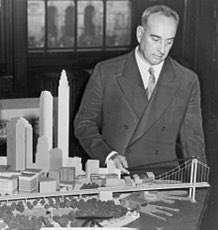
Robert Moses at one point held 12 titles simultaneously (including New York City Parks Commissioner and Chairman of the Long Island State Park Commission),[4] but was never elected to any public office (he ran only once, for governor of New York as a Republican in 1934 and
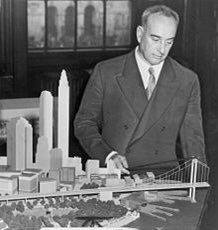
lost to Herbert H. Lehman in a landslide). Nevertheless, he created and led numerous public authorities that gave him autonomy from the general public and elected officials. Through these authorities, he controlled millions of dollars in income from his projects, such as tolls,
and he could issue bonds to borrow vast sums for new ventures with little or no input from legislative bodies. This removed him from the power of the purse as it normally functioned in the United States, and from the process of public comment on major public works. As a result
of Moses' work, New York has the United States' greatest proportion of public benefit corporations, which are the prime mode of infrastructure building and maintenance in New York and account for most of the state's debt.

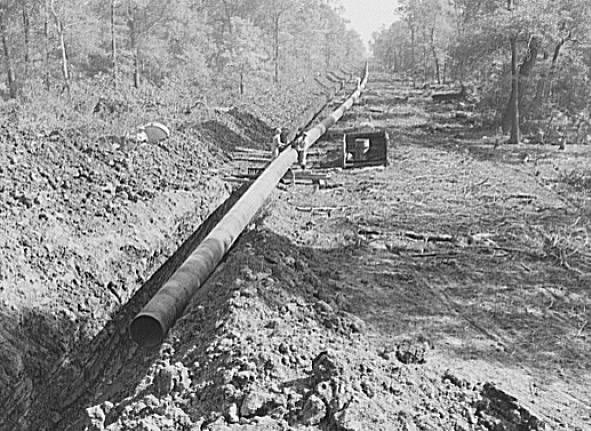
The Big Inch and Little Big Inch, collectively known as the Inch pipelines, are petroleum pipelines extending from Texas to New Jersey, built between 1942 and 1944 as emergency war measures in the U.S. Before World War II, petroleum products were transported from the oil fields
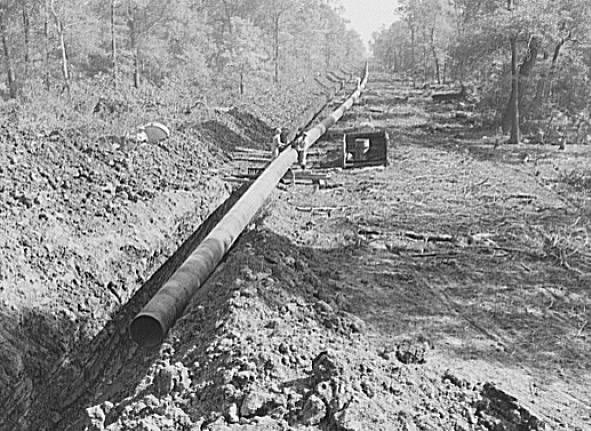
of Texas to the north-eastern states by sea by oil tankers. The pipelines were government financed and owned, but were built and operated by the War Emergency Pipelines company, a non-profit corporation backed by a consortium of the largest American oil companies. It was the l
ongest, biggest and heaviest project of its type then undertaken; the Big and Little Big Inch pipelines were 1,254 and 1,475 miles (2,018 and 2,374 kilometres) long respectively, with 35 pumping stations along their routes. The project required 16,000 people and 725,000 short
tons (658,000 t) of materials. It was praised as an example of private-public sector cooperation and featured extensively in US government propaganda.
After the end of the war there were extended arguments over how the pipelines should be used. In 1947, the Texas East
After the end of the war there were extended arguments over how the pipelines should be used. In 1947, the Texas East
Transmission Corporation purchased the pipelines for $143,127,000, the largest post-war disposal of war-surplus property. The corporation converted them to transport natural gas, transforming the energy market in the north-east. The Little Big Inch was returned to carry oil in
1957. The pipelines are owned by Spectra Energy Partners and Enterprise Products and remain in use.
On January 30, 2017, a road crew punctured the Seaway S-1 crude oil pipeline in Texas, which is jointly joined by Enterprise Products Partners and the Canadian Enbridge Inc.
On January 30, 2017, a road crew punctured the Seaway S-1 crude oil pipeline in Texas, which is jointly joined by Enterprise Products Partners and the Canadian Enbridge Inc.
through the joint venture Seaway Crude Pipeline Company.
Enterprise Products Partners L.P. (NYSE: EPD) is an American midstream natural gas and crude oil pipeline company with headquarters in Houston, Texas.[1] It acquired GulfTerra in September 2004. The company ranked
Enterprise Products Partners L.P. (NYSE: EPD) is an American midstream natural gas and crude oil pipeline company with headquarters in Houston, Texas.[1] It acquired GulfTerra in September 2004. The company ranked
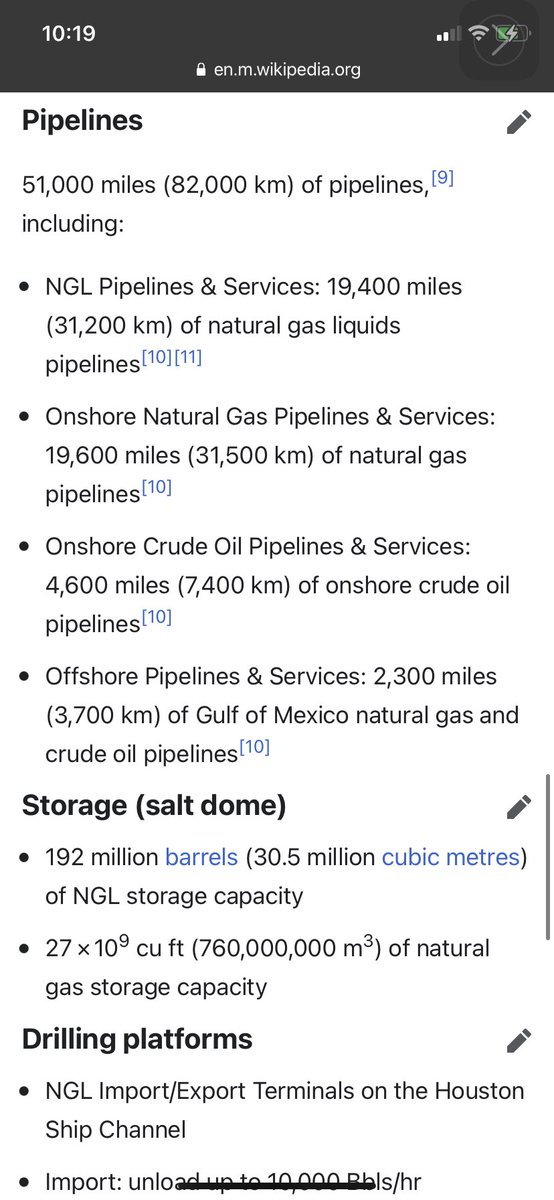
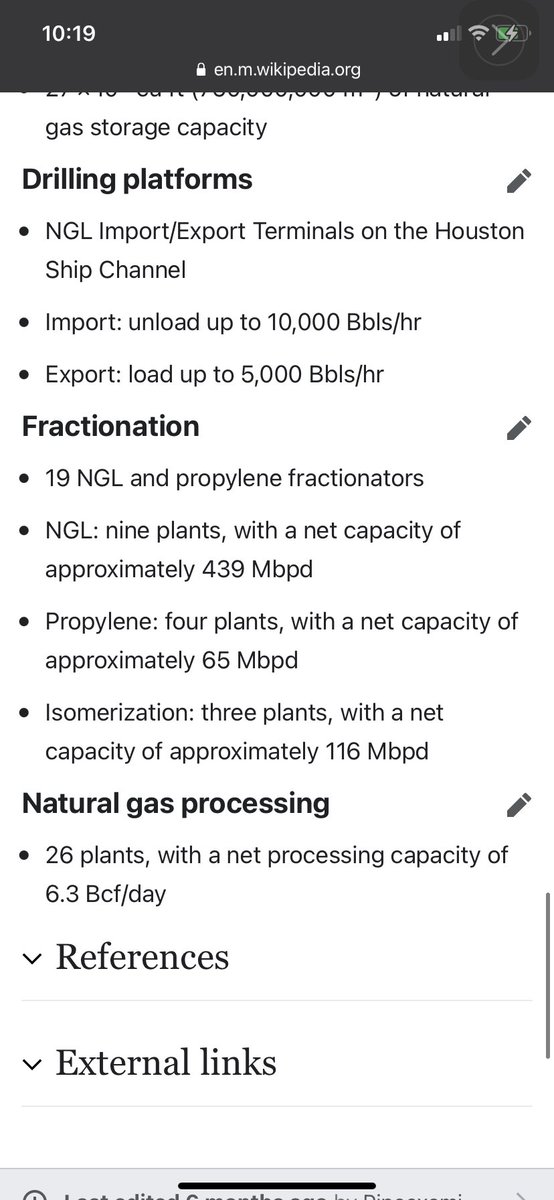
No. 105 in the 2018 Fortune 500 list of the largest United States corporations by total revenue.[2] Dan Duncan (1933–2010) was the majority owner.

It is one of the largest pipeline systems in the United States. It is owned by Enbridge. Its FERC code is 17.[1]
This pipeline was built as Big Inch by War Emergency Pipelines (WEP), a consortium of Standard Oil Company of New Jersey, Texas Pipe Line Company, Cities Service,
This pipeline was built as Big Inch by War Emergency Pipelines (WEP), a consortium of Standard Oil Company of New Jersey, Texas Pipe Line Company, Cities Service,
Socony-Vacuum Oil, Gulf Oil, Consolidated Oil, Shell Oil, Atlantic Refining, Tidewater Associated Oil, Sun Oil and Pan American Petroleum and Transport Company.
• • •
Missing some Tweet in this thread? You can try to
force a refresh