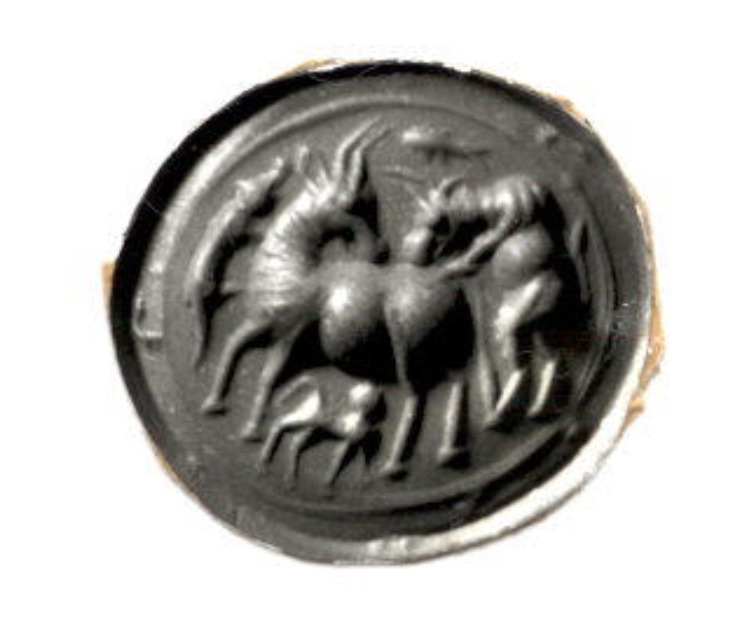
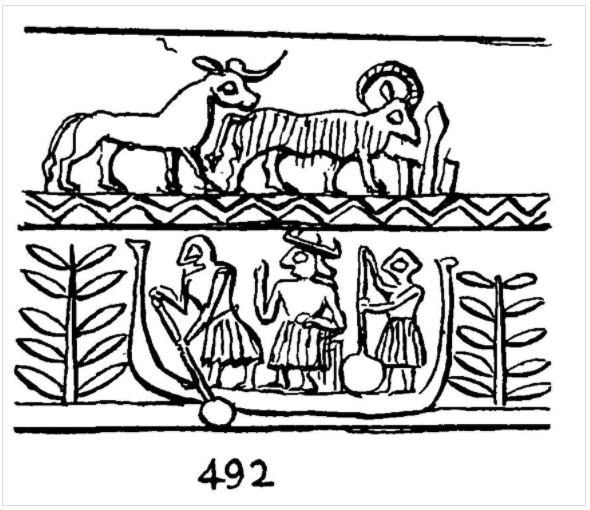
Thread: Recently I wrote and article about this Early Sumerian "Enki in the boat" seal in which I tried to explain the meaning of the scene depicted on it through animal calendar markers.
oldeuropeanculture.blogspot.com/2021/06/rain-a…
Since then I found more evidence that support my explanation...
oldeuropeanculture.blogspot.com/2021/06/rain-a…
Since then I found more evidence that support my explanation...
The other day I came across an article entitled "Problems of the abzu" (jstor.org/stable/43582808). And in it, I found this passage: "One of the titles of Enki was Dara-abzu"...
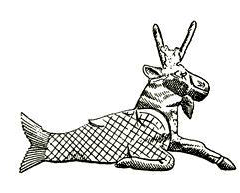
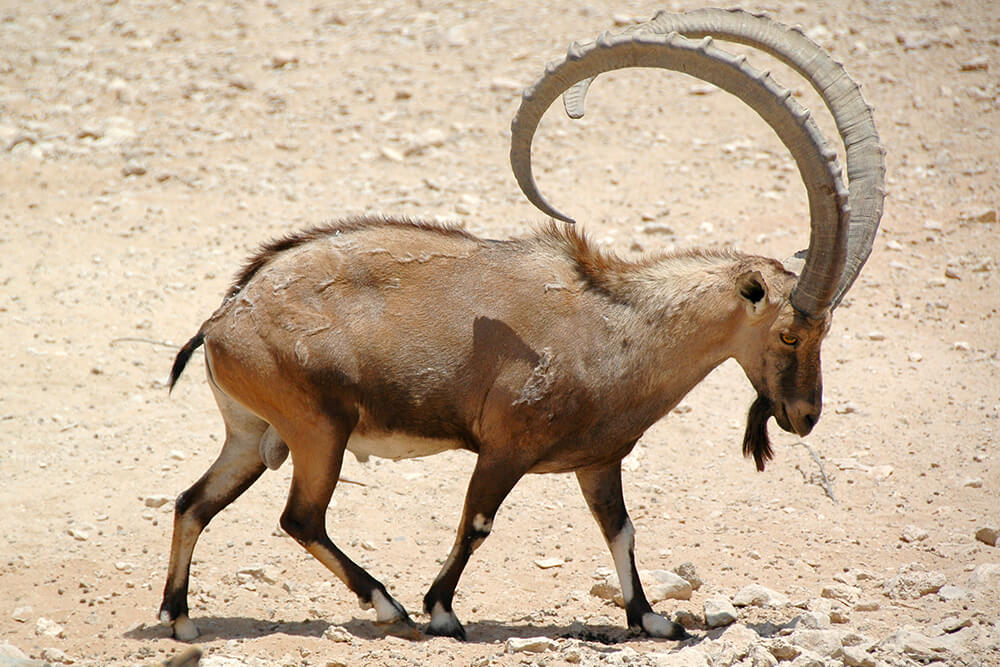
This is very interesting, cause in the Sumerian lexicon (sumerian.org/sumerian.pdf) we find that the word "duraþ, dàra, dàr" means "Mountain goat buck; Ibex"...This guy...

So why was Enki called Ibex of Abzu? Well what is Abzu? The common explanation is that it is "the underground sea of fresh water, the aquifer, which was given a religious fertilising quality in Sumerian and Akkadian mythology"...
I have already challenged this explanation in this thread about the relationship between Utu, the sun god, and Enki, the god of fresh water...
https://twitter.com/serbiaireland/status/1421563540683563011
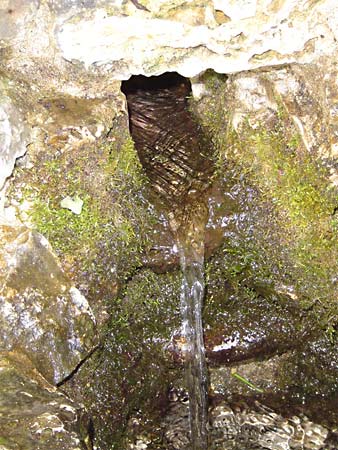
Abzu, is the source of the fresh water that flows down Tigris and Euphrates, and the fresh water that fills the wells of Mesopotamia, but is not an underground sea of fresh water...
I mean Ibex goat of the underground sea of fresh water makes no sense...Which is why it is in the article entitled
"Problems of the abzu" 🙂
"Problems of the abzu" 🙂
Hydrological report from Mesopotamia: "Tigris and Euphrates have two flood periods: an irregular, rain-fed rise of minor proportions lasting from November to the end of March (this is basically a slight increase in water levels) and the main snowmelt flood of April and May"...
These are the water flow charts for Tigris (L) and Euphrates (R)
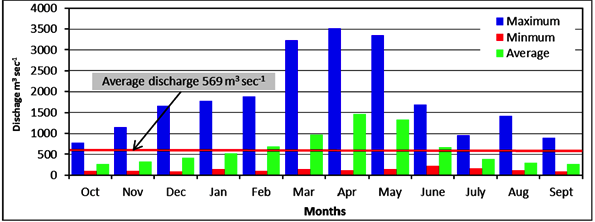
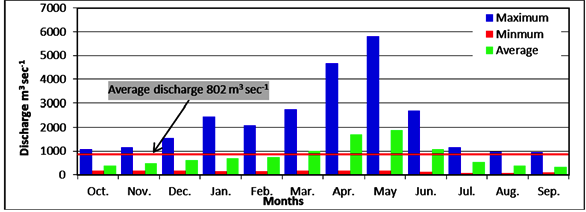
In several of my threads I talked about the fact that the annual flood is mostly result of the snowmelt in the mountain(s), highland(s) north and north-east of Sumer, the source of Tigris and Euphrates (and their tributaries), Anatolian highlands and Zagros Mountains...
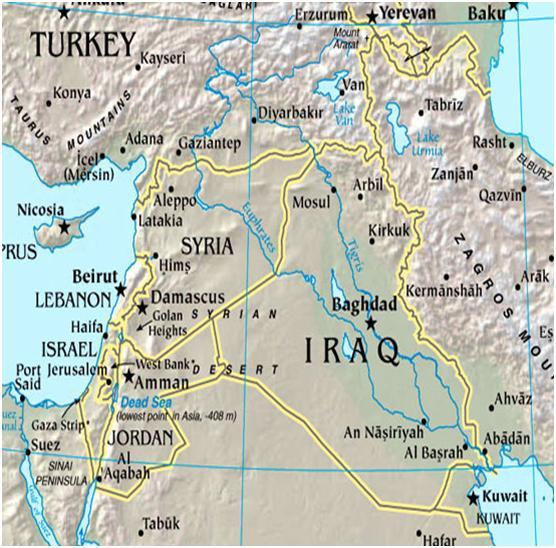
So in this post I proposed that Abzu, the source of fresh water, the source of Tigris and Euphrates, are these mountains, and more precisely, the snow that falls during the winter on these mountains and which melts during the spring and summer...
oldeuropeanculture.blogspot.com/2021/05/shamas…
oldeuropeanculture.blogspot.com/2021/05/shamas…
Which is why in the "Debate between Winter and Summer" (etcsl.orinst.ox.ac.uk/section5/tr533…) we read: "By hand Winter guided the spring floods...down from the edge of the hills. He set his foot upon the Tigris and Euphrates like a big bull and released them into the fields"...
As I was writing that, I could hear pretty much every Sumerologist screaming: Abzu means "the underground waters of the Aquifer"!!!
I think that this commonly accepted meaning of the term Abzu is actually a result of a mistranslation...
I think that this commonly accepted meaning of the term Abzu is actually a result of a mistranslation...
And not understanding the river system in Mesopotamia...
We have Sumerian ab=water and zu=knowledge, deep, far...Abzu can then mean both deep water and far away water...
We have Sumerian ab=water and zu=knowledge, deep, far...Abzu can then mean both deep water and far away water...
Considering that the source of Tigris and Euphrates is far away from Mesopotamia, in the Anatolian highlands and Zagros Mountains, the proper translation of the term Abzu is far away water...
I mean this is actually spelled for us in the Early Dynastic Za-me hymns where we read:
"Abzu, place that is a big mountain, princely crown of the heaven and earth. To the lord Nudimmud (Enki), (give) praise!" researchgate.net/publication/28…
"Abzu, place that is a big mountain, princely crown of the heaven and earth. To the lord Nudimmud (Enki), (give) praise!" researchgate.net/publication/28…
Here is Enki (god of fresh water), sitting in Abzu (on top of the mountain), while young Utu (spring sun) is climbing the mountain to release him...
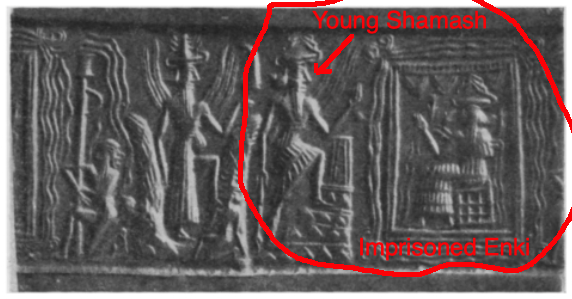
The epic "Enki and the world order" (etcsl.orinst.ox.ac.uk/section1/tr113…) tells us that Enki is the king of the Abzu...Babylonian epic Enûma Elish (en.wikipedia.org/wiki/En%C5%ABm…) tells us that Enki lives in Abzu.
Enûma Elish tells us that in the beginning, before anything else was created, Abzu (the source of fresh water, the Father) and Tiamat (salt water ocean, the Mother) were there mixing their waters.
It is from their intercourse that the younger gods were created...The younger gods then got so noisy and annoying, and pissed Tiamat off so much, and she complained to Abzu so much, that Abzu decided to destroy them...
But, Enki put Abzu to sleep, and then murdered him. Enki then set up his home "in the depths of the Abzu", and took on all of the functions of the Abzu. We could say that Enki became Abzu...Or that Enki is just Anthropomorphised Abzu...I will talk about this more soon...
Anyway, Enki became the god of fresh, fertile water. Actually, fresh water was seen as Enki's semen, as it is the fresh water that makes land fertile...
In "Enki and the world order" (etcsl.orinst.ox.ac.uk/section1/tr113…), Enki stands at the empty riverbeds and fills them with his semen (fresh water)...
While he was filling the rivers with fresh water, Enki was "full of lust like a rampant bull"...Just like winter in the "Debate between Winter and Summer"...
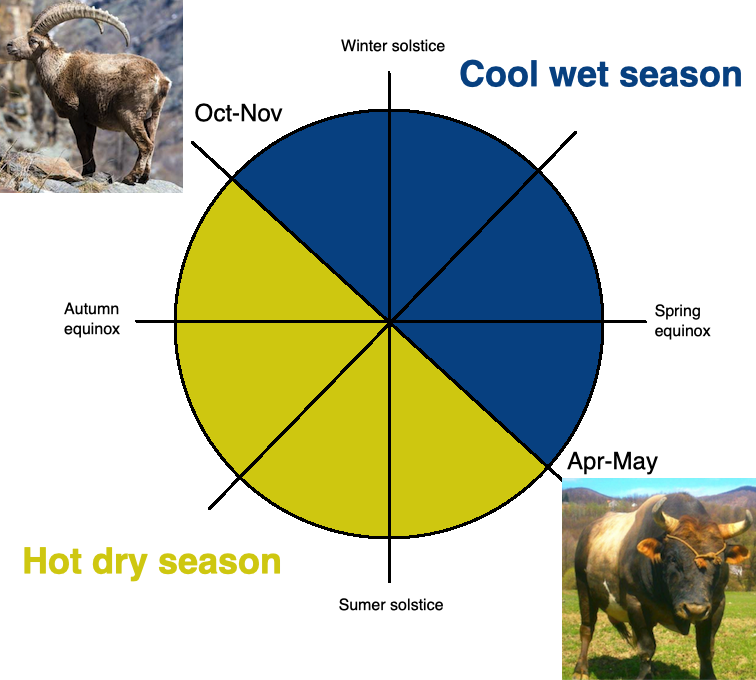
Why are both Winter and Enki compared to bulls at the moment when they "fill the rivers"? Cause the annual flood of Tigris and Euphrates reaches its peak in Apr/May, which is when the Eurasian wild cattle start calving...
I talked about this in so many of my threads and articles. Like this one
https://twitter.com/serbiaireland/status/1420858588625571843
This is the reason why in a royal hymn dedicated to Enki from the times of Šulgi we read: "Great lord...Enki...Important one of the great gods, Nudimmud, great bull of the Abzu".
But why is Enki called the Ibex of Abzu? Because the first rains arrive to Mesopotamia when Ibex mountain goats start to mate, Oct/Nov...
This is such an important event in these arid lands that Ibex was basically deified:
This is such an important event in these arid lands that Ibex was basically deified:
https://twitter.com/serbiaireland/status/1397280984224129034
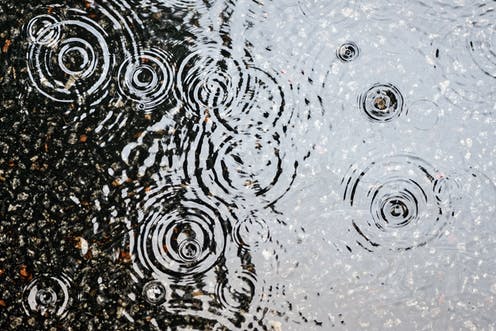
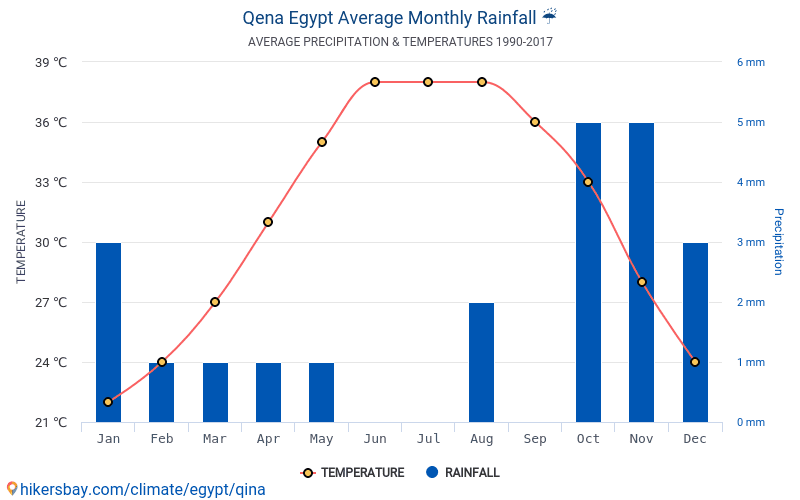
The beginning of the Ibex mating season signals the beginning of the cool, wet season, Winter. And it is the rain and snow which fall during Winter (Nov-May) that are the source of all the fresh water that flows down Tigris and Euphrates...And of Enki's flood...
Sooo...Enki, who is the source of water that flows down Tigris and Euphrates, lives in (or is) Abzu, which is the source of water that flows down Tigris and Euphrates...
The true source of water that flows down Tigris and Euphrates are of course the mountains from which these rivers and their tributaries emerge...Mountains which are the home to Mountain Goat. Ibex...
Ibex, the Goat of Rain (and Snow) that fall down during winter...Rain and snow, which are the source of water that flows down Tigris and Euphrates. "Dara-abzu", Mountain goat of Abzu...Enki...
See, all this makes a lot of sense...Not so much if we are looking for Abzu underground...
PS: I ended the article about the Enki in the boat seal with this: the Rain (and snow) which fall between Oct/Nov (when Ibex mate) and Apr/May (when Aurochs calve) are the source of the flowing water in Tigris and Euphrates (zigzag line) and Enki's flood (boat)...
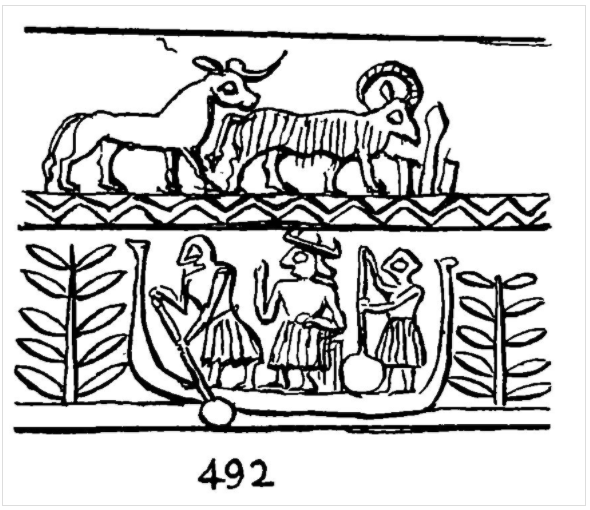
In this thread I explained why Enki's boat is the symbol of the flood...
https://twitter.com/serbiaireland/status/1399800653376110595
Interestingly, in the article "Problems of the abzu", we find that "Dara-abzu" was also the name of Enki's processional boat, which "possibly even had a goat head at prow"...
As I explained, Enki's boat is symbol for the flood...Flood which starts with the Goat of Abzu and Peaks with the Bull of Abzu...
The Goat of Abzu leading The Bull of Abzu...Just like on the above Enki in the boat seal...
The Goat of Abzu leading The Bull of Abzu...Just like on the above Enki in the boat seal...
So that's it...What you think?
• • •
Missing some Tweet in this thread? You can try to
force a refresh