Learn about modern speech recognition and the Graph Transformer Networks with @awnihannun!

In this lecture, Awni covers the connectionist temporal classification (CTC) loss, beam search decoding, weighted finite-state automata and transducers, and GTNs!
Image
«Graph Transformer Networks are deep learning architectures whose states are not tensors but graphs.
You can back-propagate gradients through modules whose inputs and outputs are weighted graphs.
GTNs are very convenient for end-to-end training of speech recognition and NLP sys.» Image
«They can be seen as a differentiable form of WFST (weighted finite-state transducers) widely used in speech recognition.

Awni is the lead author of libgtn, a GTN library for PyTorch.»
«GTNs are:
- Not connected with graph NN.
- Not connected with transformer architectures.
- Predates both of those by over 20 years.
- Connected with conditional random fields (think of GTNs as a kind of deep CRF), and predate those by 4 years.»
«GTNs are described in the second half of this paper:
Y. LeCun, L. Bottou, Y. Bengio and P. Haffner: Gradient-Based Learning Applied to Document Recognition, Proceedings of the IEEE, 86(11):2278-2324, November 1998.
yann.lecun.com/exdb/publis/pd…»
You can read an accessible blog post by clicking on the link below.
ai.facebook.com/blog/a-new-ope…
Full detailed paper available below.
arxiv.org/abs/2010.01003
And you can read the entire source code at the following @github repo.
github.com/facebookresear…

• • •

Missing some Tweet in this thread? You can try to force a refresh

 

Keep Current with Alfredo Canziani

Alfredo Canziani Profile picture

Stay in touch and get notified when new unrolls are available from this author!

Read all threads

This Thread may be Removed Anytime!

PDF

Twitter may remove this content at anytime! Save it as PDF for later use!

Try unrolling a thread yourself!

how to unroll video
  1. Follow @ThreadReaderApp to mention us!

  2. From a Twitter thread mention us with a keyword "unroll"
@threadreaderapp unroll

Practice here first or read more on our help page!

More from @alfcnz

28 Jun
Learn all about self-supervised learning for vision with @imisra_!

In this lecture, Ishan covers pretext invariant rep learning (PIRL), swapping assign. of views (SwAV), audiovisual discrimination (AVID + CMA), and Barlow Twins redundancy reduction.
Image
Here you can find the @MLStreetTalk's interview, where these topics are discussed in a conversational format.
Here, instead, you can read an accessible blog post about these topics, authored by @imisra_ and @ylecun.
Read 8 tweets
19 May
The fifth episode (of five) of the energy 🔋 saga is out! 🤩

In this last episode of the energy saga we code up an AE, DAE, and VAE in @PyTorch. Then, we learn about GAN, where a cost net C is trained contrastively with samples generated by another net.
A GAN is simply a contrastive technique where a cost net C is trained to assign low energy to samples y (blue, cold 🥶, low energy) from the data set and high energy to contrastive samples ŷ (red, hot 🥵, where the “hat” points upward indicating high energy).
y comes from the data set Y.
ŷ is produced by the generating network G, which maps a random vector to the input space ŷ = G(z).
To train G we simply minimise C(G(z)).

And that's it.
No fooling around with discriminators. 🥸
It's *simply* contrastive energy learning. 😇
Read 5 tweets
11 May
The fourth episode (of five) of the energy 🔋 saga is out! 🤩

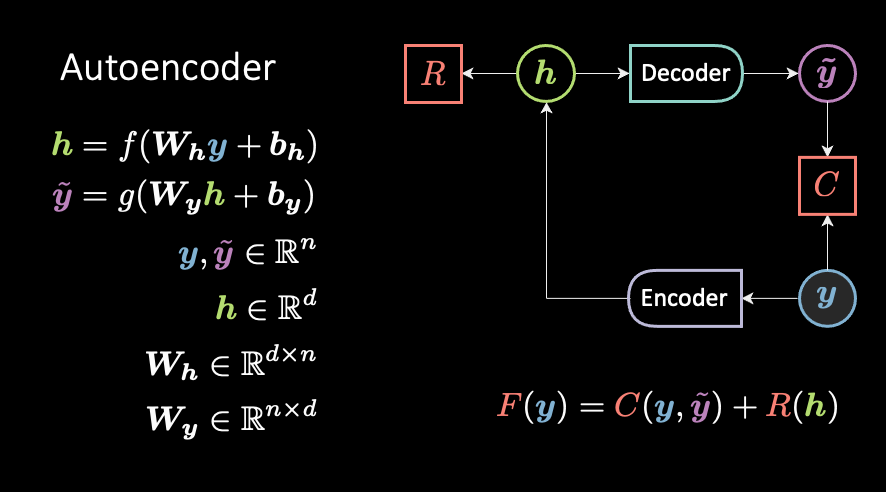
From LV EBM to target prop(agation) to vanilla autoencoder, and then denoising, contractive, and variational autoencoders. Finally, we learn about the VAE's bubble-of-bubbles interpretation.
Edit: updating a thumbnail and adding one more.

In this episode I *really* changed the content wrt last year. Being exposed to EBMs for several semesters now made me realise how all these architectures (and more to come) are connected to each other.
In the companion lecture (which will soon come online), @ylecun goes over a more powerful interpretation of VAE, which I still struggle to understand. As you can imagine, another tweak to my deck will occur when I'll actually get it. (Yeah, I'm slow, yet persistent.)
Read 5 tweets
8 Apr
— Context —

Speaking about the transformer architecture, one may incorrectly talk about an encoder-decoder architecture. But this is *clearly* not the case.
The transformer architecture is an example of encoder-predictor-decoder architecture, or a conditional language-model.
The classical definition of an encoder-decoder architecture is the autoencoder (AE). The (blue / cold / low-energy) target y is auto-encoded. (The AE slides are coming out later today.)
Now, the main difference between an AE and a language-model (LM) is that the input is delayed by one unit. This means that a predictor is necessary to estimate the hidden representation of a *future* symbol.
It's similar to a denoising AE, where there is a temporal corruption.
Read 7 tweets
23 Nov 20
#AcademicChatter

Coming from engineering, I'm a former @MATLAB user, moved to @TorchML and @LuaLang, then to @PyTorch and @ThePSF @RealPython, and now I'm exploring @WolframResearch @stephen_wolfram.
For learning, one would prefer knowledge packed frameworks and documentation.
In that regard, @MATLAB and @WolframResearch are ridiculously compelling. The user manuals are just amazing, with everything organised and available at your disposal. Moreover, the language syntax is logical, much closer to math, and aligned to your mental flow.
In Mathematica I can write y = 2x (implicit multiplication), x = 6, and y will be now equal 12. y is a variable.
Or I can create a function of x with y[x_] := 2x (notice that x_ means I don't evaluate y right now). Later, I can execute y[x] and get 12, as above.
Read 7 tweets

Did Thread Reader help you today?

Support us! We are indie developers!


This site is made by just two indie developers on a laptop doing marketing, support and development! Read more about the story.

Become a Premium Member ($3/month or $30/year) and get exclusive features!

Become Premium

Too expensive? Make a small donation by buying us coffee ($5) or help with server cost ($10)

Donate via Paypal Become our Patreon

Thank you for your support!

Follow Us on Twitter!

:(