Folks, I urge a little caution with the Florida #Covid19 numbers showing on the CDC right now. FL reports its Sat+Sun+Mon numbers on Mondays, which the CDC *usually* updates on Tuesday for the 3-day span (and divides the total by 3).
Please read this brief thread...
For whatever reason (maybe an earlier report time?), it appears that the CDC used FL's 3-day total of 56,633, which they would normally report as 18,878/day for the 3-day span. The CDC hasn't updated FL's #'s on Monday for a while. Here's how the days usually end up:
So, reporting/backdating just Sat/Sun is nonstandard hasn't been done lately. Usually there are just 0-0 as placeholders until the CDC updates the case numbers on Tuesday for all three previous days.
Someone has DM'd me and told me that his friend at the FDOH said that the 56,633 was the full 3-day number. I haven't verified that, but it makes sense based on the way FL CDC numbers have updated every week for a long time now (with a single Monday dump updated on Tuesday).
In fact, I seem to even remember a Twitter brawl over this very subject last Monday between gubernatorial backers on both sides--at how weekend data was being buried or delayed by Florida pols because it didn't come out on the CDC until Tuesday.
So, while I'm certain of nothing yet, the above makes the most sense at this point given all the data I have.
Since this is FL, I know a data issue (if it is) won't stop the conspiracy theories tomorrow when the numbers are updated. But maybe try not to fan them?
By this tweet, I meant: "used FL's 3-day total and divided it by two days instead."
So, instead of 28,316 & 28,317 for Sat/Sun, we're likely to see that change tomorrow to 18,878-18,878-18,877 (or thereabouts) for Sat-Sun-Mon.
We now enter the week that most of us on the chart below put down as the US #Covid19 peak. The average had us peaking by 8/12 (23 days). The mode/median was by 8/10 (3 weeks). So how are we doing?
Well, 8/4 has come and gone, and US reported cases per the CDC have decidedly not peaked. But was 8/4 close? Are we close now? I think so, but that depends on two factors: (1) test levels, and (2) reporting lags. If we tested/reported like the UK, we may already be post-peak.
I wanted to take a look at the trend in hospitalization census in states that are now predominantly #DeltaVariant according to the graphic below (including FL & IL, which are close). I'll do some comparisons to Alpha back in April as well.
🧵Thread🧵
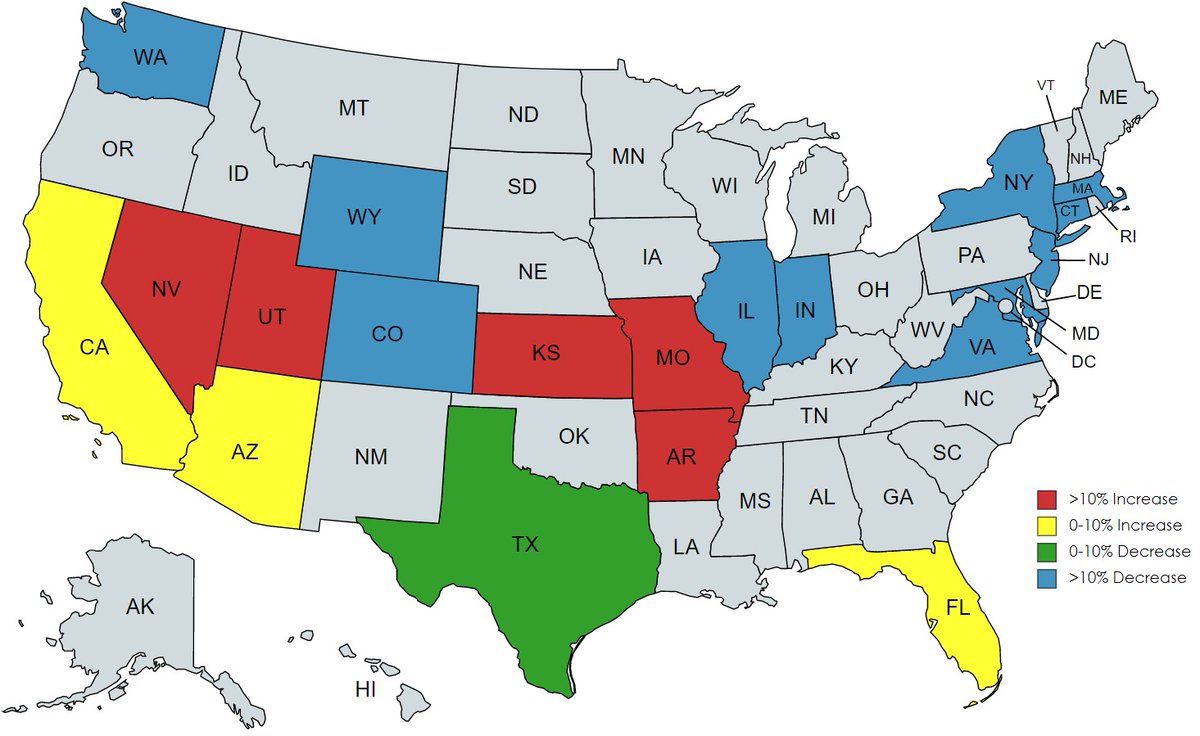
First, here is a map of the 2-week change in 7-day-average hospitalization census for each of the states above (according to state dashboards as of yesterday's data, compared to the average on Friday 2 weeks prior):
At a glance, low vax states tend to be doing the worst, which makes intuitive sense (though we're discounting prior infection by looking only at vax status, of course). But there are outliers. For example, why should IN be on a better trajectory than CA?
(Data retrieved directly from state dashboards. Not every state updates its numbers daily.)
SUN BELT
(AL, AR, AZ, CA, GA, LA, MS, NM, NV, SC, TN, TX)
Today’s Sun Belt raw reported metrics:
- Tests: 202,436 (-19,171)
- Cases: 6,956 (+1,917)
- Deaths: 141 (-32)
- Hospitalized: 5,934 (-49)
- ICU: 1,303 (-29)
(Tests/Cases/Deaths: +/- = chg from raw count same day last week)
(Hosp/ICU: +/- = chg from yesterday’s census)
Last Sun Belt-only update this week. Tomorrow we’ll have the US numbers and standard regions. Hospitalizations and ICUs down from yesterday, and deaths down from last week. Cases are up, though CA is still reporting backlogged cases this entire week (& is ~40% of the increase).
First, we're not "2 weeks past the Memorial holiday weekend data issues." Memorial Day deflates reported cases & deaths for *days after* Memorial Day. The Tuesday is extremely deflated, and usually it takes days to return to normal pipeline reporting. This time was no different.
Also, what do you think happens to the 7-day average when metrics are deflated into the middle or late portion of the holiday week? It captures that deflation and carries it further, of course. So the 7-day average is artificially low typically through the *following* ~Wed.
Got a bit curious about the US v. UK as it relates to the #DeltaVariant. Some good news on that front for the US: at least in the early stages, the US rate of increase is nowhere near the UK.
🧵thread🧵
First: I used covariants.org/per-country, which shows percentage of sequenced variants based on 2-week blocks. One potential point of confusion to note when you use the site: the dates along the x-axis indicate the *start* of the 2-week period.
Here are the percentages of sequences that made up the #DeltaVariant in the UK (by 2-week period):